Type 3 is a genuine turning point on the Norwood scale. Where Type 1 and Type 2 are mostly about telling normal hairline maturation apart from the earliest hints of loss, Type 3 is where that ambiguity mostly disappears. The recession is deep enough, and defined enough, that it’s rarely mistaken for a mature hairline anymore. It’s also the first stage where hair transplant surgery becomes a genuinely sensible option for a meaningful number of patients, rather than something to hold off on.

What Is Norwood Type 3 Hair Loss?
Type 3 is a genuine turning point on the Norwood scale. Where Type 1 and Type 2 are mostly about telling normal hairline maturation apart from the earliest hints of loss, Type 3 is where that ambiguity mostly disappears. The recession is deep enough, and defined enough, that it's rarely mistaken for a mature hairline anymore. It's also the first stage where hair transplant surgery becomes a genuinely sensible option for a meaningful number of patients, rather than something to hold off on.What Is Norwood Type 3 Hair Loss?Type 3 describes a clearly defined recession at both temples, deep enough to form a pronounced M or V shape rather than the soft, subtle version seen at Type 2. The centre of the frontal hairline typically sits lower than the corners, which makes the M shape more visually obvious, and density immediately behind the hairline is often noticeably reduced compared to earlier stages.There are two recognised variants worth knowing at this stage, since they call for different attention. Type 3A describes a pattern where the entire frontal hairline has moved back more or less uniformly, without the sharp M shape, more of an even overall retreat across the forehead. Type 3 Vertex (3V) is the other direction: the classic temple M-shape stays, but early thinning also appears at the crown, meaning two separate areas are losing density at the same time rather than just one. Distinguishing 3 from 3A from 3V matters because it changes what a treatment plan actually needs to address.How Norwood Type 3 Differs From a Mature HairlineBy this stage, the distinction is usually much clearer than it was at Type 2, but it's still worth stating plainly. A mature hairline settles once, typically by around a centimetre, stays symmetrical, and stops moving entirely. Type 3 recession goes considerably further than that, often continues to progress rather than plateauing, and comes with visible thinning in the hairs immediately behind the receded corners, a sign of the follicle miniaturisation that a simple mature hairline never shows. If there's any real doubt at this stage, comparing photos taken a year or more apart is usually enough to settle it.What Causes Norwood Type 3 to Develop?The underlying driver is the same one behind every stage of androgenetic alopecia: dihydrotestosterone, or DHT, acting on genetically susceptible follicles at the temples and, in the 3V variant, the crown as well. Over successive growth cycles, affected follicles produce progressively finer and shorter hairs before some stop producing a visible strand at all. Genetics from either side of the family determine which follicles are vulnerable, and while the process can become noticeable as early as someone's twenties, age on its own isn't the cause, it's simply when genetically primed follicles tend to start responding to hormonal exposure.It's worth knowing that not everything that looks like Type 3 recession is androgenetic alopecia. Sudden or patchy hair loss, scalp pain, inflammation, scaling, or pustules point toward a different condition entirely, things like alopecia areata, fungal scalp infection, or a scarring form of hair loss, and none of these respond to the treatments discussed below. A proper evaluation is what separates a confident Type 3 diagnosis from a guess.How Predictable Is Progression at Type 3?Less predictable than most people expect. Hair loss tends to move in cycles rather than a straight line, so someone might notice a fast-feeling change over one year and then apparent stability for the next two. Some men stay at Type 3 for years, particularly when the recession is confined mostly to the temples; others progress toward further frontal thinning or, in the 3V pattern, more pronounced crown involvement. Lighting, hairstyle, and hair length all affect how severe the recession looks day to day, which is exactly why standardised photos, same lighting, same angle, taken every few months, give a far more honest read on progression than checking the mirror.Treatment Options at Norwood Type 3This is the first Norwood stage where medical therapy and surgery genuinely sit side by side as reasonable options, rather than surgery being premature. Oral finasteride and topical minoxidil remain the strongest evidence-based starting point, particularly for anyone whose pattern is still actively progressing, since slowing or stabilising the loss protects both native hair and any future transplant plan. PRP therapy is sometimes added alongside medication to support follicle health during this stage, though it works best as a complement to, not a replacement for, finasteride or minoxidil where those are appropriate.For patients whose recession is stable, or who understand and accept the trade-offs of operating on a still-progressing pattern, FUE or DHI can rebuild the frontal hairline with genuinely strong results at this stage. Donor supply is typically still excellent, and the gap between the current hairline and a natural target hairline is modest enough that graft counts usually fall somewhere between 1,500 and 2,500, depending on how far the recession has progressed and whether the 3V variant's crown thinning also needs addressing. For 3V specifically, treatment planning has to account for both zones rather than the frontal hairline alone, which can shift the graft plan and priorities meaningfully compared to a straightforward temple-only Type 3.Age remains a genuine factor in this decision even at Type 3. A man in his early twenties whose recession has only recently become obvious is a different case from a man in his mid-thirties whose pattern has been stable at this stage for years. The first case calls for more caution, continued medical therapy, and closer monitoring before committing donor hair to a plan; the second is often a strong, low-risk candidate for surgery precisely because the pattern has already shown where it stabilises."Type 3 is genuinely the stage where I feel most confident recommending surgery, when the situation calls for it," says Dr. Gökay Bilgin. "The donor area is strong, the recipient zone is well defined, and for a patient whose pattern has settled, the results tend to be excellent. What I'm more careful about is a very young patient who's only just noticed the change. In that case I'd rather start medication, watch it for a year, and make the surgical decision once we actually know what we're dealing with."When to See a SpecialistA consultation makes sense as soon as temple recession becomes clearly noticeable, especially if it's accompanied by any thinning at the crown, since that points toward the 3V pattern and changes the conversation considerably. It's worth seeking care sooner rather than later if the hair loss came on suddenly, appears patchy rather than symmetrical, or comes with scalp pain, scaling, or redness, since those features suggest something other than ordinary androgenetic alopecia. A proper evaluation, including a close look at donor density and the true extent of miniaturisation, is what turns a Type 3 self-diagnosis into an actual treatment plan. If you're weighing whether surgery makes sense now versus later, it also helps to understand how the later Norwood stages progress and what they mean for long-term donor planning.Frequently Asked QuestionsIs Norwood Type 3 considered bald? No. Most people at Type 3 still have substantial hair coverage overall; the change is concentrated at the temples, and in the 3V variant, the crown as well. It's a clearly established stage of androgenetic alopecia rather than significant baldness.What's the difference between Type 3, 3A, and 3V? Type 3 involves a defined M-shaped temple recession. Type 3A describes a more uniform, even retreat of the whole frontal hairline without a sharp M shape. Type 3 Vertex (3V) keeps the temple M-shape but adds early crown thinning, meaning two areas need attention rather than one.Is a hair transplant a good option at Type 3? Often, yes, this is typically the first stage where surgery is a genuinely strong option for suitable candidates. The right choice still depends on age, how stable the pattern is, and whether the 3V variant's crown involvement needs to be planned for alongside the hairline.Can Type 3 hair loss stabilise without treatment? It can, progression varies significantly between individuals and isn't guaranteed to continue at any particular pace. That said, medical therapy started early gives the best chance of slowing further loss regardless of how quickly the pattern might otherwise progress.SourcesNorwood OT. Male pattern baldness: classification and incidence. Southern Medical Journal. 1975;68(11):1359-1365. PubMed
Wirya CT, Wu W, Wu K. Classification of Male-pattern Hair Loss. International Journal of Trichology. 2017;9(3):95-100. PMC5596658This guide was prepared and reviewed by Dr. Gökay Bilgin, M.D., hair transplant surgeon at Smile Hair Clinic, Istanbul.

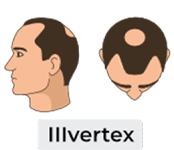
Norwood Type 3 Vertex

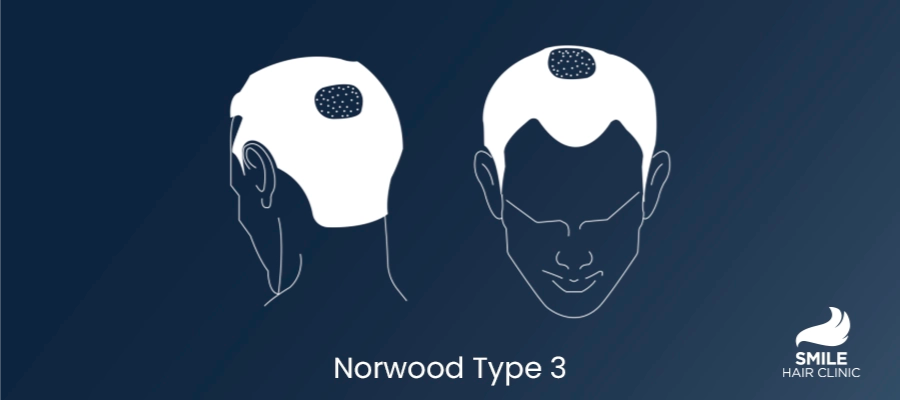
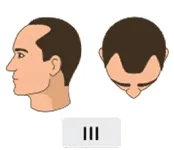
Type 3 describes a clearly defined recession at both temples, deep enough to form a pronounced M or V shape rather than the soft, subtle version seen at Type 2. The centre of the frontal hairline typically sits lower than the corners, which makes the M shape more visually obvious, and density immediately behind the hairline is often noticeably reduced compared to earlier stages.

There are two recognised variants worth knowing at this stage, since they call for different attention. Type 3A describes a pattern where the entire frontal hairline has moved back more or less uniformly, without the sharp M shape, more of an even overall retreat across the forehead. Type 3 Vertex (3V) is the other direction: the classic temple M-shape stays, but early thinning also appears at the crown, meaning two separate areas are losing density at the same time rather than just one. Distinguishing 3 from 3A from 3V matters because it changes what a treatment plan actually needs to address.

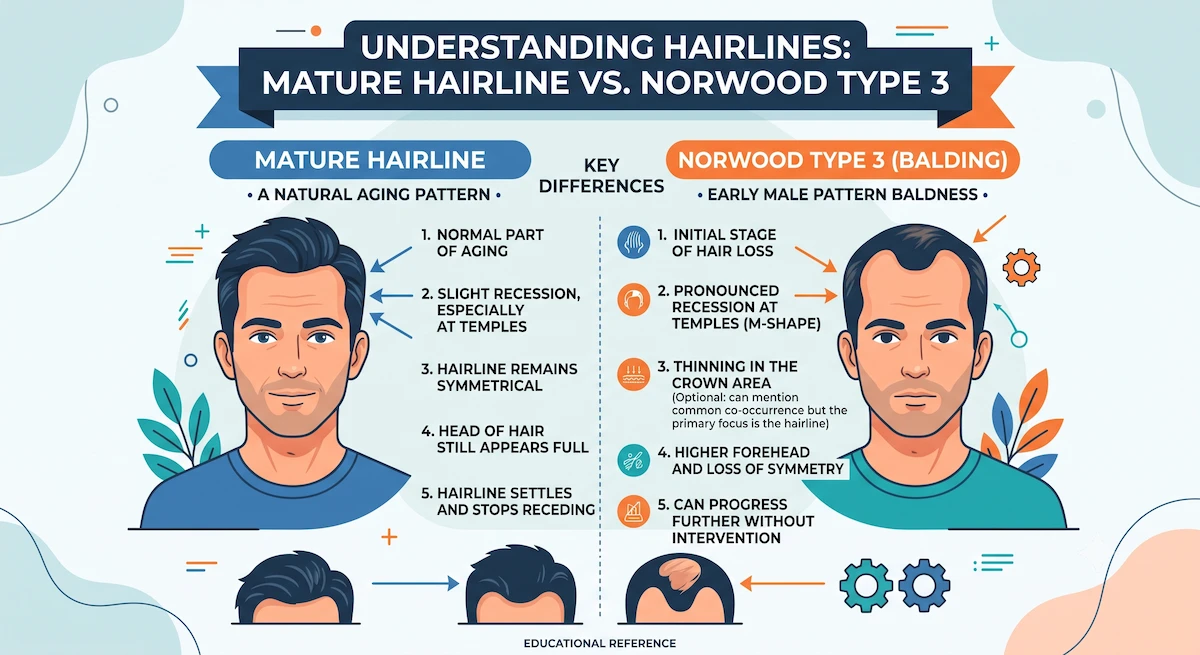
How Norwood Type 3 Differs From a Mature Hairline?
How Norwood Type 3 Differs From a Mature Hairline

By this stage, the distinction is usually much clearer than it was at Type 2, but it’s still worth stating plainly. A mature hairline settles once, typically by around a centimetre, stays symmetrical, and stops moving entirely. Type 3 recession goes considerably further than that, often continues to progress rather than plateauing, and comes with visible thinning in the hairs immediately behind the receded corners, a sign of the follicle miniaturisation that a simple mature hairline never shows. If there’s any real doubt at this stage, comparing photos taken a year or more apart is usually enough to settle it.

What Causes Norwood Type 3 to Develop?

The underlying driver is the same one behind every stage of androgenetic alopecia: dihydrotestosterone, or DHT, acting on genetically susceptible follicles at the temples and, in the 3V variant, the crown as well. Over successive growth cycles, affected follicles produce progressively finer and shorter hairs before some stop producing a visible strand at all. Genetics from either side of the family determine which follicles are vulnerable, and while the process can become noticeable as early as someone’s twenties, age on its own isn’t the cause, it’s simply when genetically primed follicles tend to start responding to hormonal exposure.

It’s worth knowing that not everything that looks like Type 3 recession is androgenetic alopecia. Sudden or patchy hair loss, scalp pain, inflammation, scaling, or pustules point toward a different condition entirely, things like alopecia areata, fungal scalp infection, or a scarring form of hair loss, and none of these respond to the treatments discussed below. A proper evaluation is what separates a confident Type 3 diagnosis from a guess.

How Predictable Is Progression at Norwood Type 3?
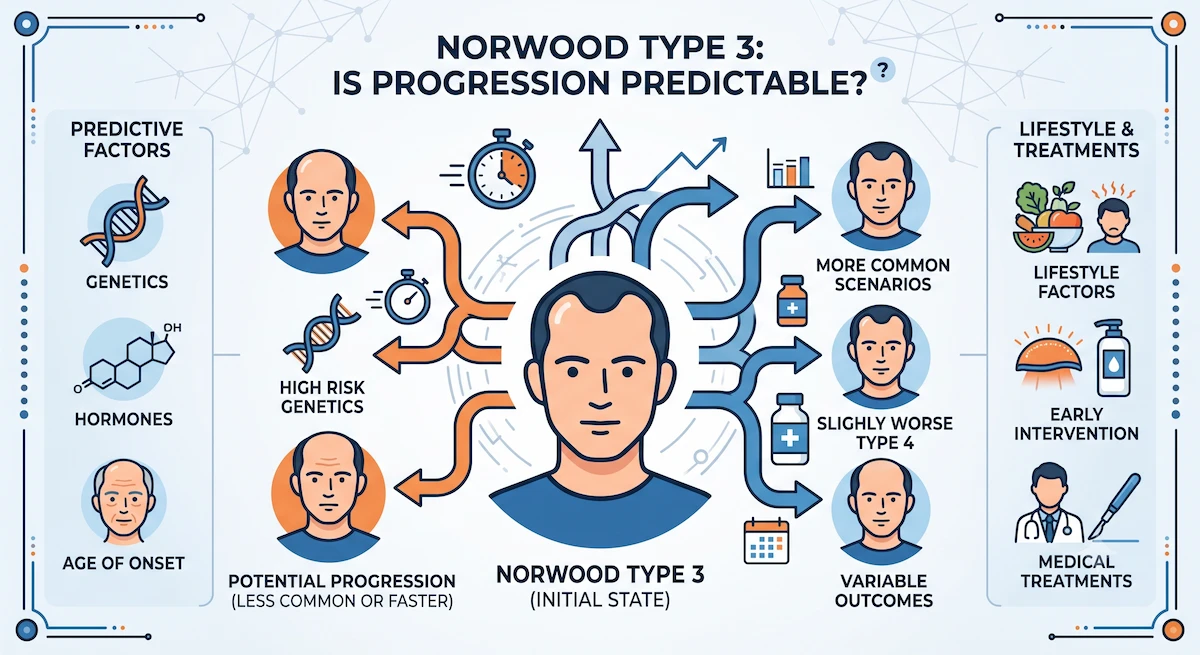
How Predictable Is Progression at Norwood Type 3

Less predictable than most people expect. Hair loss tends to move in cycles rather than a straight line, so someone might notice a fast-feeling change over one year and then apparent stability for the next two. Some men stay at Type 3 for years, particularly when the recession is confined mostly to the temples; others progress toward further frontal thinning or, in the 3V pattern, more pronounced crown involvement. Lighting, hairstyle, and hair length all affect how severe the recession looks day to day, which is exactly why standardised photos, same lighting, same angle, taken every few months, give a far more honest read on progression than checking the mirror.

Treatment Options at Norwood Type 3

This is the first Norwood stage where medical therapy and surgery genuinely sit side by side as reasonable options, rather than surgery being premature. Oral finasteride and topical minoxidil remain the strongest evidence-based starting point, particularly for anyone whose pattern is still actively progressing, since slowing or stabilising the loss protects both native hair and any future transplant plan. PRP therapy is sometimes added alongside medication to support follicle health during this stage, though it works best as a complement to, not a replacement for, finasteride or minoxidil where those are appropriate.

For patients whose recession is stable, or who understand and accept the trade-offs of operating on a still-progressing pattern, FUE or DHI can rebuild the frontal hairline with genuinely strong results at this stage. Donor supply is typically still excellent, and the gap between the current hairline and a natural target hairline is modest enough that graft counts usually fall somewhere between 1,500 and 2,500, depending on how far the recession has progressed and whether the 3V variant’s crown thinning also needs addressing. For 3V specifically, treatment planning has to account for both zones rather than the frontal hairline alone, which can shift the graft plan and priorities meaningfully compared to a straightforward temple-only Type 3.

Age remains a genuine factor in this decision even at Type 3. A man in his early twenties whose recession has only recently become obvious is a different case from a man in his mid-thirties whose pattern has been stable at this stage for years. The first case calls for more caution, continued medical therapy, and closer monitoring before committing donor hair to a plan; the second is often a strong, low-risk candidate for surgery precisely because the pattern has already shown where it stabilises.

“Type 3 is genuinely the stage where I feel most confident recommending surgery, when the situation calls for it, the donor area is strong, the recipient zone is well defined, and for a patient whose pattern has settled, the results tend to be excellent. What I’m more careful about is a very young patient who’s only just noticed the change. In that case I’d rather start medication, watch it for a year, and make the surgical decision once we actually know what we’re dealing with.”

When to See a Specialist?

A consultation makes sense as soon as temple recession becomes clearly noticeable, especially if it’s accompanied by any thinning at the crown, since that points toward the 3V pattern and changes the conversation considerably. It’s worth seeking care sooner rather than later if the hair loss came on suddenly, appears patchy rather than symmetrical, or comes with scalp pain, scaling, or redness, since those features suggest something other than ordinary androgenetic alopecia. A proper evaluation, including a close look at donor density and the true extent of miniaturisation, is what turns a Type 3 self-diagnosis into an actual treatment plan. If you’re weighing whether surgery makes sense now versus later, it also helps to understand how the later Norwood stages progress and what they mean for long-term donor planning.

Frequently Asked Questions

Is Norwood Type 3 considered bald?

No. Most people at Type 3 still have substantial hair coverage overall; the change is concentrated at the temples, and in the 3V variant, the crown as well. It’s a clearly established stage of androgenetic alopecia rather than significant baldness.

What’s the difference between Type 3, 3A, and 3V?

Type 3 involves a defined M-shaped temple recession. Type 3A describes a more uniform, even retreat of the whole frontal hairline without a sharp M shape. Type 3 Vertex (3V) keeps the temple M-shape but adds early crown thinning, meaning two areas need attention rather than one.

Is a hair transplant a good option at Type 3?

Often, yes, this is typically the first stage where surgery is a genuinely strong option for suitable candidates. The right choice still depends on age, how stable the pattern is, and whether the 3V variant’s crown involvement needs to be planned for alongside the hairline.

Can Type 3 hair loss stabilise without treatment?

It can, progression varies significantly between individuals and isn’t guaranteed to continue at any particular pace. That said, medical therapy started early gives the best chance of slowing further loss regardless of how quickly the pattern might otherwise progress.


Sources

  1. Norwood OT. Male pattern baldness: classification and incidence. Southern Medical Journal. 1975;68(11):1359-1365. PubMed
  2. Wirya CT, Wu W, Wu K. Classification of Male-pattern Hair Loss. International Journal of Trichology. 2017;9(3):95-100. PMC5596658

This guide was prepared and reviewed by Dr. Gökay Bilgin, M.D., hair transplant surgeon at Smile Hair Clinic, Istanbul.