


Table of Contents
Seeing more hair than usual in the shower, on a pillow, or in a hairbrush can be unsettling. Hair shedding is part of the normal growth cycle, but a noticeable increase can also signal stress, hormonal changes, nutritional problems, scalp disease, or medication effects.
The pattern, timing, scalp condition, recent health changes, and whether the hair is growing back all matter. Some causes are temporary and improve once the trigger settles. Others, such as androgenetic alopecia, tend to progress unless they are treated.
One reason hair fall can be confusing is that several conditions may occur together. A person can have genetic pattern thinning and then develop a temporary episode of telogen effluvium after illness or rapid weight loss. That can make the change look sudden even though the underlying thinning was gradual. Looking at the full history helps separate a temporary increase in shedding from a condition that may continue to progress.
Hair fall vs. hair loss, what’s the difference?
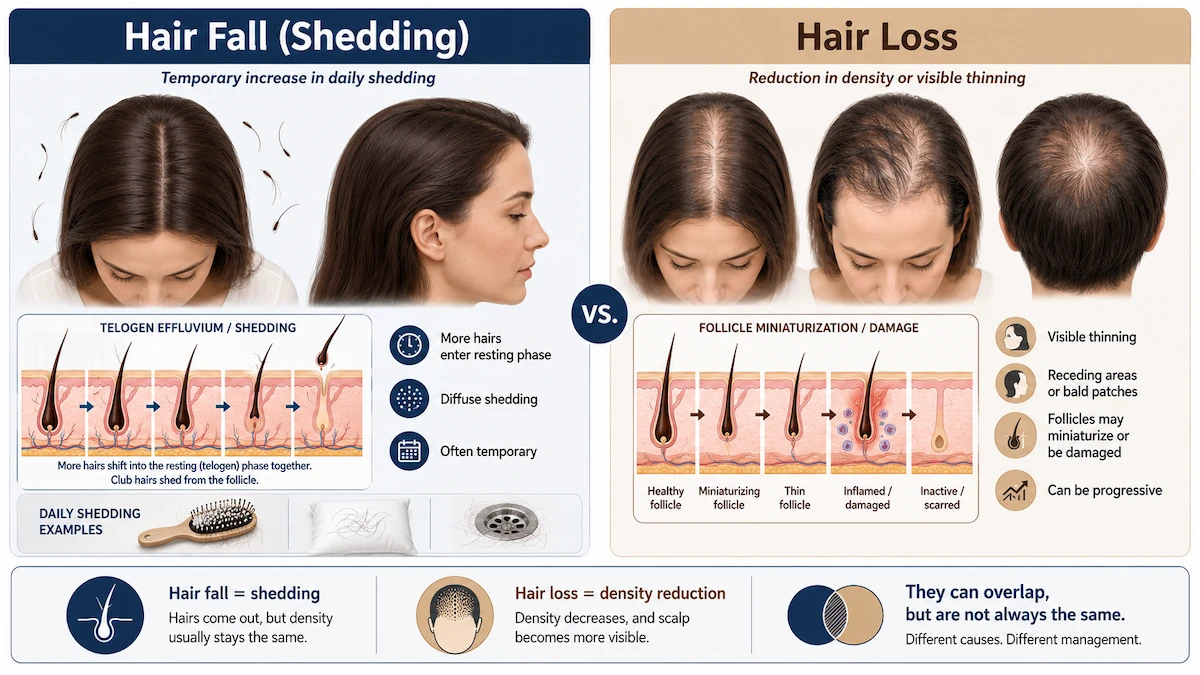
“Hair fall” is often used to describe shedding, while “hair loss” usually refers to a reduction in hair density, a receding hairline, bald patches, or progressive thinning. The two can overlap, but they are not always the same problem.
Excessive shedding, often called telogen effluvium, occurs when more follicles than usual move into the resting phase and shed around the same time. True hair loss can also happen when follicles become smaller, inflamed, scarred, or affected by an autoimmune process. The American Academy of Dermatology distinguishes everyday shedding from visible thinning, bald spots, and receding areas that suggest hair loss.
How much hair fall is normal?
Losing around 50 to 100 scalp hairs a day is generally considered normal. This number is only a guide, because the amount noticed can depend on hair length, washing frequency, brushing habits, curl pattern, and how often loose hairs are removed.
A sudden change from the usual pattern is often more useful than counting every strand. If a ponytail feels smaller, the part looks wider, the temples are receding, or the scalp is becoming easier to see, the issue may be more than normal shedding.
The most common causes of hair fall
Hair fall has many possible causes. Some affect the growth cycle, while others damage the follicle or hair shaft.
Genetics (androgenetic alopecia)
Androgenetic alopecia is one of the most common forms of hair loss. It develops through a combination of genetic susceptibility and androgen-related effects on hair follicles. Over time, affected follicles produce hairs that become shorter and finer, a process known as miniaturization.
In men, thinning often begins at the temples or crown. In women, the central part may gradually widen and overall density on the top of the scalp may decrease. The pattern and speed of progression can vary considerably between individuals.
Telogen effluvium (stress-related shedding)
Telogen effluvium causes diffuse shedding rather than one isolated bald patch. It can follow major physical or emotional stress, illness, surgery, childbirth, rapid weight loss, or other changes that disturb the normal hair cycle. Shedding often becomes noticeable weeks or months after the original trigger, which is why the connection may not immediately be obvious.
Acute telogen effluvium is often temporary. Once the trigger resolves, follicles can return to their normal cycle. Hair density may still take time to recover because newly growing hairs need several months to become visible.
Hormonal changes
Hormones have a strong influence on the hair cycle. Postpartum changes are a classic example. Falling estrogen levels after childbirth can lead to a period of increased shedding several months later.
Thyroid disorders, menopause, and conditions associated with androgen changes can also affect hair density. Hormonal hair loss should not be diagnosed from appearance alone because several forms of diffuse thinning can look similar.
Nutritional deficiencies
Hair follicles are metabolically active and depend on adequate protein, energy, vitamins, and minerals. Iron deficiency is one of the nutritional issues often considered when investigating diffuse shedding. Vitamin D, zinc, and some B vitamins have also been studied in relation to different forms of hair loss.
High-dose supplements are not a universal solution. Testing and correcting a confirmed deficiency is more sensible than guessing. Excess intake of certain nutrients may even contribute to hair problems rather than solving them.
Scalp infections
Inflammation or infection on the scalp can interfere with healthy hair growth. Fungal infections, follicle problems, and severe inflammatory scalp conditions may cause shedding, broken hairs, tenderness, scale, or patchy loss.
Hair loss accompanied by redness, crusting, pus, pain, or thick scale deserves medical assessment. Scarring disorders are particularly important to identify early because permanent follicle damage can occur if inflammation continues.
Hairstyles and hair care habits
Tight braids, ponytails, extensions, and hairstyles that repeatedly pull on the same areas can lead to traction alopecia. Continued tension can eventually damage follicles and, in advanced cases, cause permanent hair loss.
Bleaching, chemical straightening, frequent high heat, aggressive brushing, and rough handling can weaken the hair shaft. When strands keep snapping near the ends, the hair may appear thinner or seem as though it is no longer growing even when follicle growth continues.
Medications and medical treatments
Some medications can trigger increased shedding by altering the hair cycle. Cancer treatments are well known for causing hair loss, but a range of other prescription medicines may also contribute depending on the medication and individual response.
Hair fall that begins after starting or changing a medicine should be discussed with the prescribing clinician. Medication should not be stopped abruptly because of shedding. Any change should be made with medical guidance.
Autoimmune conditions
Alopecia areata is an autoimmune form of nonscarring hair loss in which the immune system targets hair follicles. It commonly causes round or oval patches, although more widespread or diffuse forms can also occur.
Patchy scalp loss, eyebrow or eyelash loss, or suddenly appearing smooth bald areas should be evaluated rather than treated as simple stress-related shedding. Alopecia areata varies significantly in severity and course.
Signs your hair fall might be a medical issue
Some changes make medical evaluation more important:
- Hair is coming out in noticeably larger amounts for several weeks or months.
- The central part is widening or the hairline is gradually receding.
- Smooth round or irregular bald patches have appeared.
- The scalp is painful, burning, very itchy, crusted, or heavily inflamed.
- Hair loss is accompanied by fatigue, weight changes, menstrual changes, or other new symptoms.
- Eyebrows, eyelashes, beard hair, or body hair are also being lost.
- There is visible scarring or unusually smooth skin where hair has disappeared.
- Hair density continues to decrease despite gentle hair care and adequate nutrition.
These signs do not identify one diagnosis, but persistent or progressive changes deserve examination because several hair disorders can have similar early appearances.
How is the cause of hair fall diagnosed?
Diagnosis usually starts with medical history. A dermatologist may ask when the shedding began, whether it was sudden or gradual, which areas are affected, what medications are being taken, whether there was recent illness or major stress, and whether hair loss runs in the family. Diet, menstrual history, pregnancy, weight changes, and hair-care practices may also provide useful clues.
The scalp is then examined for changes in density, miniaturized hairs, broken shafts, redness, scale, scarring, and the shape of the thinning pattern. Dermoscopy or trichoscopy can magnify the scalp and help distinguish androgenetic alopecia, telogen effluvium, alopecia areata, and other conditions. Hair-pull testing may also be useful in selected cases.
Blood tests are not required for every person with hair loss, but they may be considered when the history suggests iron deficiency, thyroid disease, nutritional problems, or another medical cause. A scalp biopsy is sometimes used when the diagnosis remains unclear or a scarring form of alopecia is suspected.
Photographs taken under similar lighting can also be useful during follow-up because daily shedding is difficult to judge from memory alone. Comparing the hairline, crown, and part over several months may show whether density is stable, improving, or continuing to decline.
Treatment options based on the cause
Treatment works best when it targets the reason for the hair fall rather than the symptom alone.
- Androgenetic alopecia may be treated with evidence-based options such as topical minoxidil and, for appropriate male patients, prescription finasteride. Other options may be considered after medical assessment.
- Telogen effluvium is usually managed by identifying and correcting the trigger, such as severe stress, illness, rapid weight loss, or a confirmed nutritional problem. Hair density often improves gradually as the normal cycle returns.
- Nutritional hair loss requires correction of the actual deficiency rather than routine use of high-dose supplements.
- Traction-related hair loss requires reducing tension on the follicles. Early changes may recover, while long-standing scarring can become permanent.
- Scalp infections and inflammatory conditions require treatment directed at the underlying organism or disease.
- Alopecia areata has several medical treatment options, selected according to age, severity, and the amount of hair loss.
- Medication-related shedding should be reviewed with the prescribing clinician so the risks, benefits, and possible alternatives can be considered safely.
When to see a doctor about hair fall?
Medical assessment becomes more important when shedding lasts for months, density is clearly decreasing, or thinning continues to progress. Early evaluation can help distinguish a temporary shedding episode from a condition that may require ongoing treatment.
An earlier appointment is sensible for sudden bald patches, scalp pain, burning, severe itching, infection, visible scarring, eyebrow or eyelash loss, or hair loss accompanied by other physical symptoms. Disorders that permanently damage follicles need timely diagnosis, while many nonscarring causes have a better chance of recovery when the underlying problem is identified early.
Hair fall is therefore best viewed as a symptom rather than a diagnosis. Genetics, stress, hormones, nutrition, scalp disease, medications, autoimmune conditions, and everyday hair practices can all play a role. Finding the cause first makes it much easier to choose a treatment with a realistic chance of improving shedding and protecting long-term hair density.
Sources
- Hughes, E. C., Syed, H. A., Saleh, D. (2024). Telogen Effluvium. StatPearls, NCBI Bookshelf, National Library of Medicine.
- DermNet NZ. Telogen effluvium (hair shedding).
- American Academy of Dermatology Association. Hair loss, Who gets and causes.
- American Academy of Dermatology Association. Hair loss, Diagnosis and treatment.
- Nasimi, M. et al. Deciphering the Complex Immunopathogenesis of Alopecia Areata. PMC.
- Pathophysiological mechanisms of hair follicle regeneration and potential therapeutic strategies. PMC.
