


Table of Contents
MSM has become a common ingredient in hair supplements, often appearing alongside biotin, collagen, zinc, and other nutrients marketed for stronger or faster-growing hair. Short for methylsulfonylmethane, MSM is a sulfur-containing compound that has been studied more widely for joint health, inflammation, and oxidative stress than for hair loss.
The idea behind MSM for hair growth sounds reasonable. Hair is made largely from keratin, and sulfur-containing amino acids help give keratin its strength. MSM also has antioxidant and anti-inflammatory properties that could theoretically support the environment around a hair follicle. The problem is that these possible mechanisms are often presented as proof that MSM regrows hair.
Human evidence remains limited. Small studies have reported improvements in hair appearance, shine, and volume, but there is not yet strong evidence showing that MSM can reverse androgenetic alopecia or reliably increase clinically meaningful hair density.
What is MSM (methylsulfonylmethane) ?
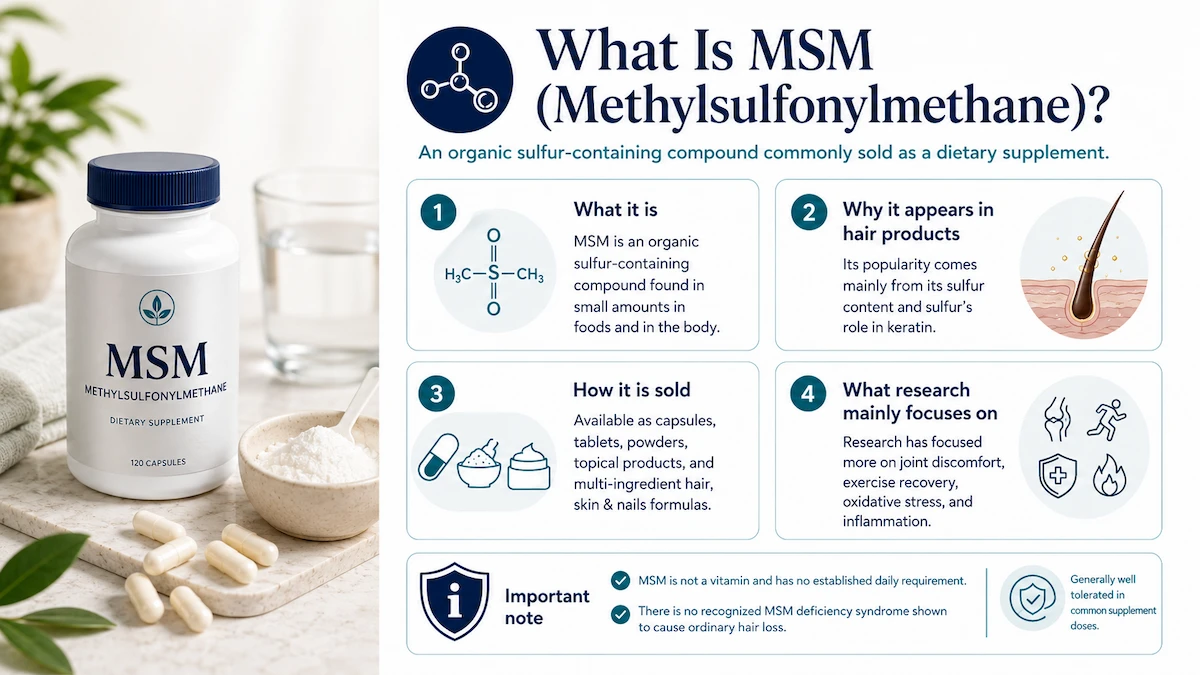
Methylsulfonylmethane, commonly called MSM, is an organic sulfur-containing compound. Small amounts occur naturally in certain foods and within the body, while concentrated MSM is widely sold as a dietary supplement.
Most research on MSM has focused on areas such as joint discomfort, exercise recovery, oxidative stress, and inflammation, and MSM is recognized as a Generally Recognized As Safe food ingredient that is generally well tolerated at doses up to about four grams daily (Butawan et al., Nutrients, 2017). Its popularity in hair products comes largely from its sulfur content and the importance of sulfur-containing amino acids in keratin.
MSM is available as capsules, tablets, powders, and topical products. It is also included in multi-ingredient formulas marketed for hair, skin, and nails.
That does not make MSM a vitamin or an essential nutrient with an established daily requirement. There is no recognized MSM deficiency syndrome that has been shown to cause ordinary hair loss.
How MSM is thought to support hair growth
Several explanations have been proposed for why MSM might benefit hair. Some are biologically plausible, but most have not yet been confirmed in strong human hair-loss trials.
Sulfur and keratin production
Hair shafts are made mainly from keratin, a structural protein rich in the sulfur-containing amino acid cysteine, and disulfide bonds formed between these sulfur-containing residues are a major source of the hair shaft’s strength and shape (Hoover et al., StatPearls, NCBI Bookshelf).
Because MSM contains sulfur, manufacturers often claim that supplementation gives the body additional building material for keratin. This explanation is possible in theory but is much simpler than actual hair biology.
The body does not directly turn dietary MSM into new hair simply because keratin contains sulfur. Hair growth also depends on adequate protein, energy, hormones, micronutrients, genetics, follicle health, and normal cycling.
MSM may influence hair quality or appearance, but evidence that extra sulfur directly speeds follicle growth in people who already have adequate nutrition is limited.
Anti-inflammatory and antioxidant effects
MSM has been studied for anti-inflammatory and antioxidant activity. Oxidative stress and inflammation are involved in many biological processes and may contribute to certain scalp and hair disorders.
Reducing excessive oxidative stress could theoretically create a more favorable environment for follicles. However, showing antioxidant activity does not automatically prove that a compound treats hair loss.
Androgenetic alopecia, alopecia areata, telogen effluvium, and scarring alopecia have very different causes. MSM has not been established as a targeted treatment for these conditions simply because it may affect inflammatory pathways.
Extending the anagen (growth) phase
Some hair supplements claim that MSM keeps follicles in anagen, the active growth phase, for longer. A longer anagen period could theoretically allow hairs to grow for more time before entering rest and shedding.
At present, this claim is not supported by strong human evidence. There is no well-established clinical trial showing that oral MSM reliably extends the anagen phase in people with common forms of hair loss.
Animal findings and laboratory theories may help researchers develop new hypotheses, but they should not be treated as proof that the same effect occurs in human scalp follicles.
What does the research actually show?
The research on MSM and hair is much smaller than the marketing surrounding it. There are some interesting findings, but they need to be interpreted carefully.
Human studies
One small double-blind study involving 63 women compared daily doses of 1 gram and 3 grams of MSM over four months. Researchers reported improvements in measures such as hair shine, volume, and overall appearance, with some effects appearing sooner in the higher-dose group.
The major limitation is what the study actually measured. Improvement in shine or perceived volume does not necessarily mean that new follicles grew or that a medical hair-loss condition improved.
The study also did not establish MSM as a treatment for male pattern baldness, female pattern hair loss, alopecia areata, or telogen effluvium.
Human trials directly measuring standardized hair counts, follicle miniaturization, hair diameter, and long-term regrowth with MSM alone remain limited. The existing evidence is therefore more supportive of possible improvements in hair quality than proven treatment of hair loss.
Animal studies
Animal research has produced more dramatic results, but it cannot be applied directly to people.
One mouse study examined MSM in combination with magnesium ascorbyl phosphate. Hair growth improved as the concentration of MSM in the combination increased. However, researchers concluded that MSM appeared mainly to enhance the retention and delivery of the other active ingredient rather than acting as a proven independent hair-growth treatment.
Another study in male mice reported reduced hair loss and improved growth after topical MSM, including when it was evaluated with minoxidil.
These results are useful for generating research questions, but mouse skin, hair cycles, dosing, and follicle biology differ from those of humans. Controlled human trials are needed before similar claims can be made clinically.
MSM vs. other hair growth ingredients
Minoxidil has far more human evidence and is an established treatment for certain forms of pattern hair loss. MSM does not currently have comparable clinical support. Finasteride targets DHT and is an established prescription treatment for male pattern hair loss. MSM has not been shown to block the same pathway reliably. Biotin can support hair when a genuine deficiency exists, but routine high-dose biotin is not a proven treatment for people with normal levels. Rosemary oil has limited but direct human research in androgenetic alopecia. MSM research has focused more on hair appearance and experimental models. Iron and zinc should be corrected when a confirmed deficiency is contributing to shedding. MSM cannot replace treatment of a nutritional deficiency. Collagen supplements are also marketed for hair, but evidence for meaningful regrowth remains limited. Like MSM, they should not be confused with established hair-loss medication.
How to use MSM for hair?
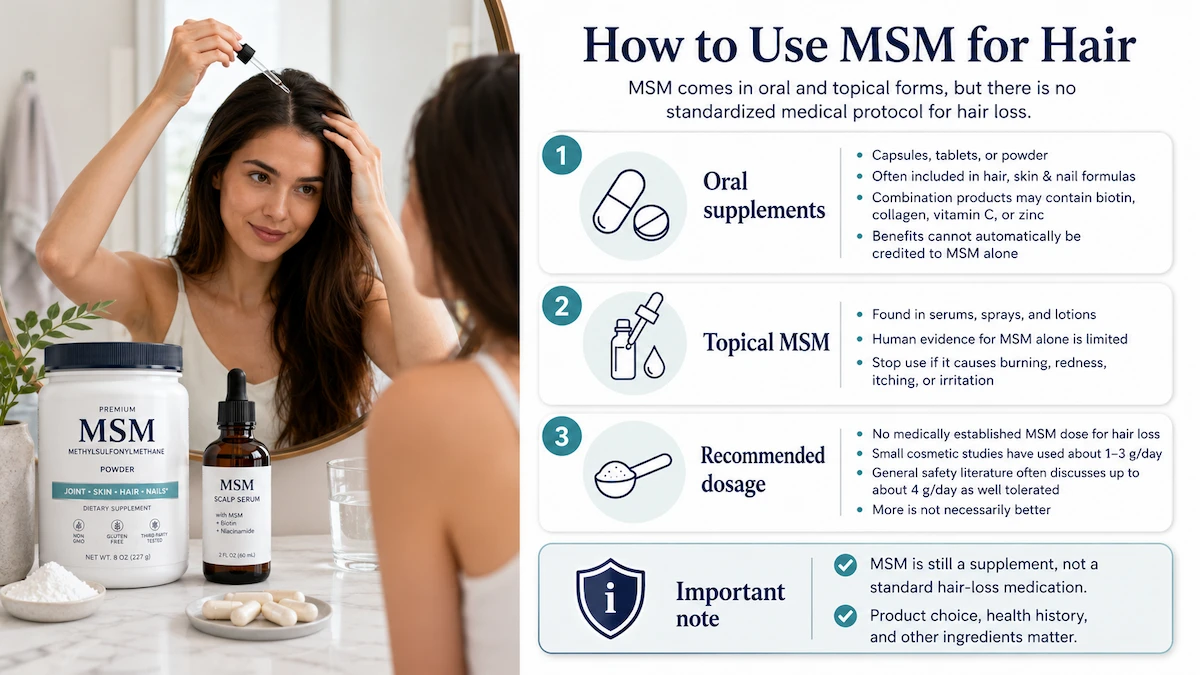
MSM is sold in both oral and topical forms. There is no standardized medical protocol for using it to treat hair loss.
Oral supplements
Oral MSM is usually available as capsules, tablets, or powder. Hair, skin, and nail supplements may contain MSM alone or combine it with ingredients such as biotin, collagen, vitamin C, zinc, or other nutrients.
Because combination products contain several active ingredients, any improvement cannot automatically be attributed to MSM.
Supplements also do not need to demonstrate that they regrow hair before being sold in the same way that a new hair-loss drug would need to demonstrate safety and effectiveness for approval.
Anyone taking regular medication or managing a medical condition should review supplements before adding them to a daily routine.
Topical MSM
Topical MSM appears in scalp serums, lotions, sprays, and experimental formulations. Some animal studies have investigated topical application, but there is little high-quality human evidence showing that topical MSM alone can treat common hair-loss disorders.
Its ability to affect the skin may make it interesting as part of future formulations. That does not establish it as a stand-alone treatment.
A new topical product should be stopped if it repeatedly causes burning, redness, itching, or worsening scalp irritation.
Recommended dosage
There is no medically established MSM dosage for treating hair loss.
Small studies assessing cosmetic hair benefits have used around 1 to 3 grams per day. Other MSM research unrelated to hair has investigated different doses, generally staying within the range regarded as well tolerated in the wider safety literature, up to about four grams daily (Butawan et al., Nutrients, 2017).
Those numbers should not be interpreted as a universal hair-growth recommendation. The correct amount can depend on the specific product, other ingredients, health history, and medications.
More MSM should not be assumed to create faster or thicker hair. The lack of an established therapeutic dose is another sign that MSM remains a supplement with limited hair-specific evidence rather than a standard hair-loss medication.
How long does it take to see results?
Hair biology moves slowly, so any product claiming dramatic new growth within days should be approached cautiously.
In the small human study of MSM and hair appearance, some changes in shine were reported within the first several weeks, while improvements in other cosmetic measures developed over the four-month study period.
Changes in shine or texture can happen faster than genuine increases in hair density. A hair follicle must enter active growth, produce a new strand, and then allow that strand enough time to become visible above the scalp.
For true hair-loss treatments, progress is normally assessed over several months. If someone uses MSM for three to six months while density continues to decline, continuing the supplement indefinitely is unlikely to be a good substitute for diagnosing the cause.
Side effects and who should avoid MSM
Possible side effects can include digestive discomfort, bloating, diarrhea, headache, or skin reactions. Stop using topical MSM if it causes persistent burning, itching, redness, swelling, or rash. Pregnant or breastfeeding people should discuss MSM supplements with a healthcare professional because safety information is limited. People taking prescription medicines should check for possible interactions before starting a supplement. Children should not be given high-dose MSM supplements for hair growth without medical guidance. Anyone with unexplained or rapidly worsening hair loss should seek a diagnosis rather than relying on MSM. People scheduled for medical treatment or surgery should tell their care team about all supplements they take.
Short-term human studies have generally reported that MSM is reasonably well tolerated, but long-term hair-specific safety data are limited.
Is MSM FDA-approved for hair loss?
No. MSM is not FDA-approved as a treatment for hair loss.
This point can become confusing because MSM has been evaluated as a food ingredient under the FDA’s GRAS process for certain uses. GRAS means “generally recognized as safe” under specified food-use conditions. It does not mean the FDA has approved MSM as a drug that treats baldness or stimulates hair growth.
Dietary supplements are also regulated differently from prescription and over-the-counter drugs. A supplement containing MSM does not receive FDA approval for effectiveness before reaching the market simply because it is labeled for hair support.
At present, there is not enough high-quality human evidence to consider MSM a proven treatment for androgenetic alopecia or other common forms of hair loss.
MSM remains interesting because sulfur plays an important role in hair structure and the compound has antioxidant and anti-inflammatory properties. Small human studies suggest it may improve aspects of hair appearance, while animal research raises questions worth exploring further. What is still missing is strong proof that MSM alone increases meaningful hair density or reverses follicle miniaturization in people with hair loss.
For someone mainly interested in healthier-looking hair, MSM may be an optional supplement to discuss. When the hairline is receding, the central part is widening, bald patches are appearing, or shedding continues for months, identifying the cause and using treatments with stronger clinical evidence should take priority.
Sources
- Hoover E, Alhajj M, Flores JL. “Physiology, Hair.” StatPearls, NCBI Bookshelf, 2023. ncbi.nlm.nih.gov
- Butawan M, Benjamin RL, Bloomer RJ. “Methylsulfonylmethane, Applications and Safety of a Novel Dietary Supplement.” Nutrients, 2017. ncbi.nlm.nih.gov
