


Table of Contents
Looking at a full head of hair, it is almost impossible to guess how many individual strands are actually there. The number is much higher than most people imagine. A healthy human scalp typically contains tens of thousands of hair follicles, with commonly cited estimates falling around 80,000 to 150,000 (Goldin et al., StatPearls, NCBI Bookshelf).
The exact number varies from person to person. Genetics, scalp size, ancestry, natural hair characteristics, age, and hair loss all affect how dense the hair appears. Hair count is only one part of the picture, though. Strand diameter and the spacing between follicles can make two people with similar numbers of hairs look completely different.
Understanding how many hairs are on the human head can also make normal shedding and early hair loss easier to understand.
How many hairs does the average person have?
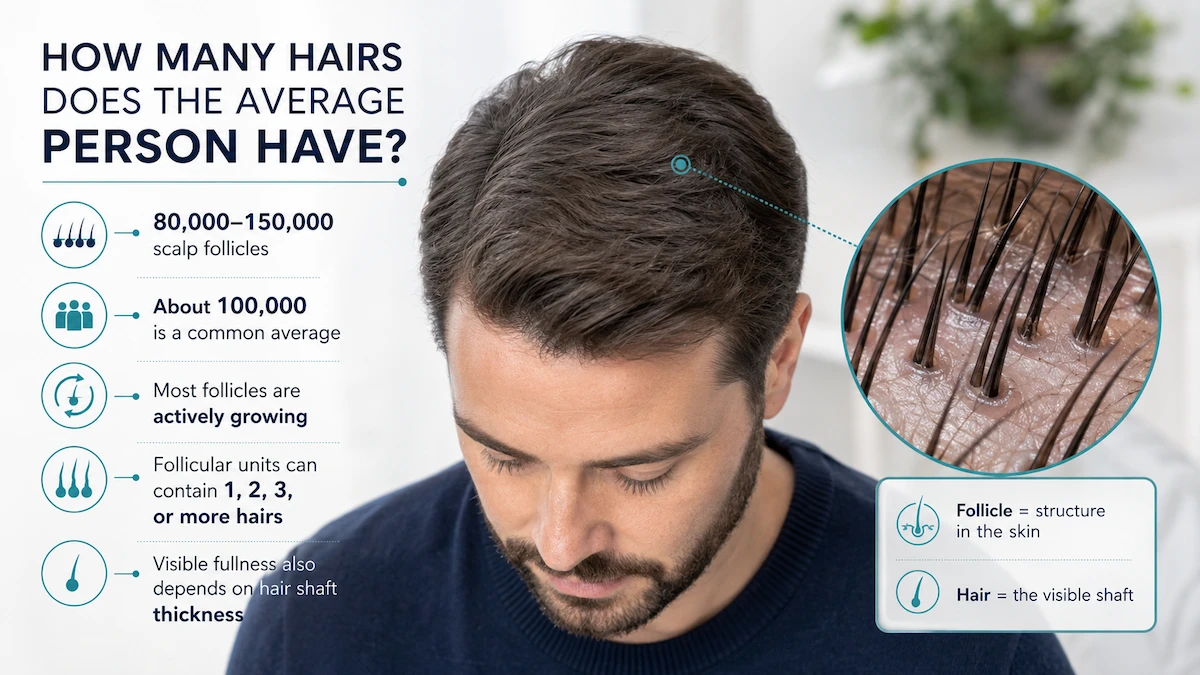
There is no single number that applies to every scalp. Research and clinical references generally place the number of scalp follicles around the following range:
A human scalp commonly contains roughly 80,000 to 150,000 hair follicles. Around 100,000 follicles is often used as a simple average when discussing scalp hair. Most healthy scalp follicles are actively growing at any given time. Hair count varies naturally between individuals and across different areas of the scalp. Having fewer hairs does not automatically mean the hair will look thin, since strand diameter also affects visible fullness. The number of visible hairs can change even though the underlying number of follicles has not changed.
It is also important to separate follicles from individual hairs. A follicle is the structure inside the skin that produces a hair shaft. Hair follicles often grow in natural groups called follicular units, which typically contain one to four individual terminal hairs along with a shared sebaceous gland (Goldin et al., StatPearls, NCBI Bookshelf).
How hair color affects hair count?
You may have seen claims that people with blond hair have the most hairs, followed by brunettes, while redheads have the fewest. These figures are repeated widely, but natural hair color alone is not a reliable way to predict how many follicles a particular person has.
Hair pigmentation and hair density are both influenced by genetics, but they are not the same trait. A person can have light hair with low density or dark hair with very high density. Population background, hair diameter, scalp region, and individual genetics all influence the result.
Hair color can also change how dense the scalp appears. Dark hair against a light scalp creates more contrast, so small gaps may be easier to notice. Light hair against lighter skin can create less contrast and sometimes give the impression of better coverage.
Strand thickness makes an even bigger cosmetic difference. A head containing fewer thick hairs may look fuller than one containing more very fine hairs. This is why simply estimating total hair count from color can be misleading.
Hair density explained
Hair density describes how closely hairs are packed within a specific area of the scalp. It is usually expressed as the number of hairs per square centimeter rather than the total number of hairs on the entire head.
Density is not identical across the scalp. The frontal area, crown, temples, and back of the head may naturally have different counts. Studies also show meaningful variation between populations and individuals.
Hair density should not be confused with hair thickness. Thickness usually refers to the diameter of a single strand. Someone with fine hair may have a large number of follicles but still feel that the hair lacks volume. Someone else may have fewer follicles but coarse strands that provide excellent scalp coverage.
Curl pattern also changes the visual result. Curly and coily hair can occupy more space, creating considerable volume even when measured follicle density is lower.
This is why dermatologists and hair transplant specialists rarely judge hair by count alone. Density, shaft diameter, color contrast, curl, scalp area, and follicular grouping all contribute to the way hair looks.
How many hair follicles do you have?
The scalp commonly contains around 80,000 to 150,000 hair follicles. Approximately 100,000 is often used as a convenient reference figure, but the actual number differs significantly between people.
Most follicles do not sit completely alone. They are arranged in small natural groupings known as follicular units. One follicular unit may contain a single hair or several individual hairs.
This becomes especially important in hair transplantation. A surgeon may talk about transplanting 3,000 grafts, but this does not mean only 3,000 hairs are being moved. Because many grafts contain more than one follicle, the total number of transplanted hairs can be considerably higher.
Not every follicle is producing a clearly visible terminal hair at every moment either. Follicles continuously move through growth, transition, resting, and shedding phases. Some hairs are actively growing while others are temporarily resting.
In conditions such as androgenetic alopecia, follicles can also become miniaturized. They remain present but begin producing increasingly fine, short hairs, a process driven mainly by androgen signaling acting on the dermal papilla (Inui & Itami, Journal of Dermatological Science, 2011). The follicle count may therefore remain relatively high while visible density drops.
Why your hair count is set before birth?
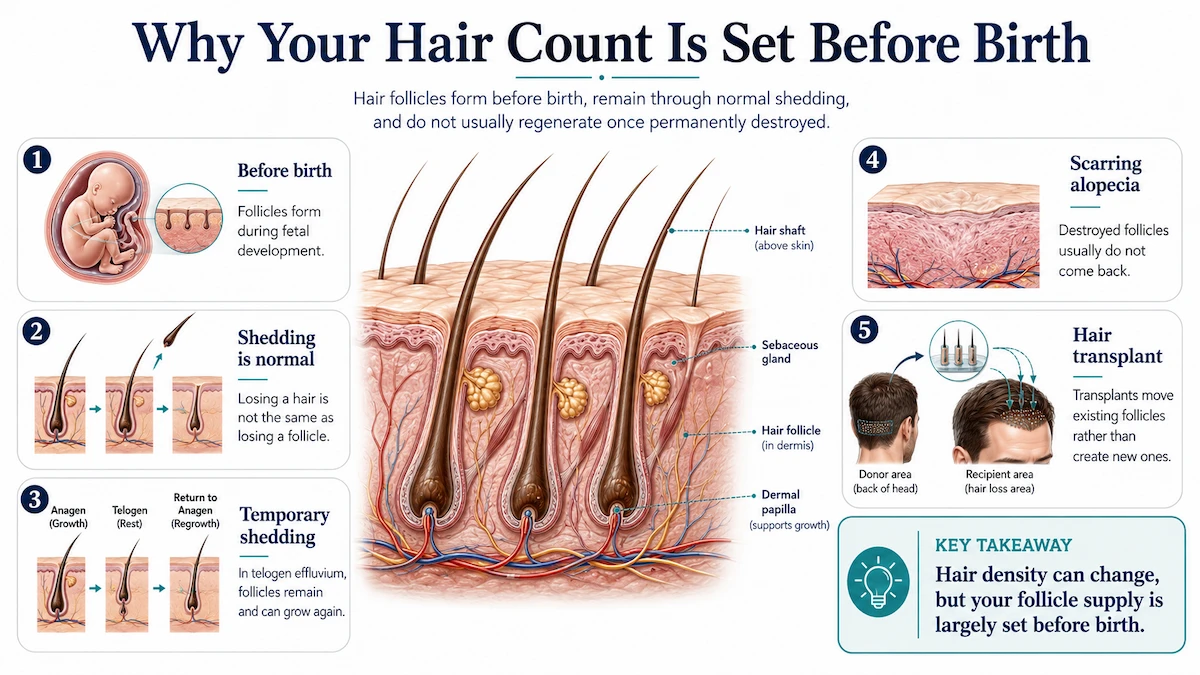
Hair follicles begin forming while a baby is still developing before birth. Their development depends on a complex interaction between the developing epidermis and deeper skin tissue.
By the time normal development is complete, the basic population and distribution of hair follicles has been established. New hair follicles do not form after birth, and the adult human scalp does not normally create large numbers of brand-new follicles to replace ones that have been permanently destroyed (Martel et al., StatPearls, NCBI Bookshelf).
This point helps explain several things about hair loss.
When a healthy hair sheds naturally, the follicle itself usually remains in the scalp. It can enter another growth cycle and produce a new strand. Losing a hair is therefore not the same as losing a follicle.
With temporary conditions such as telogen effluvium, many follicles enter a resting phase at approximately the same time. Hair density may drop temporarily, but the follicles are still present and can resume growth.
Scarring alopecia is different. Severe inflammation can permanently destroy follicles and replace them with scar tissue (StatPearls, NCBI Bookshelf). Because the body does not routinely generate replacement follicles, hair cannot simply restart from a follicle that no longer exists.
Hair transplantation works around this limitation by moving existing follicles from one part of the scalp to another rather than creating completely new follicles.
What affects hair density over time?
People may begin life with a genetically determined follicle pattern, but visible hair density is not fixed forever. Follicles can produce thicker or thinner strands as the years pass, and some may eventually stop producing cosmetically significant hair.
Genetics
Genetics plays a major role in natural hair density, strand diameter, curl pattern, hairline shape, and the likelihood of developing androgenetic alopecia.
Pattern hair loss is a good example. In genetically susceptible follicles, hormonal signals gradually shorten the growth phase and lead to miniaturization, a progression commonly tracked using the Norwood scale in men. Each new hair may become shorter and finer than the one before it.
This process can continue for years. Someone may technically retain follicles across an area that looks thin because many of those follicles are producing tiny hairs that provide very little coverage.
Genetics also influences how densely follicles are distributed naturally. This is why comparing one person’s hair count with another person’s can be misleading.
Age
Hair naturally changes with age. Individual strands may become finer, pigment production can decrease, and the hair-growth cycle can change.
The duration of the active growth phase may shorten in some follicles. At the same time, fewer follicles may be producing thick terminal hairs. The result is often a gradual reduction in volume even without a sudden episode of hair loss.
Age-related changes can overlap with genetic pattern hair loss. A person who already has genetically sensitive follicles may notice thinning more clearly as the years pass.
Gray hair also changes how density looks. Reduced pigment alters the contrast between the scalp and the strands, which can make coverage appear either better or worse depending on skin tone and lighting.
Hormones and health conditions
Hormones can have a strong effect on follicle activity without changing the number of follicles someone was born with.
Androgens are particularly important in pattern hair loss. In susceptible scalp follicles, dihydrotestosterone can contribute to progressive miniaturization. Hormonal changes after childbirth can also cause many hairs to enter the resting phase, producing temporary heavy shedding several months later.
Thyroid disorders may lead to diffuse thinning. Nutritional deficiencies, severe illness, rapid weight loss, surgery, autoimmune disease, medications, and intense physical or emotional stress can also affect the growth cycle.
Some of these conditions reduce visible density only temporarily. Others can lead to progressive or permanent loss if they continue untreated.
Hair count vs. hair density, what actually matters
Total hair count sounds like the most obvious measure of a full head of hair, but visible density is usually more important cosmetically.
Imagine two people who each have a similar number of scalp hairs. The first has fine, straight strands that sit close together. The second has thick, wavy hair with a larger diameter. Even with similar hair counts, the second person’s scalp may look considerably fuller.
Color contrast matters as well. Thick dark hair against a light scalp may expose gaps more clearly when density starts to decline. Curl can make each strand occupy more space and increase apparent volume.
Hair specialists sometimes describe this concept as coverage or visual density. It explains why simply adding a certain number of grafts during a hair transplant does not guarantee the same appearance for every patient.
The condition of the existing hair matters too. Miniaturized hairs contribute much less coverage than healthy terminal hairs, even though they are still counted as hairs during close examination.
For someone worried about hair loss, changes in part width, ponytail size, hairline position, crown coverage, and average strand diameter usually provide more useful information than trying to calculate the total number of hairs on the head.
How hair count relates to daily shedding?
A scalp containing roughly 100,000 hairs can lose dozens of strands each day without becoming visibly thinner. This happens because follicles do not grow and shed in perfect synchronization, with most healthy scalp hairs sitting in the active anagen phase at any one time (Martel et al., StatPearls, NCBI Bookshelf).
Most scalp follicles are normally in the active anagen phase. A much smaller percentage are resting or preparing to shed. Because each follicle follows its own timetable, old hairs are released gradually rather than all at once.
Losing around 50 to 100 hairs per day is generally considered normal. That represents only a tiny fraction of the total scalp hair population.
The amount seen in the shower can vary. Someone who washes every day may notice relatively few loose strands at each wash. Someone who washes every four or five days may see several days of naturally shed hair appear at once.
Long, curly, or coily hair can make normal shedding look even more dramatic because shed strands remain trapped among the other hairs until washing or detangling.
The more important warning sign is a sustained change from the normal pattern. If shedding increases for weeks or overall density begins falling, there may be more happening than ordinary hair cycling.
How doctors use hair density to assess hair loss?
Dermatologists do not need to count every hair on the entire head. Instead, they can examine representative scalp areas and look for patterns that reveal what the follicles are doing.
Trichoscopy magnifies the scalp and can show hair-shaft diameter variability, follicle openings, and miniaturized hairs, a technique with well-documented diagnostic value in pattern hair loss (Kuczara et al., Journal of Clinical Medicine, 2024). Hair density measurements can estimate how many hairs are growing within a defined scalp area. Hair diameter measurements help show whether follicles are producing normal terminal hairs or becoming miniaturized. Standardized photographs allow changes in the hairline, part, crown, and overall coverage to be compared over time. Hair-pull testing can help assess whether unusually active shedding is occurring. Scalp biopsy may be used when the diagnosis is uncertain or a scarring form of hair loss is suspected.
In pattern hair loss, density measurements are particularly useful when combined with information about strand diameter. A scalp may still contain many hairs, but a growing percentage may have become too fine to provide normal coverage.
This is why hair loss is not simply a question of how many hairs remain. The health, thickness, growth phase, and distribution of those hairs matter just as much.
A human head may carry roughly 100,000 hairs, but that number alone tells only part of the story. Natural density varies considerably, and the appearance of fullness depends on strand thickness, curl, color contrast, follicle spacing, age, and the condition of individual follicles. Tracking changes in density over time is far more useful than trying to count every strand.
Sources
- Goldin J, Zito PM, Raggio BS. “Hair Transplantation.” StatPearls, NCBI Bookshelf, 2026. ncbi.nlm.nih.gov
- Martel JL, Miao JH, Badri T, Fakoya AO. “Anatomy, Hair Follicle.” StatPearls, NCBI Bookshelf, 2024. ncbi.nlm.nih.gov
- Inui S, Itami S. “Molecular basis of androgenetic alopecia, from androgen to paracrine mediators through dermal papilla.” Journal of Dermatological Science, 2011. PubMed
- StatPearls, NCBI Bookshelf. “Central Centrifugal Cicatricial Alopecia.” ncbi.nlm.nih.gov
- Kuczara A, Waśkiel-Burnat A, Rakowska A, Olszewska M, Rudnicka L. “Trichoscopy of Androgenetic Alopecia, A Systematic Review.” Journal of Clinical Medicine, 2024. ncbi.nlm.nih.gov
