


Table of Contents
Diffuse thinning can be difficult to notice at first. Instead of one obvious bald patch, the change is spread across a larger part of the scalp. A ponytail may feel smaller, the part may look wider, or more scalp may become visible under bright light.
The term diffuse thinning describes a pattern rather than one specific diagnosis. Telogen effluvium is a common cause, but thyroid disorders, nutritional problems, medications, illness, hormonal changes, and pattern hair loss can create a similar appearance. Finding the cause is important because temporary shedding and progressive follicle miniaturization require different approaches.
What is diffuse thinning?
Diffuse thinning means a general reduction in hair density across part or all of the scalp rather than hair loss limited to one clearly defined patch. Hair may still cover the scalp, but overall volume falls and the skin underneath becomes easier to see.
Diffuse shedding is commonly associated with telogen effluvium, a nonscarring form of hair loss in which more follicles than usual enter the resting phase and eventually shed. Telogen effluvium can appear suddenly or persist for a longer period.
Acute cases often follow a recognizable trigger and become noticeable weeks or months afterward. Longer-lasting diffuse thinning may overlap with female pattern hair loss, making an accurate diagnosis especially important when density does not recover.
Diffuse thinning vs. pattern hair loss, what’s the difference?
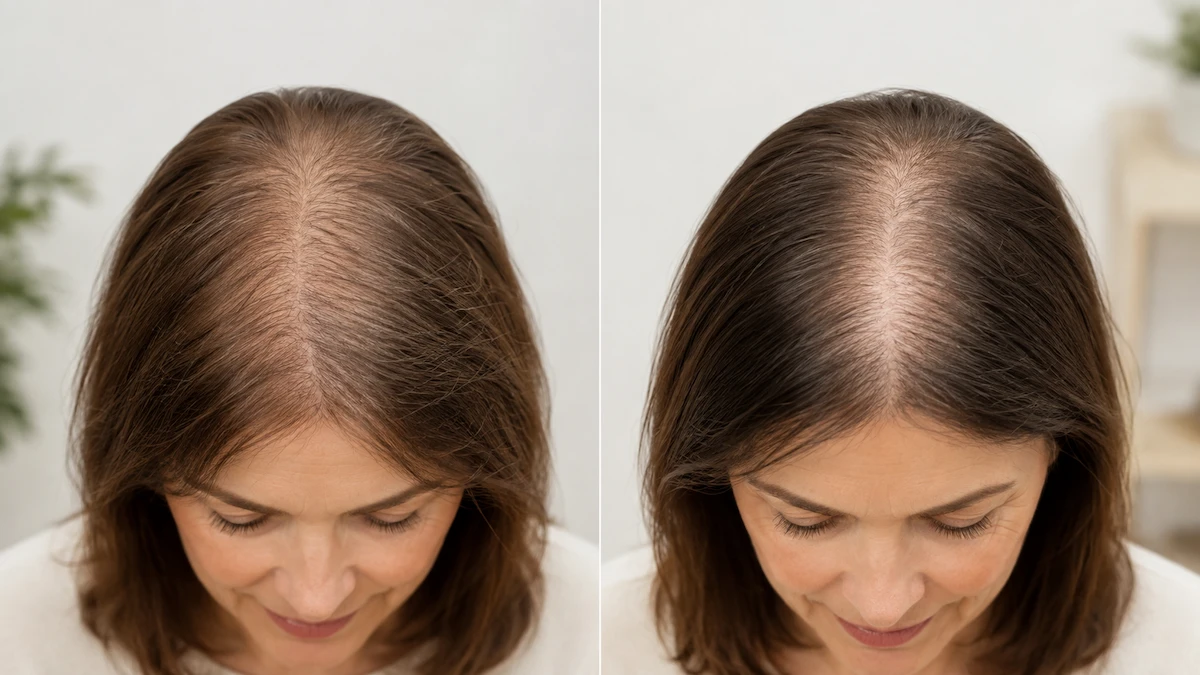
Diffuse thinning describes the appearance of the hair, while pattern hair loss refers to conditions such as androgenetic alopecia. In androgenetic alopecia, susceptible follicles gradually miniaturize and produce finer, shorter hairs. Women may notice a widening central part and lower density across the top of the scalp.
Telogen effluvium is different. Rather than progressive miniaturization being the main problem, more follicles move into the resting phase and shed. The two conditions can also occur together. A period of illness, stress, or rapid weight loss can trigger telogen effluvium and make previously mild pattern thinning far more noticeable.
Signs and symptoms of diffuse thinning
- The central part appears wider than before.
- A ponytail or bun feels noticeably smaller.
- More scalp becomes visible under bright light.
- Hair feels less full across the crown or entire scalp.
- More strands appear during washing or brushing.
- The hairline may remain relatively intact while density decreases elsewhere.
- The scalp may appear normal without redness, heavy scale, or scarring.
These signs can occur with both telogen effluvium and pattern hair loss, so the pattern alone does not always reveal the cause.
Widening part
A widening part is one of the most recognizable signs of female pattern hair loss. The change is often gradual, so it may not seem obvious from day to day. Comparing photographs taken with similar lighting, hairstyle, and camera position can make changes in density easier to notice.
Reduced hair density and volume
Lower density may change the way hair behaves before clear scalp exposure develops. Hairstyles may feel flatter, clips may hold less hair, and the ends can appear less substantial.
This is different from breakage. With breakage, shortened or snapped strands are more likely to be visible along the hair shaft, while true diffuse shedding involves hairs being lost from the follicles.
Increased shedding
Increased shedding is a classic feature of telogen effluvium. More hairs may come away during shampooing, brushing, or simply running the fingers through the hair. The trigger can occur months earlier, so illness, surgery, childbirth, rapid weight loss, medication changes, and major stress are important parts of the history.
A more visible scalp
The scalp becomes more noticeable when hair density falls, individual strands become finer, or both occur together. In pattern hair loss, progressive miniaturization creates finer hairs. With telogen effluvium, a temporary reduction in actively growing hairs can expose more scalp until the cycle recovers.
What causes diffuse thinning?

Diffuse hair thinning can have several causes, and more than one condition may be present at the same time. Telogen effluvium, androgenetic alopecia, thyroid disease, nutritional deficiencies, medications, illness, and major physiological stress are among the possibilities.
Telogen effluvium
Telogen effluvium occurs when a higher percentage of follicles enter the resting phase after a physical, metabolic, hormonal, or emotional trigger. Because resting hairs do not fall immediately, shedding often begins after a delay.
Common triggers include fever, major illness, surgery, childbirth, severe calorie restriction, rapid weight loss, psychological stress, and certain medications. Acute telogen effluvium is usually temporary. Once the trigger resolves, shedding often decreases gradually, although visible density may take longer to recover.
Hormonal changes and thyroid disorders
Hormonal changes can alter the normal hair cycle. Postpartum hormonal shifts are a well-known trigger for shedding, while androgen-related changes may contribute to female pattern thinning.
Both an overactive and underactive thyroid can also be associated with diffuse hair loss. Iron deficiency and thyroid disorders are commonly considered during the investigation of unexplained telogen effluvium.
Nutritional deficiencies
Hair follicles require adequate energy, protein, vitamins, and minerals. Iron deficiency is one of the nutritional issues commonly investigated in diffuse hair loss, particularly in people with heavy menstrual bleeding, restrictive diets, or other risk factors for reduced iron stores.
Other nutrients may be tested when the medical history suggests a deficiency. Supplements should not automatically be taken simply because hair is thinning. Excessive intake of certain nutrients, including vitamin A, vitamin E, and selenium, has itself been linked to hair loss.
Medications
Some medications can disrupt the hair cycle and produce diffuse shedding. The link is sometimes difficult to recognize because hair loss can start weeks or months after a medication is introduced or changed.
A prescription medication should not be stopped without medical advice. The prescribing doctor can review whether hair loss is a recognized effect and whether another option is appropriate.
Illness, surgery, and stress
Major physical stress can temporarily shift follicles away from active growth. High fever, infection, hospitalization, surgery, childbirth, and rapid weight loss are recognized triggers for telogen effluvium. Emotional stress may also contribute.
Someone may feel completely recovered by the time shedding begins. This delay is one reason the original trigger can easily be overlooked.
Common myths about diffuse thinning
Diffuse thinning does not automatically mean permanent baldness. Telogen effluvium is often temporary when the trigger resolves and the follicles remain healthy. Pattern hair loss is different because follicle miniaturization can continue without treatment.
Cutting hair shorter does not change follicle activity or make the roots grow faster. A shorter hairstyle may make thin hair appear fuller, but it cannot increase the number of follicles.
Frequent washing is also often blamed for shedding. Washing does not create telogen effluvium. It simply releases hairs that were already ready to fall. Waiting several days between washes may make shedding appear heavier because more loose hairs are removed at once.
How is diffuse thinning diagnosed?
Diagnosis usually begins with the timing and pattern of hair loss. A dermatologist may ask about recent illness, surgery, medications, diet changes, pregnancy, menstrual history, emotional stress, weight loss, and family history.
The scalp is examined for differences in hair diameter, broken shafts, inflammation, scale, scarring, and the distribution of density loss. A hair-pull test may help assess active shedding, while trichoscopy can provide a magnified view of the follicles and hair shafts.
Blood testing is based on the individual history. A complete blood count, ferritin and other iron studies, and thyroid testing may be considered. Zinc or other tests may be added when relevant. A scalp biopsy is occasionally used if the diagnosis remains uncertain or scarring alopecia is suspected.
Treatment options for diffuse thinning
- Correct an identified cause such as iron deficiency, thyroid disease, severe dietary restriction, or another medical problem.
- Allow time for acute telogen effluvium to recover after its trigger has resolved.
- Consider topical minoxidil when androgenetic alopecia contributes to the thinning.
- Use prescription finasteride only in appropriate patients with androgenetic alopecia, not as routine treatment for telogen effluvium.
- Review medications with the prescribing doctor if shedding began after a treatment change.
- Use gentle hair care to reduce unnecessary breakage while density recovers.
- Treat scalp inflammation or another dermatologic condition when one is present.
The correct treatment depends on the diagnosis rather than the amount of hair being shed.
Addressing the underlying cause
When telogen effluvium has an identifiable trigger, management focuses on correcting that problem where possible. This could mean treating iron deficiency, managing thyroid disease, restoring adequate protein and calorie intake, or allowing the body to recover after illness or surgery.
Hair recovery is slow. Shedding may take several months to return toward normal, and new hairs need additional time to become long enough to noticeably improve density.
Minoxidil
Minoxidil is an established treatment for pattern hair loss. Topical minoxidil may reduce loss and support growth when androgenetic alopecia is contributing to diffuse thinning.
It is not necessary for every case of acute telogen effluvium because many episodes improve after the trigger is corrected. When pattern hair loss is present, ongoing treatment is generally required to maintain the benefits.
Finasteride
Finasteride is a prescription 5-alpha-reductase inhibitor used to reduce the effects of dihydrotestosterone on susceptible follicles. Oral finasteride 1 mg is FDA-approved for male pattern hair loss in men. It is not a general treatment for all forms of diffuse thinning.
Finasteride requires medical assessment because it has precautions and potential adverse effects. The FDA also states that there is currently no FDA-approved topical finasteride formulation in the United States.
Can diffuse thinning be reversed?
Diffuse thinning can often improve, but the likelihood of recovery depends on the cause. Acute telogen effluvium commonly improves after the triggering illness, nutritional issue, physiological stress, or other cause resolves. Because the follicles are not normally destroyed, they can return to active growth.
Pattern hair loss behaves differently because follicle miniaturization tends to progress. Treatments such as minoxidil and, for appropriate men, finasteride may help slow further loss and support growth.
Permanent hair loss is more concerning when scarring alopecia is present because inflammation can permanently damage follicles. Pain, burning, visible scarring, or significant scalp inflammation should therefore be evaluated promptly.
When to see a doctor
A doctor or dermatologist should assess diffuse thinning that continues for several months, becomes progressively worse, or has no clear trigger. Sudden hair loss accompanied by scalp pain, burning, redness, heavy scaling, sores, or visible scarring also warrants medical evaluation.
Assessment is also useful when thinning occurs alongside fatigue, major weight changes, menstrual changes, or symptoms that could suggest thyroid disease or nutritional deficiency.
Diffuse thinning is not one disease and does not have one universal treatment. The key is determining whether the problem comes from increased shedding, progressive follicle miniaturization, an underlying health condition, or a combination of factors. Once the cause is identified, treatment can focus on protecting existing hair and supporting a healthier growth cycle.
Sources
- U.S. Food and Drug Administration (2025). Concerns Over Compounded Topical Finasteride Prompt FDA Alert. Dermatology Advisor.
- Hughes, E. C., Syed, H. A., Saleh, D. (2024). Telogen Effluvium. StatPearls, NCBI Bookshelf, National Library of Medicine.
- American Academy of Dermatology Association. Hair loss, Who gets and causes.
- Yip, L., Rufaut, N., Sinclair, R. (2019). Female Pattern Hair Loss and Androgen Excess, A Report From the Multidisciplinary Androgen Excess and PCOS Committee. The Journal of Clinical Endocrinology and Metabolism.
- Almohanna, H. M., Ahmed, A. A., Tsatalis, J. P., Tosti, A. (2019). The Role of Vitamins and Minerals in Hair Loss, A Review. Dermatology and Therapy, 9(1), 51-70.
