


Table of Contents
Stem cell therapy has become one of the most discussed emerging treatments for hair loss. The idea is appealing, use cells or cell-derived signals with regenerative potential to support weakened hair follicles and encourage stronger growth. Early studies in androgenetic alopecia have reported improvements in hair density and other measures, but the field is still developing and treatment methods are far from standardized (Shimizu et al., Regenerative Therapy, 2022).
It is also important to separate genuine clinical research from marketing. Treatments advertised as “stem cell hair restoration” may involve living cells, stromal vascular fraction, conditioned media, secretomes, micrografts, or cell-derived products. These are not interchangeable treatments, and they do not all have the same evidence, processing methods, or regulatory status.
What is a stem cell?
A stem cell is a cell with two important abilities. It can renew itself by producing more cells, and under suitable conditions it can develop into specialized cell types. Different stem cells have different levels of developmental potential.
Hair follicles naturally contain populations of stem and progenitor cells involved in the repeated growth cycle of hair. These cells help the follicle move between resting and active growth phases. Research into hair restoration aims to understand whether these cells, or signals produced by other stem cells, can be used to improve follicle activity.
Mesenchymal stem cells have received particular attention. They can be obtained from tissues such as fat, bone marrow, and umbilical tissue. In hair research, adipose-derived cells are especially common because fat tissue can contain regenerative cell populations and signaling molecules that may influence surrounding tissue.
What is stem cell therapy for hair loss?
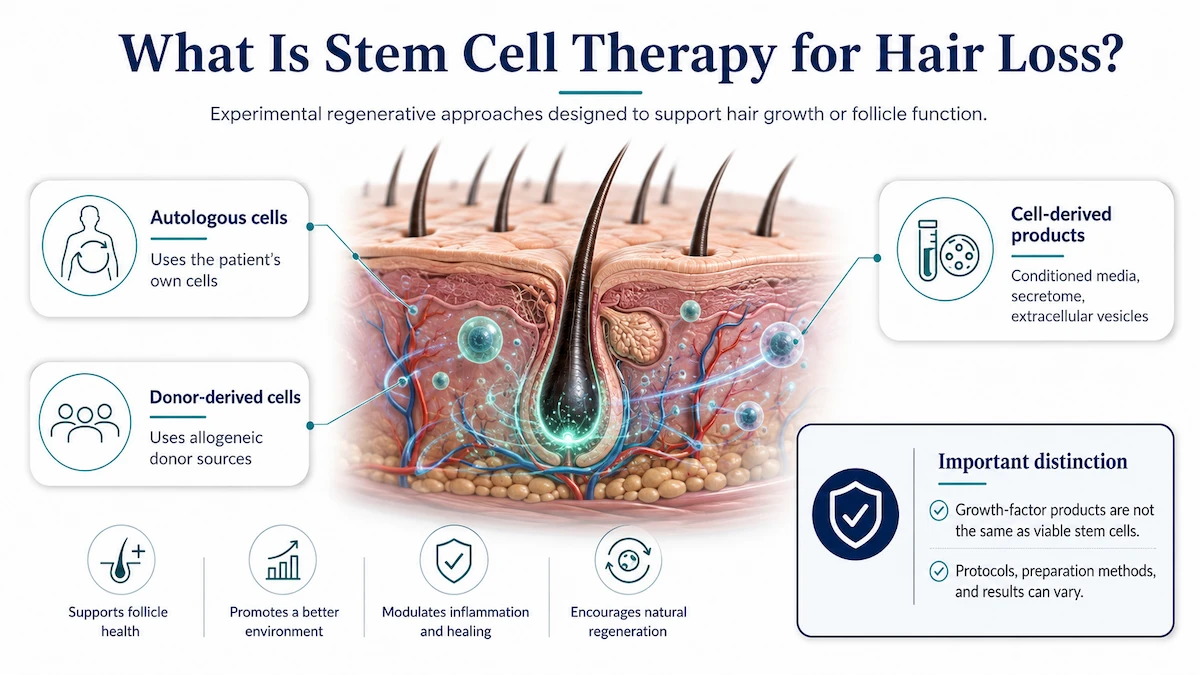
Stem cell therapy for hair loss is a broad term covering experimental regenerative approaches designed to improve hair growth or follicle function.
Some methods use a patient’s own cells. Others use allogeneic cells obtained from a donor source. Research has also examined products made from stem cells rather than the cells themselves, including conditioned media, secretomes, and extracellular vesicles.
This distinction matters. A treatment containing growth factors secreted by stem cells is not the same thing as an injection containing viable stem cells. Studies involving these approaches have reported promising results, but reviews continue to emphasize that protocols, cell sources, preparation methods, treatment schedules, and outcome measurements vary considerably.
How stem cell therapy works?
The main goal is not necessarily to create completely new follicles from nothing. Many current approaches aim to influence existing follicles that are still present but producing weaker or thinner hairs.
Researchers are investigating whether regenerative cells and their signaling molecules can influence dermal papilla cells, blood vessel formation, inflammation, growth factors, and pathways involved in the hair cycle. These effects could potentially encourage follicles to remain in or return to the active growth phase.
Harvesting stem cells
In autologous treatment, biological material comes from the same patient who will receive it. Fat tissue is one commonly studied source because adipose tissue contains regenerative cell populations.
A small amount of tissue may be collected and processed to isolate a cell-rich fraction or prepare another regenerative product. Other experimental studies have investigated hair follicle-derived cells and different mesenchymal stem cell sources.
The exact harvesting method depends on the treatment. This is one reason the phrase “stem cell therapy” alone tells very little about what a patient is actually receiving.
Lab processing and expansion
After collection, cells may be separated, concentrated, prepared, or cultured depending on the research protocol. Cell expansion means allowing a small population of cells to multiply under controlled laboratory conditions before use.
Not every treatment involves expansion. Some studies use freshly prepared cell fractions, while others investigate cultured cells or products secreted by those cells.
This stage is important because processing can significantly change what the final product contains. Highly manipulated or cultured cell products also raise more complex safety, manufacturing, and regulatory questions. This is one reason commercially marketed procedures should not automatically be assumed to be equivalent to therapies studied under controlled research protocols.
Injecting cells into the scalp
In clinical research, regenerative preparations may be delivered into thinning areas of the scalp through multiple small injections. The aim is to expose follicles and surrounding tissue to cells or biological signals that might encourage stronger activity.
Some clinical studies using hair follicle-derived mesenchymal cells or adipose-derived products have reported increases in measures such as hair density or hair shaft diameter. However, study sizes remain relatively small and treatment protocols differ.
Changes are generally evaluated over several months rather than immediately because the hair cycle moves slowly.
How stem cell therapy differs from PRP?
PRP, or platelet-rich plasma, uses a concentrated portion of the patient’s own blood. After blood is processed, the platelet-rich component is injected into the scalp. Platelets release growth factors that may influence follicle activity and tissue repair.
Stem cell therapy is different because it involves cells with regenerative properties or materials produced by these cells. PRP does not contain a therapeutic population of stem cells.
PRP currently has a larger clinical evidence base in androgenetic alopecia. A systematic review and meta-analysis of clinical trials has found that PRP can increase hair density, although study protocols still vary (Papakonstantinou et al., Plastic and Reconstructive Surgery, 2023).
Stem cell treatments remain more experimental. Some studies have even investigated combining regenerative cells with PRP, but this should not be confused with standard PRP treatment.
How stem cell therapy differs from a hair transplant?
A hair transplant physically moves existing follicles from a donor area, usually the back or sides of the scalp, into thinning or bald areas. The procedure does not create new follicles. It redistributes follicles that are more resistant to androgen-related miniaturization.
Stem cell therapy takes a different approach. Rather than moving thousands of mature follicles, regenerative treatment attempts to influence the biological activity of follicles already present in the thinning area.
This means the two treatments address different situations. A hair transplant can restore coverage in an area where suitable recipient sites no longer contain enough cosmetic hair. Experimental regenerative therapy is more often investigated for thinning areas where follicles are still present.
Who is a candidate for stem cell therapy?
People with early or moderate androgenetic alopecia may be more relevant candidates for research-based regenerative approaches because miniaturized follicles are still present. Candidates should have a confirmed diagnosis rather than unexplained shedding or an undiagnosed scalp disease. People expecting a completely bald area to grow dense new follicles should have realistic expectations because current evidence does not support that promise. Anyone considering treatment should understand whether the product contains actual cells, a cell-derived preparation, stromal vascular fraction, secretome, or another material. Participation in a properly registered clinical trial offers a clearer framework for experimental treatment than choosing an unapproved product marketed with guaranteed results.
Current research has focused heavily on androgenetic alopecia, and findings cannot automatically be applied to every form of hair loss.
Current research and clinical trials
Research into regenerative hair treatment has expanded considerably. Studies have investigated adipose-derived cells, hair follicle mesenchymal stem cells, stromal vascular fractions, conditioned media, secretomes, and related cell-derived products.
A 2024 systematic review of autologous stem cell-derived approaches reported encouraging changes in hair regeneration and density, but also highlighted the need for optimized protocols and stronger long-term evidence (Gasteratos et al., Plastic and Reconstructive Surgery Global Open, 2024).
A separate clinical trial involving hair follicle mesenchymal stem cells reported improvement in patients with androgenetic alopecia (Gan et al., Plastic and Reconstructive Surgery, 2024). Other randomized work has found increases in hair count with adipose-derived stem cell constituent extracts (Tak et al., Stem Cells Translational Medicine, 2020).
Research is continuing rather than reaching a final answer. Registered trials are still testing mesenchymal stem cells and related approaches for androgenetic alopecia, which shows that effectiveness, dose, treatment schedules, and long-term safety remain active research questions.
Is stem cell therapy FDA-approved?
No stem cell therapy is currently FDA-approved specifically for the treatment of hair loss in the United States, and reviews of the regulatory landscape confirm this remains true even as commercial marketing of these treatments has expanded (Gupta et al., Medical Sciences, 2025). The current list of licensed cellular and gene therapy products does not include a stem cell treatment for androgenetic alopecia or other forms of common hair loss.
Regenerative products marketed for medical treatment can fall under FDA regulation, and unapproved stem cell products have been the subject of repeated safety warnings. A clinic offering a treatment commercially should not use the words “stem cell” or “regenerative” as proof that the treatment has FDA approval or established effectiveness.
Potential benefits of stem cell therapy
The main potential benefit is the possibility of improving the environment around weakened follicles without transplanting them. Small clinical studies have reported improvements in hair density, hair diameter, or photographic assessments after several types of regenerative treatment.
Another possible advantage is that autologous approaches use material obtained from the patient’s own body, which may reduce certain immune compatibility concerns.
The treatment may also eventually become useful as an additional therapy rather than a replacement for existing options. Reviews have suggested that regenerative treatments may have a future role alongside established medical therapy or hair transplantation.
These benefits remain potential benefits. Results reported in small studies should not be turned into guarantees of permanent regrowth.
Risks and side effects
Scalp injections can cause temporary pain, swelling, tenderness, redness, bruising, or bleeding. Any procedure that breaks the skin creates a risk of infection. Poorly processed or contaminated biological products can create additional safety concerns. Unapproved regenerative products may not have been adequately tested for quality, purity, dose, or long-term effects. Results may be limited, temporary, or completely absent despite the cost of treatment. Procedures involving tissue collection can create additional risks at the harvesting site. Long-term safety data for many experimental hair-loss protocols remain limited.
Published hair-loss studies have often reported relatively mild short-term adverse effects, but small trials cannot reliably detect every uncommon or delayed complication. Regulatory warnings about unapproved regenerative products emphasize infection, immune reactions, contamination, and other serious risks that can occur when poorly controlled products are used.
How much does stem cell therapy for hair loss cost?
There is no standard price for stem cell hair treatment because there is no single standardized procedure. A treatment involving adipose tissue harvesting and laboratory processing is very different from a clinic applying a commercial cell-derived scalp product.
Cost may depend on the source of the biological material, the amount of processing required, how many sessions are planned, the country, and whether the treatment is being provided as part of a clinical study.
Because these approaches are generally experimental for hair loss, insurance coverage should not be assumed. Price should also not be used as a measure of scientific quality. An expensive treatment can still have limited evidence.
When to consider stem cell therapy vs. other treatments
Stem cell therapy is best viewed as an emerging option rather than the default first treatment for hair loss. A diagnosis should come before choosing a regenerative procedure.
For androgenetic alopecia, established options such as minoxidil and prescription anti-androgen treatment have a much longer history of clinical use. PRP also has more accumulated clinical evidence than most stem cell approaches. Hair transplantation remains an established surgical option when suitable donor follicles are available and permanent redistribution of hair is needed.
Stem cell treatment may be worth discussing when someone understands its experimental status, has realistic expectations, and is considering a properly controlled clinical study or a treatment whose exact biological product and regulatory status can be verified.
The research is genuinely promising, but that is different from saying the technology is already proven. At present, the strongest approach is to identify the type of hair loss first, use established treatments when appropriate, and view stem cell therapy as a developing field that still needs larger studies, standardized protocols, and longer follow-up before its exact role in hair restoration becomes clear.
Sources
- Shimizu Y, Ntege EH, Sunami H, Inoue Y. “Regenerative medicine strategies for hair growth and regeneration, a narrative review of literature.” Regenerative Therapy, 2022. ncbi.nlm.nih.gov
- Gasteratos K, Kouzounis K, Goverman J. “Autologous Stem Cell-derived Therapies for Androgenetic Alopecia, A Systematic Review of Randomized Control Trials on Efficacy, Safety, and Outcomes.” Plastic and Reconstructive Surgery Global Open, 2024. ncbi.nlm.nih.gov
- Gan Y, Du L, Wang H, Li K, Fan Z, Sun P, Zhang J, Hu Z, Miao Y. “A Clinical Trial of Treating Androgenic Alopecia with Mesenchymal Stem Cell Suspension Derived from Autologous Hair Follicle.” Plastic and Reconstructive Surgery, 2024. ncbi.nlm.nih.gov
- Tak YJ, Lee SY, Cho AR, Kim YS. “A Randomized, Double-Blind, Vehicle-Controlled Clinical Study of Hair Regeneration Using Adipose-Derived Stem Cell Constituent Extract in Androgenetic Alopecia.” Stem Cells Translational Medicine, 2020. PubMed
- Papakonstantinou M, Siotos C, Gasteratos KC, Spyropoulou GA, Gentile P. “Autologous Platelet-Rich Plasma Treatment for Androgenic Alopecia, A Systematic Review and Meta-Analysis of Clinical Trials.” Plastic and Reconstructive Surgery, 2023. PubMed
- Gupta AK, Wang T, Welter R, Unger R, Mejia R. “Promises and Pitfalls of Regenerative Therapies for Androgenetic Alopecia, Platelet-Rich Plasma, Photobiomodulation, Stem Cells, and Exosomes.” Medical Sciences, 2025. ncbi.nlm.nih.gov
