


Table of Contents
A single strand of hair may look simple, but its internal structure is surprisingly complex. Each hair is built from layers of tightly organized proteins, pigments, lipids, and other components that influence its strength, color, texture, shine, and response to everyday styling.
Understanding what is inside hair also helps explain why bleach can weaken strands, why damaged hair becomes frizzy, and why some hair types handle heat or chemicals better than others. The visible strand above the scalp is only one part of the story. Beneath the skin sits a living follicle that produces the strand and controls its growth.
From the protective cuticle on the outside to the cortex that gives hair most of its strength, every layer has a different role.
What is hair made of?
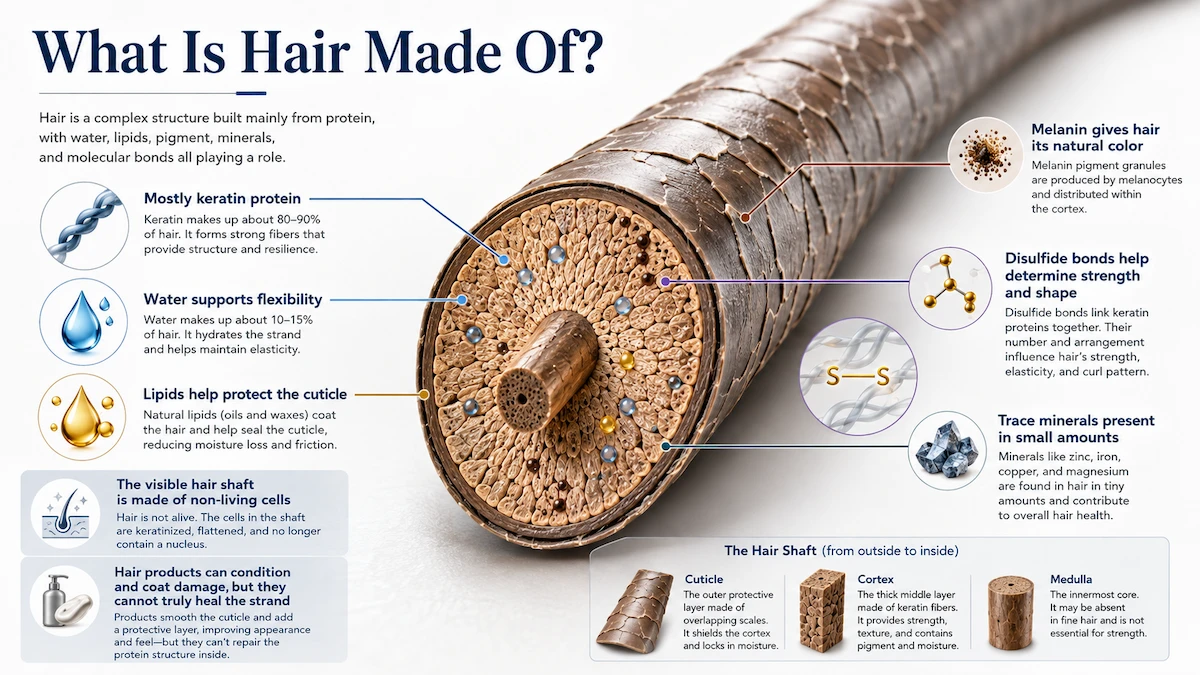
Human hair is made mainly from a tough structural protein called keratin, but a strand contains more than protein alone, a composition described in the physiology literature on human hair (Hoover et al., StatPearls, NCBI Bookshelf).
Keratin proteins form most of the hair shaft and provide strength and structure. Water is naturally present within hair and influences flexibility and texture. Lipids help protect the strand and support the barrier between cuticle cells. Melanin pigments determine natural hair color. Trace minerals and other molecules are present in much smaller amounts. Disulfide bonds between keratin proteins help determine strength, shape, and resistance to chemical change.
The visible part of hair is made from cells that are no longer living. This is why cutting hair does not hurt and why a damaged strand cannot heal itself in the same way that skin can repair a wound.
Hair products can smooth, coat, condition, or temporarily reinforce damaged areas, but they cannot turn an already damaged hair shaft back into completely new tissue.
The three layers of a hair strand
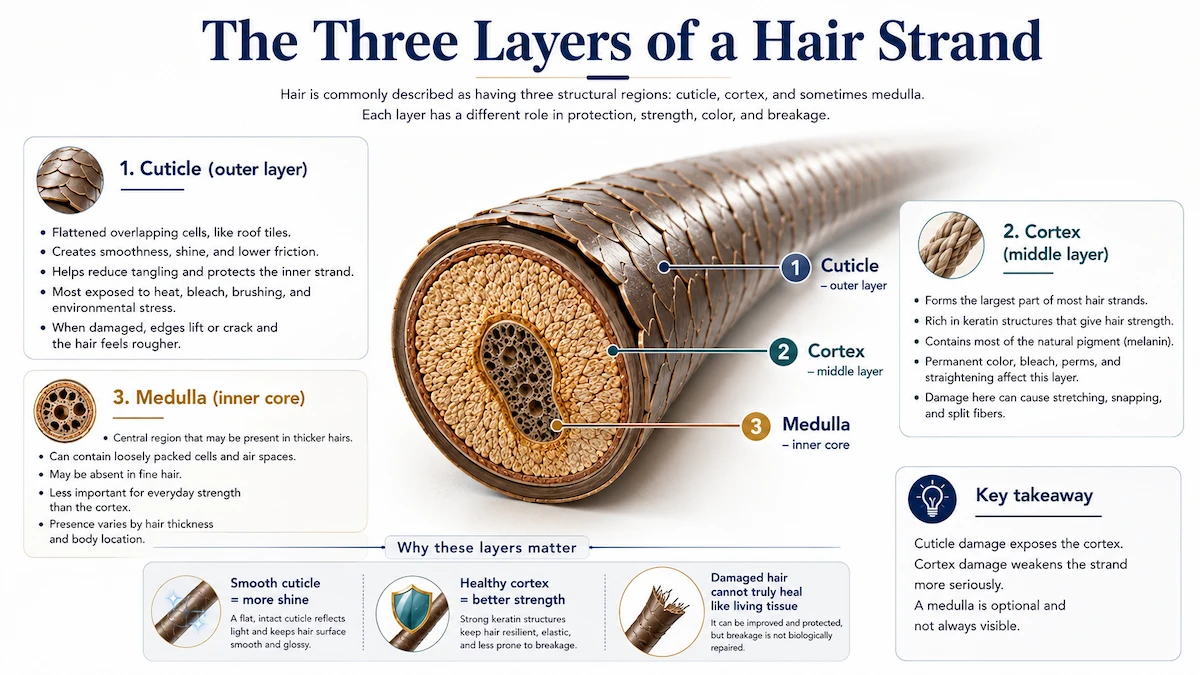
A mature hair shaft is commonly described as having three possible structural regions, the cuticle, cortex, and medulla, with the cuticle cells derived from matrix progenitor cells that fill with keratin as they differentiate (Brown & Krishnamurthy, StatPearls, NCBI Bookshelf). The cuticle forms the outer surface, while the cortex makes up most of the strand. A medulla may be present in the center, particularly in thicker hairs.
These layers are arranged differently and perform very different jobs. Their condition can affect everything from how shiny hair looks to how easily it breaks during brushing or chemical treatments.
The cuticle (outer layer)
The cuticle is the outermost protective layer of the hair shaft. It consists of flattened cells arranged in overlapping layers, often compared with roof tiles or fish scales.
When these cells lie relatively flat, the surface feels smoother and reflects light more evenly. This creates the appearance commonly described as healthy shine. A smooth cuticle also reduces friction between neighboring hairs, making the hair easier to comb and less likely to tangle.
The cuticle is the first part of the strand exposed to shampoo, sunlight, heat, hair color, bleach, brushes, straighteners, and environmental stress. Repeated damage can cause the edges of the cuticle cells to lift, crack, or wear away.
Once the protective surface becomes damaged, the underlying cortex becomes more vulnerable. This is why heavily bleached or repeatedly heat-styled hair often feels rougher and becomes easier to break.
The condition of the cuticle also plays an important role in hair porosity. Hair with a more damaged or raised cuticle may absorb water quickly but lose it just as easily.
The cortex (middle layer)
The cortex sits beneath the cuticle and forms the largest part of most hair strands. It contains long keratin structures organized into bundles that provide much of the hair’s mechanical strength.
Natural hair pigment is also found mainly within the cortex. Tiny melanin granules inside this layer influence whether hair appears black, brown, blond, red, or somewhere between these shades.
The cortex is especially important during chemical treatments. Permanent hair color and bleaching products need to reach this area to alter natural pigments. Permanent straightening and perming also change chemical bonds within cortical keratin.
Because the cortex carries so much of the strand’s structural load, damage here is more serious than simple surface roughness. Once the cortex becomes severely weakened, hair may stretch excessively when wet, snap during brushing, or split along the shaft.
This explains why very damaged hair cannot always be restored simply with conditioner. Conditioning may improve the surface, but extensive internal damage can remain.
The medulla (inner core)
The medulla is the central region that may run through the middle of certain hair shafts. It can contain loosely packed cells and air spaces and is generally more noticeable in coarse or thick hairs.
Unlike the cortex and cuticle, the medulla is not always continuous. In some hairs, it may appear only in certain sections. In others, it may be completely absent.
Its exact biological role is less important to everyday hair strength than the role of the cortex. A strand can remain perfectly normal without a visible medulla.
The presence or absence of the medulla also varies according to hair diameter and body location. Thick terminal hairs are more likely to contain one than very fine hairs.
What is keratin and why does it matter?
Keratin is a family of fibrous proteins that provides structure to hair, nails, and the outer layers of skin. Hair keratin is particularly strong because protein chains are linked together in several ways.
One important type of connection is the disulfide bond. These chemical bonds form between sulfur-containing amino acids within keratin proteins and contribute significantly to the strength and shape of the hair.
This is why chemical straighteners and permanent waving products can change hair texture. They work by disrupting and then reforming some of these bonds so the hair takes on a different shape.
Keratin is also the reason hair has a certain degree of elasticity. Healthy hair can stretch slightly and return toward its original length without immediately breaking. When proteins are weakened by bleach, repeated chemical processing, or extreme heat, this balance changes.
Protein-containing hair products may temporarily improve the feel and strength of damaged strands by filling irregular areas or forming a film on the surface. They do not permanently rebuild the original internal structure of heavily damaged hair.
What gives hair its color?
Natural hair color comes mainly from melanin pigments produced by specialized cells called melanocytes inside the hair follicle. These pigments are incorporated into the growing hair and become concentrated primarily within the cortex.
Two main pigment families are responsible for most natural hair colors. Eumelanin produces darker brown and black tones, while pheomelanin contributes more yellow, red, and copper shades, a distinction documented in the clinical literature on hair pigmentation (Kumar et al., International Journal of Trichology, 2018).
Different combinations and concentrations of these pigments create the wide range of natural hair colors seen among people.
Hair turns gray or white when pigment production within the follicle decreases. As melanocyte activity declines, new hairs grow with less melanin. Eventually, some strands may contain almost no pigment.
This change happens while the hair is being formed inside the follicle. Once a strand has emerged from the scalp, its natural pigment content does not change on its own.
Hair dye works differently. Permanent color products chemically alter or deposit pigment within the shaft, while temporary products usually remain closer to the surface.
The hair follicle, what’s below the scalp
The visible hair shaft is dead tissue, but the follicle beneath the scalp is biologically active. A hair follicle is a small tube-like structure extending down into the skin, comprised of the follicle itself along with its associated sebaceous gland and arrector pili muscle (Martel et al., StatPearls, NCBI Bookshelf). It produces the strand and goes through repeated cycles of growth, transition, rest, and shedding.
The follicle contains several specialized structures that help regulate hair production. Blood vessels supply nutrients to growing cells, while hormones and chemical signals influence how long the follicle remains in its active growth phase.
This distinction between shaft and follicle explains why products placed on the hair lengths mainly affect texture and appearance, while true hair-growth treatments must influence processes taking place at or around the follicle.
The hair bulb and dermal papilla
At the base of an actively growing follicle is the hair bulb. This enlarged structure contains rapidly dividing matrix cells that eventually form the hair shaft.
The dermal papilla sits within the lower part of the bulb and contains connective tissue, blood vessels, and signaling cells. It plays a major role in regulating follicle growth and cycling.
As new cells form in the matrix, they move upward, fill with keratin, lose their nuclei, and become part of the developing hair shaft. Pigment-producing melanocytes in this area add melanin to the hair during growth.
The dermal papilla is also important in research into androgenetic alopecia. Hormonal signals around this structure can influence follicle size and growth duration, and in genetically susceptible follicles, repeated exposure to androgen-driven paracrine signals from the dermal papilla can lead to gradual miniaturization (Inui & Itami, Journal of Dermatological Science, 2011).
The sebaceous gland
Most hair follicles are connected to a sebaceous gland. This gland produces sebum, an oily substance that moves onto the skin and hair, with production levels shaped by hormonal and other physiological factors (Hoover et al., StatPearls, NCBI Bookshelf).
Sebum helps lubricate the scalp and can reduce moisture loss from the skin surface. It also coats nearby hair, contributing to flexibility and protection.
The amount of sebum produced varies between people. Hormones, age, genetics, scalp condition, and environmental factors can all influence oil production.
Straight hair may distribute scalp oils along the strand relatively easily, while curly or coily hair can remain dry through the lengths because the bends make it harder for sebum to travel downward. This is one reason different hair textures often need different conditioning routines.
Why hair structure affects how you should care for it
Hair-care routines work better when they protect the structures that already exist. The cuticle is particularly important because it acts as the first barrier against everyday damage.
Hair does not need to be treated like living skin. Once the shaft becomes severely damaged, it cannot biologically heal. The practical goal is to reduce additional damage, improve lubrication, lower friction, and protect the cortex for as long as possible.
This is also why prevention usually works better than trying to repair years of damage afterward.
Why damaged cuticles cause frizz and dullness
A healthy cuticle creates a relatively smooth outer surface. When the cuticle becomes worn or lifted, the hair feels rough and interacts differently with moisture.
Damaged sections may absorb water more easily, swell unevenly, and develop greater friction between strands. This contributes to tangling and frizz.
A rough surface also reflects light less evenly, which is why damaged hair often appears dull even when it has been freshly washed.
Bleaching, excessive heat, UV exposure, repeated coloring, rough towel drying, and aggressive brushing can all contribute to cuticle damage.
Conditioners, silicones, oils, and other coating ingredients can temporarily smooth the surface and reduce friction. They do not replace missing cuticle cells, but they can make damaged hair easier to manage.
Why the cortex determines strength and elasticity
The cortex carries most of the mechanical load of the hair shaft. Its keratin fibers and chemical bonds allow hair to bend, stretch, and resist breakage during normal handling.
When cortical proteins are heavily damaged, the strand becomes less predictable. Hair may feel unusually stretchy when wet, lose elasticity, or snap with little force.
Chemical treatments are particularly important because they can alter bonds within the cortex. Bleach also removes pigment while causing oxidative damage to proteins and lipids.
Repeated processing increases the chance that the internal structure will weaken faster than surface products can compensate for it.
Protecting the cortex therefore starts with protecting the cuticle. Lower heat settings, fewer chemical treatments, regular conditioner, gentle detangling, and reduced friction can all help preserve the strand’s internal strength.
Does every hair have a medulla?
No. The medulla is not present in every human hair, and its absence is considered normal.
Fine scalp hairs may have no visible medulla. Coarse terminal hairs are more likely to contain one. A medulla can run continuously through a strand or appear only in sections. Different hairs from the same person may show different medullary patterns. Hair can remain completely normal and strong without a medulla.
The most important structural layers for everyday hair strength are the cuticle and cortex. The cuticle protects the shaft, while the cortex provides most of its strength, elasticity, color, and bulk.
Looking at a single hair under a microscope reveals why hair care is ultimately about preserving structure. The strand may no longer be living tissue, but it is a highly organized material built to survive years of washing, bending, styling, and environmental exposure. Protecting its outer layers helps the entire strand remain smoother, stronger, and more resilient for longer.
Sources
- Hoover E, Alhajj M, Flores JL. “Physiology, Hair.” StatPearls, NCBI Bookshelf, 2023. ncbi.nlm.nih.gov
- Brown TM, Krishnamurthy K. “Histology, Hair and Follicle.” StatPearls, NCBI Bookshelf, 2023. ncbi.nlm.nih.gov
- Martel JL, Miao JH, Badri T, Fakoya AO. “Anatomy, Hair Follicle.” StatPearls, NCBI Bookshelf, 2024. ncbi.nlm.nih.gov
- Kumar AB, Shamim H, Nagaraju U. “Premature Graying of Hair, Review with Updates.” International Journal of Trichology, 2018. PubMed
- Inui S, Itami S. “Molecular basis of androgenetic alopecia, from androgen to paracrine mediators through dermal papilla.” Journal of Dermatological Science, 2011. PubMed
- Hoover E, Aslam S, Krishnamurthy K. “Physiology, Sebaceous Glands.” StatPearls, NCBI Bookshelf, 2022. ncbi.nlm.nih.gov
