


Table of Contents
Hair oils are everywhere, but they do not all do the same job. Some oils are mainly useful for reducing dryness and breakage. Others may support scalp health. A much smaller group has actually been studied for its possible effect on hair growth.
This difference matters. An oil can make hair look smoother, shinier, and thicker without changing what happens inside the follicle. Better conditioning can also reduce breakage, allowing hair to retain more length. That is useful, but it is not the same as stimulating new hair growth.
So, what are the best oils for hair? Rosemary oil currently has some of the most interesting human research for hair growth, while coconut oil has stronger evidence for protecting the hair shaft. Peppermint oil looks promising in laboratory and animal research, but human evidence remains limited. Oils such as argan, jojoba, and castor are better viewed mainly as conditioning products.
Hair oils, growth-promoting vs. conditioning, what’s the difference?
- Growth-promoting oils are intended to influence the scalp or hair follicle in a way that may support active hair growth. Only a small number of natural oils have been tested directly for this purpose in clinical research.
- Conditioning oils mainly act on the existing hair shaft. They can reduce friction, improve shine, limit moisture loss, and make damaged hair easier to manage.
- An oil that reduces breakage can make hair appear to grow faster because more length is retained, even though the follicle itself is growing at the same rate.
- Scalp oils may also improve comfort or reduce dryness without directly stimulating new follicles.
- Hair growth claims should be treated carefully when they are based only on laboratory studies, animal studies, or traditional use.
The most useful oil therefore depends on the goal. Someone dealing with bleached, brittle lengths has very different needs from someone experiencing progressive thinning at the crown.
Oils with the strongest evidence for hair growth
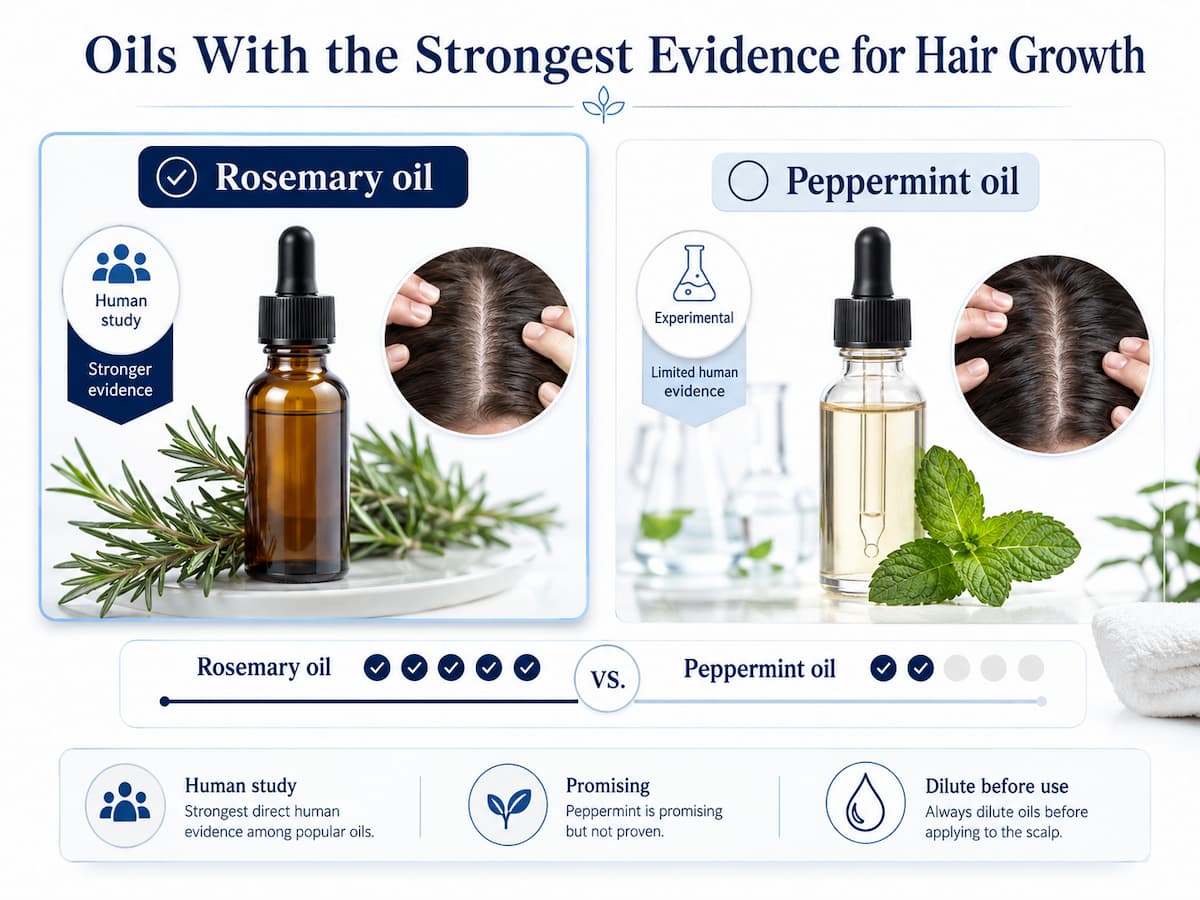
Natural oils have not been studied as extensively as established hair-loss medications. Even the most promising oils have a relatively small evidence base. Among commonly used options, rosemary oil has the strongest direct human research, while peppermint oil remains more experimental.
Rosemary oil
Rosemary oil is one of the few essential oils that has been tested directly in people with androgenetic alopecia, also known as male or female pattern hair loss.
The best-known clinical study compared rosemary oil with 2% topical minoxidil over six months. Neither group showed a significant change in hair count after three months. At six months, both groups experienced an increase in hair count, without a significant difference between the two groups.
This study is encouraging, but it should not be interpreted as proof that rosemary oil is universally equal to minoxidil. The trial was relatively small, involved 2% minoxidil, and has not been repeated in many large independent studies.
Rosemary oil also contains compounds with antioxidant, antimicrobial, and anti-inflammatory activity. These properties may help support scalp health. The oil is highly concentrated, however, so it should normally be diluted before it is applied directly to the scalp.
For people interested in a natural oil specifically because of hair-growth research, rosemary currently has a stronger case than most popular alternatives.
Peppermint oil
Peppermint oil often appears beside rosemary in hair-growth products, but the evidence is very different.
One widely discussed study found that topical peppermint oil promoted significant hair growth in mice. Researchers observed changes in follicle depth, follicle number, and other markers associated with growth.
The important detail is that this was an animal study. Results in mice do not establish that peppermint oil can treat human pattern hair loss.
Peppermint contains menthol, which creates its familiar cooling sensation and can affect blood vessels and sensory receptors in the skin. These effects have helped create theories about improved scalp circulation.
Peppermint oil may eventually prove useful, but current human evidence is too limited to rank it alongside established medical hair-loss treatments. It should be considered promising rather than proven.
Oils best for moisture and conditioning
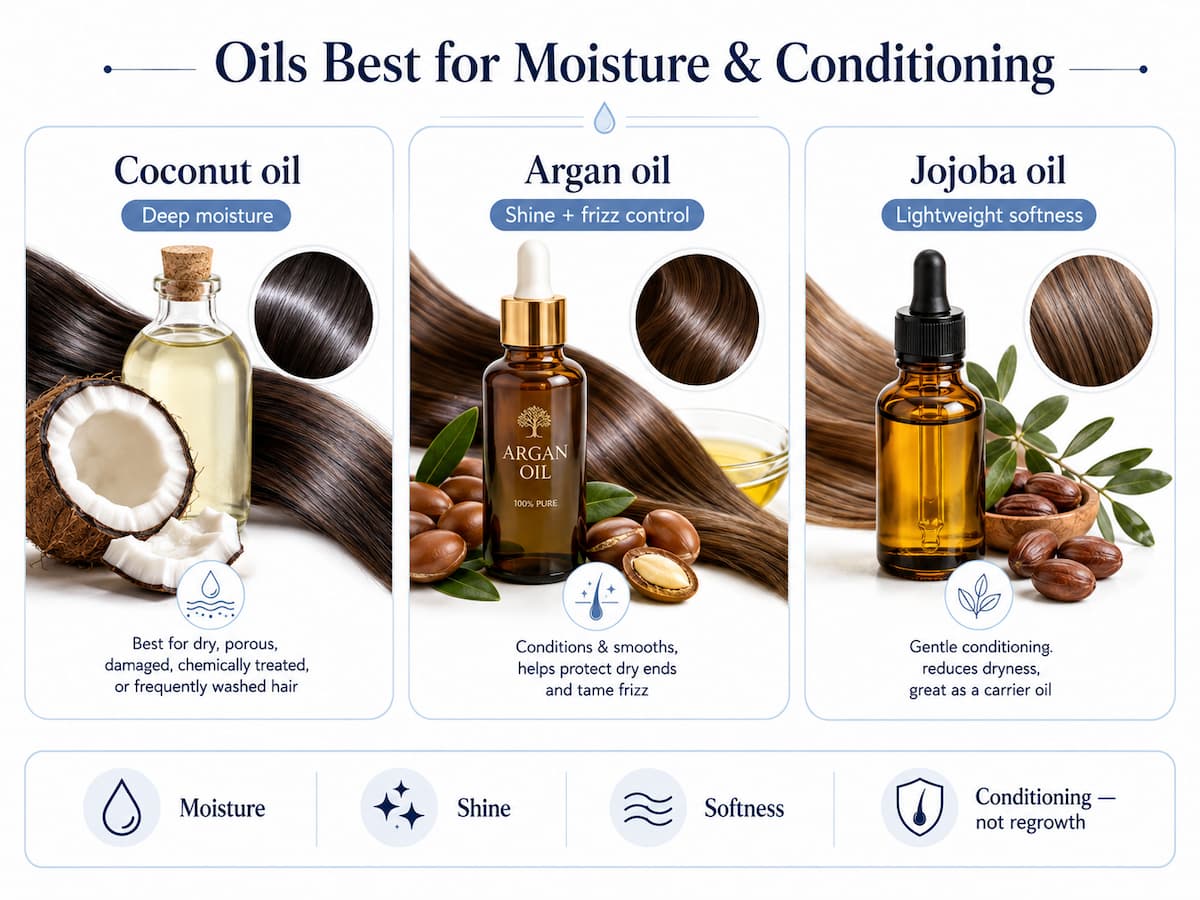
If the goal is softer hair, less breakage, improved shine, or protection from everyday damage, conditioning oils have much more to offer. Their value comes mainly from how they interact with the hair shaft rather than the follicle.
Coconut oil
Coconut oil stands out because it has been studied directly for its effect on the hair shaft. Research has found that coconut oil can reduce protein loss from both damaged and undamaged hair when used before or after washing.
Its effectiveness is linked partly to lauric acid, a fatty acid with properties that allow coconut oil to penetrate the hair shaft more effectively than many other oils.
This makes coconut oil particularly useful for dry, porous, chemically treated, or frequently washed hair. A pre-shampoo application can reduce the amount of water entering and leaving the strand during washing, which may help limit repeated swelling and structural stress.
Coconut oil is relatively heavy. Fine hair may become flat or greasy when too much is used, so a small amount is often enough.
Argan oil
Argan oil is popular for shine and frizz control. It contains fatty acids and antioxidant compounds, and research on human hair fibers suggests that using argan oil before oxidative treatments can reduce some forms of protein damage.
Its strongest role is therefore protection and conditioning rather than proven hair regrowth.
Argan oil can be particularly useful on dry ends, chemically processed hair, and strands frequently exposed to styling. Compared with heavier oils, a small amount of argan oil can provide a smoother finish without leaving some hair types as coated.
It can also improve the appearance of dull hair because smoothing the cuticle allows light to reflect more evenly.
Jojoba oil
Jojoba is technically a liquid wax rather than a conventional triglyceride oil. Its chemical structure gives it good stability and makes it popular in skin and hair products.
For hair, jojoba works best as a lightweight conditioner. It can coat the strand, reduce dryness, and improve softness without the same heavy feel associated with castor oil or large amounts of coconut oil.
Jojoba also has anti-inflammatory properties that have been studied in skin care. That does not establish it as a treatment for hair loss, but it can make it a practical carrier oil for people using diluted essential oils such as rosemary.
There is currently no convincing human evidence showing that jojoba oil alone stimulates significant new hair growth.
Oils best for scalp health
Scalp health and hair growth are connected, but treating a scalp problem is not automatically the same as stimulating follicles. Castor oil and tea tree oil are good examples because their realistic benefits are often different from the claims made online.
Castor oil
Castor oil is probably one of the most exaggerated hair oils. It is regularly promoted as a way to grow hair dramatically faster, restore thinning eyebrows, and fill bald areas.
Clinical evidence does not support those claims.
Castor oil is rich in ricinoleic acid and has a thick, highly coating texture. It can improve lubrication and shine and may help dry hair feel softer. By reducing friction and breakage, it can also help existing hair retain length.
That cosmetic effect can make hair look healthier and fuller, but it should not be confused with the creation of new follicles or treatment of androgenetic alopecia.
Its heavy consistency also means it may not suit oily or buildup-prone scalps. Using large amounts can make washing difficult and may require more aggressive cleansing afterward.
Tea tree oil
Tea tree oil is more relevant to scalp care than direct hair growth. It has antimicrobial and antifungal properties and has been studied in people with dandruff.
A clinical trial using a shampoo containing 5% tea tree oil found a meaningful improvement in dandruff severity, as well as symptoms such as itching and greasiness.
That makes tea tree oil interesting for dandruff-prone scalps, but it does not prove that tea tree oil stimulates hair follicles.
Like other essential oils, pure tea tree oil can irritate the skin. A formulated shampoo is generally more predictable than applying concentrated essential oil directly to the scalp.
Which oil is best for your hair type?
There is no single best oil for everyone. Hair diameter, curl pattern, damage level, scalp oil production, and styling habits all change how an oil behaves.
Dry or damaged hair
Coconut oil is one of the strongest choices for dry or damaged hair because of its ability to penetrate the shaft and reduce protein loss. It can work especially well as a pre-shampoo treatment on bleached, high-porosity, curly, or frequently styled hair.
Argan oil is another good choice when the goal is smoother ends and better shine without using a large amount of heavy oil.
Fine or oily hair
Fine hair can quickly lose volume when coated with thick oils. Lightweight jojoba or a very small amount of argan oil may work better than castor oil.
Apply oil mainly to the lengths and ends rather than covering the entire scalp. Fine hair often needs far less product than curly or coarse hair.
Dandruff-prone scalp
Tea tree oil has some direct clinical evidence for dandruff when used in a formulated shampoo. However, persistent seborrheic dermatitis may respond better to proven anti-dandruff ingredients such as ketoconazole or selenium sulfide.
Heavy scalp oiling can sometimes make dandruff management more difficult, particularly when it creates buildup.
Frizzy or dull hair
Argan oil is especially practical for frizz and dullness because a small amount can smooth the outer surface of the strand and improve shine.
Coconut oil may be more useful when frizz is associated with significant dryness or structural damage. Jojoba offers a lighter alternative for hair that becomes weighed down easily.
How to use hair oils safely
Hair oils can be useful when the amount, location, and type of product match the goal.
- Start with a small amount. Adding more is easier than removing excess oil from the hair.
- Apply heavier conditioning oils mainly to the lengths and ends unless scalp treatment is the goal.
- Use coconut oil before washing when the main concern is dryness, protein loss, or chemical damage.
- Wash heavy oils thoroughly enough to prevent persistent buildup.
- Stop using any product that repeatedly causes burning, redness, itching, swelling, or increased scalp irritation.
Carrier oils vs. essential oils
Coconut, jojoba, argan, and castor oils are generally used as carrier or conditioning oils. Rosemary, peppermint, and tea tree oils are essential oils and are far more concentrated.
Essential oils should not be treated like ordinary hair oils. Applying them undiluted can cause irritation or contact dermatitis.
A carrier oil can be used to dilute an essential oil before scalp application. Commercial products with known concentrations can also provide a simpler option.
Patch testing and dilution
Try a small amount of a new oil mixture on a limited area before applying it across the scalp. This is particularly important with essential oils.
Watch for redness, burning, itching, swelling, or rash. A product that causes persistent irritation should be discontinued even if it is marketed as natural.
Avoid applying concentrated essential oils to damaged, bleeding, infected, or severely inflamed scalp skin.
Common hair oil mistakes to avoid
- Assuming every oil that conditions hair also stimulates new growth.
- Applying pure rosemary, peppermint, or tea tree essential oil directly to the scalp without proper dilution.
- Using large amounts of castor or coconut oil on fine hair and then aggressively shampooing to remove it.
- Leaving heavy oils on an oily or dandruff-prone scalp despite worsening buildup or itching.
- Applying oil to dry, damaged hair and expecting it to permanently repair broken internal bonds.
- Switching oils every few weeks before giving a consistent routine time to show whether it helps.
- Treating sudden bald patches, progressive thinning, scalp pain, or scarring with oils instead of finding the medical cause.
- Believing that tingling, burning, or intense cooling means an oil is stimulating faster hair growth.
The best hair oil is ultimately the one that matches the problem being treated. Rosemary has the most notable human research among popular oils promoted for hair growth, while peppermint remains promising but largely supported by animal evidence. Coconut oil stands out for protecting the hair shaft, and argan and jojoba are useful for softness, shine, and daily conditioning. Castor oil is better for lubrication than regrowth, while tea tree oil has a more convincing role in dandruff care than in stimulating new follicles.
Hair oils can be a valuable part of a healthy routine, but realistic expectations matter. They are particularly good at protecting the hair you already have. When density is steadily decreasing or bald areas are developing, finding the cause of the hair loss matters far more than choosing another oil.
Sources
- Panahi, Y., Taghizadeh, M., Marzony, E. T., Sahebkar, A. (2015). Rosemary oil vs minoxidil 2% for the treatment of androgenetic alopecia, a randomized comparative trial. SKINmed.
- Oh, J. Y. et al. (2014). Peppermint Oil Promotes Hair Growth without Toxic Signs. Toxicological Research, 30(4), 297-304.
- Rele, A. S., Mohile, R. B. (2003). Effect of mineral oil, sunflower oil, and coconut oil on prevention of hair damage. Journal of Cosmetic Science, 54(2), 175-192.
- Satchell, A. C., Saurajen, A., Bell, C., Barnetson, R. S. (2002). Treatment of dandruff with 5% tea tree oil shampoo. Journal of the American Academy of Dermatology, 47(6), 852-855.
- Fernandes, N. C. et al. Impact of Hair Damage on the Penetration Profile of Coconut, Avocado, and Argan Oils into Caucasian Hair Fibers. Cosmetics, 11(2), 64.
