


Table of Contents
Hair loss treatment has moved well past shampoos and generic supplements, and exosome therapy is one of the clearest signs of that shift. Rather than working on the surface, it delivers a concentrated set of cellular signals directly to the scalp, aiming to wake up follicles that have gone quiet rather than simply covering up the areas where hair has thinned.
This guide covers what exosome therapy actually is, how it works at the follicle level, what the research and our own clinical experience say about it, what a session looks like, and how it fits alongside a hair transplant or other regenerative treatments at Smile Hair Clinic.
What is Exosome Therapy for Hair Loss?
Exosome therapy for hair loss is a regenerative injection treatment that delivers cell-signalling vesicles, called exosomes, directly into the scalp to stimulate weakened or dormant hair follicles.
It works at a level most other treatments never reach: the communication between cells that decides whether a follicle grows, rests, or shuts down.
Exosomes are tiny extracellular vesicles released by stem cells, far smaller than a single cell itself. Inside them is a concentrated payload of growth factors, proteins, and genetic material that cells use to communicate with one another. Applied to the scalp, this payload speaks directly to hair follicles at a cellular level, encouraging them toward a healthier growth cycle rather than a resting or shedding one.
Research backs this up. A 2025 systematic review covering eleven clinical studies found consistent gains in hair density and thickness with a solid safety record, and that lines up with what we see in our own patients. It’s still a newer field than PRP or medication, and we’re honest with patients about that: the science is strong and growing, not yet as deep a track record as a treatment that’s been around for twenty years.
That’s also why sourcing matters so much. In the United States, the FDA has flagged unregulated exosome products sold by clinics cutting corners, and we take that seriously. Every solution we use is properly sourced and purified, and every session is administered by a physician, not a technician working from a script.
“Patients often come in having read about exosome therapy online and aren’t sure how much of it is real,” says Dr. Gökay Bilgin. “What I tell them is straightforward: the biology behind it is sound, we’ve been using it for long enough to know what results to expect, and where we’re honest is in setting the right expectations for the timeline and the number of sessions it actually takes.”

How Exosome Injections Stimulate Hair Follicles?
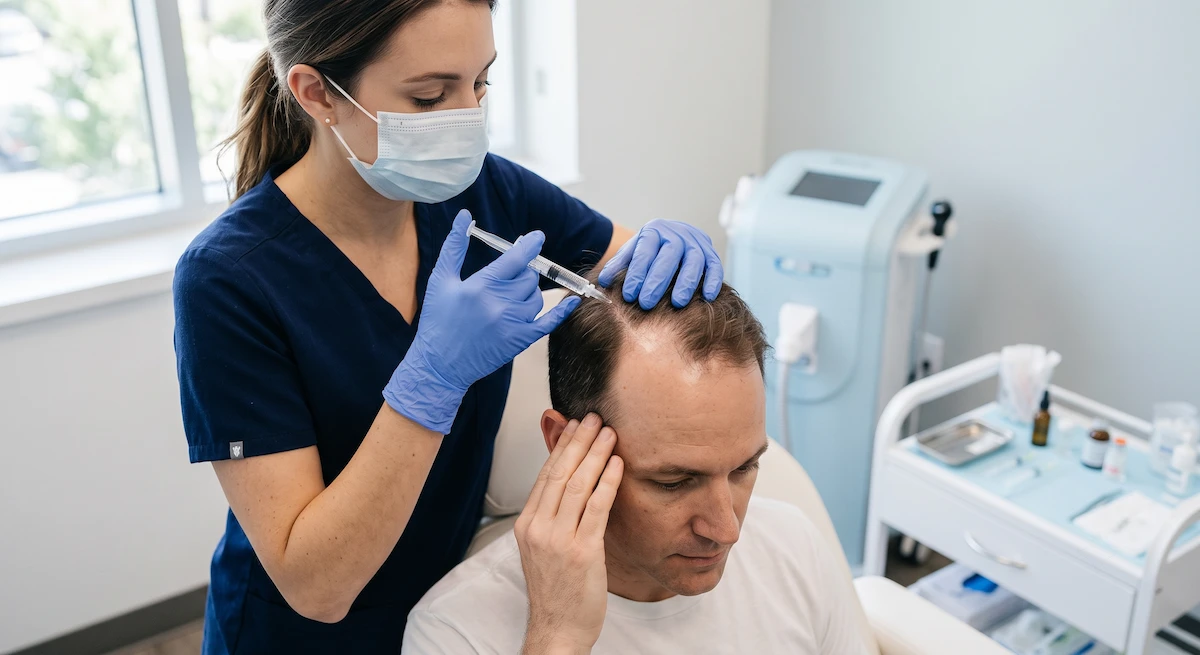
Once injected, exosomes work through three main pathways, as clinical research has outlined. They stimulate the dermal papilla cells that regulate the hair growth cycle, wake up follicle stem cells that have gone dormant, and encourage the formation of new blood vessels around the follicle so it gets better oxygen and nutrient supply. That last part matters more than people expect: a follicle can be structurally intact and still underperform simply because it isn’t getting fed properly, and this is one of the areas where we see the most consistent improvement.
In practice, this means the treatment is not simply coating the scalp with a product. A concentrated exosome serum is delivered into the scalp using fine microneedles, following the application of a numbing cream so the process stays comfortable throughout. Most sessions run between 30 and 45 minutes.
Discomfort is minimal for the majority of patients. What sensation there is usually comes down to mild tingling or pressure from the needles, and the numbing cream handles most of that before it becomes noticeable. There is no meaningful recovery period involved; patients typically return to their day immediately afterward.
Benefits of Exosome Hair Treatment
The primary appeal of exosome therapy is that it works on the underlying biology of hair growth rather than masking the symptoms of loss. Patients typically see stimulated follicle activity, encouragement of new growth, reduced shedding, and gains in both density and strand strength over the course of treatment. Scalp circulation and overall scalp health tend to improve alongside these changes, since the same regenerative signalling that benefits the follicle also supports the surrounding tissue.
The treatment suits both men and women alike, and because it is non-surgical with no meaningful downtime, it fits easily alongside other treatments or works as a standalone option for people who are not ready for, or do not need, a surgical procedure. Side effects are generally limited to mild redness or tenderness at the injection sites, which typically settles within a few hours. Because the solution used in a properly run clinical setting is highly purified, more serious adverse reactions are uncommon, though as with any injectable treatment, they are not impossible.
What to Expect During and After the Procedure
A typical course starts with a full evaluation to confirm the treatment is appropriate for your specific situation. Exosome therapy tends to suit people dealing with genetic hair loss (androgenetic alopecia), general thinning or weakened strands, hair loss linked to stress, hormonal shifts, or nutrient deficiencies, and post-transplant patients looking to get more out of their surgical result.
The treatment is not right for everyone, and it should generally be avoided by people with active scalp infections or autoimmune conditions, women who are pregnant or breastfeeding, patients currently undergoing chemotherapy or living with active cancer, and anyone with a known allergy to components of the exosome solution. Before treatment, it is important to give your doctor a complete picture of your medical history and any medications you are currently taking.
Most patients do well with two to four sessions spaced roughly a month apart, though the exact protocol gets adjusted to each patient’s hair condition and goals during consultation. It is also worth understanding how the treatment compares to other regenerative options available at the clinic. PRP therapy uses growth factors concentrated from the patient’s own blood, mesotherapy delivers a different cocktail of vitamins and actives directly into the scalp, and ozone therapy works more on scalp inflammation and circulation than on the follicle itself. Exosome therapy occupies its own place in that lineup, working through cell-to-cell signalling rather than any of those mechanisms, and for some patients a combination of these approaches produces better results than any single one alone.
Exosome Hair Treatment Before and After
Exosome therapy is used at two distinct points around a transplant, and each serves a different purpose.
Used before surgery, it strengthens follicles that are already thinning, reduces the rate of shedding, and puts the scalp in better condition ahead of the procedure. Used after surgery, typically starting around one month following a Sapphire hair transplant, DHI, or manual FUE procedure once the initial healing phase has settled, it speeds up recovery, calms post-surgical inflammation, and helps limit shock loss, the temporary shedding that can affect surrounding native hair after a procedure. It also supports the survival and growth of the newly transplanted grafts themselves, which is where much of its value after surgery comes from.
“We’ve watched the evidence around exosome therapy mature over the past few years, and we’ve been careful to only offer it once we were confident in both the science and the sourcing of the solution itself,” says Dr. Gökay Bilgin. “Where it earns its place most clearly is in the weeks after a transplant. Patients who add it to their recovery protocol tend to move through the shock loss phase more comfortably, and the grafts themselves seem to settle in with less friction.”
Why Choose Turkey for Exosome Hair Treatment?
Turkey has built its reputation in hair restoration on a combination of surgical volume and cost that few other countries can match, and the same advantages apply to regenerative treatments like exosome therapy. Istanbul in particular has developed a dense concentration of clinics and specialists, which has driven meaningful competition on quality, technology, and pricing over the past decade.
For patients travelling from the UK, the US, or Western Europe, the price difference is significant even after accounting for flights and accommodation, largely because clinical and staffing costs in Turkey remain considerably lower than in those markets without any corresponding drop in the qualifications of the physicians performing the treatment. Many clinics, including ours, also package exosome sessions alongside transplant procedures and aftercare into a single coordinated visit, which is difficult to arrange as efficiently in most other countries.
Why Choose Smile Hair Clinic for Your Exosome Hair Loss Treatment?
Smile Hair Clinic is the only hair transplant clinic in Turkey holding a TEMOS A-Rating accreditation, an international quality and patient safety standard that few clinics in the country have pursued, let alone achieved at this level. Our surgical team, led by Dr. Mehmet Erdoğan and Dr. Gökay Bilgin, has built the clinic’s regenerative treatment protocols, including exosome therapy, around the same standard of evidence and physician oversight applied to every surgical procedure we perform.
Every patient who comes in for exosome therapy at our clinic receives a full evaluation beforehand, a clear explanation of what the procedure involves, direct access to their physician rather than a technician, and personalised aftercare guidance once treatment is complete. The procedure itself is carried out by internationally certified physicians in a sterile clinical setting, using solution sourced to the standard we would want for our own patients.
Contact our team today and take the next step toward thicker, healthier hair.
Sources
- Exosomes and Hair Regeneration: A Systematic Review of Clinical Evidence Across Alopecia Types and Exosome Sources. Clinical, Cosmetic and Investigational Dermatology. 2025;18:2215–2227. Dove Medical Press
- Gupta AK, Wang T, Rapaport JA. Systematic review of exosome treatment in hair restoration: Preliminary evidence, safety, and future directions. Journal of Cosmetic Dermatology. 2023;22(9):2424–2433. PubMed
- Paiewonsky B, Heinen N, Bellefeuille G, et al. Exosome therapy for scalp hair growth, a review of the in vivo and in vitro evidence. Journal of the American Academy of Dermatology. 2022;87(3):e123–e130. JAAD
- U.S. Food and Drug Administration. Public Safety Notification on Exosome Products. FDA.gov
This guide was prepared and reviewed by Dr. Mehmet Erdoğan, M.D. and Dr. Gökay Bilgin, M.D., hair transplant surgeons at Smile Hair Clinic, Istanbul.