


Table of Contents
Birth control can affect much more than the menstrual cycle. Hormonal contraception changes estrogen and progestin exposure, and those shifts can sometimes influence the hair growth cycle. Some people notice increased shedding after starting birth control, switching methods, or stopping hormonal contraception. Others find that certain birth control pills actually improve hormone-related hair problems.
So, can birth control cause hair loss? It can be associated with hair shedding in some people, but it is rarely the only possible explanation. Genetics, iron deficiency, thyroid disease, PCOS, stress, rapid weight loss, illness, and other medications can cause similar changes.
The type of contraception matters too. Combination pills, progestin-only pills, hormonal IUDs, implants, and injections expose the body to different hormones and doses. Understanding those differences can help explain why one method may affect hair differently from another.
Can birth control really cause hair loss?
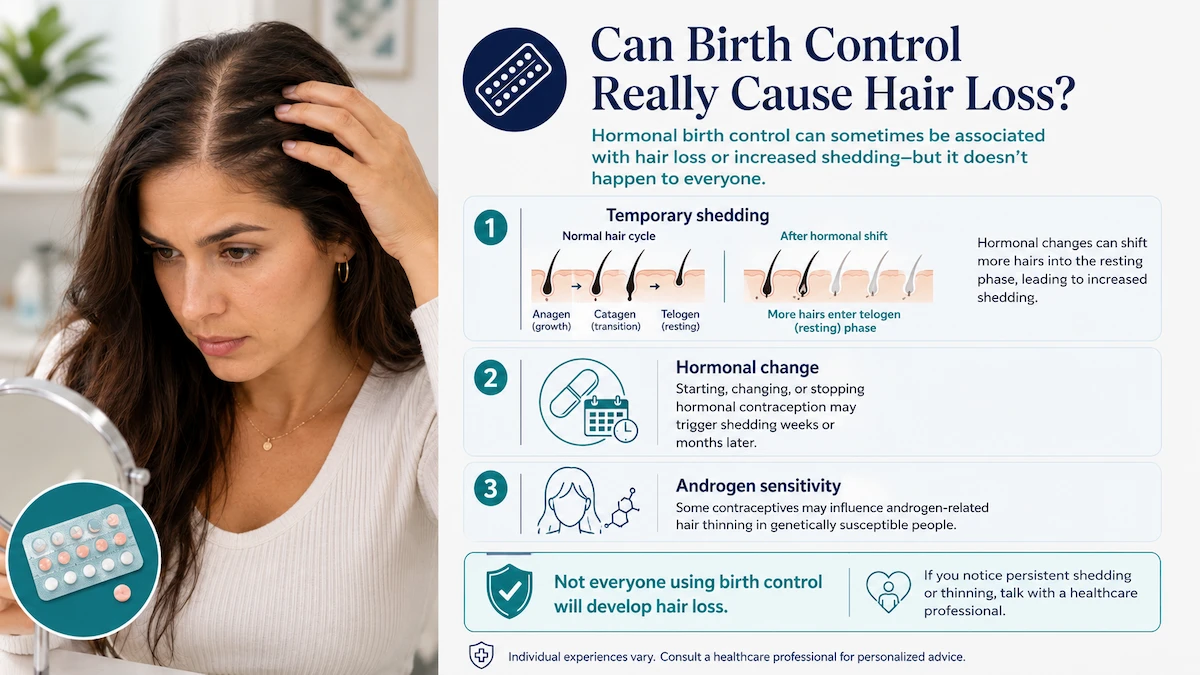
Yes, hormonal birth control can sometimes be associated with hair loss or increased shedding. The effect is not universal, and most people using contraception will not experience noticeable thinning.
One possible response is telogen effluvium. A major hormonal shift can cause more follicles than usual to enter the resting phase. Hair then begins shedding several weeks or months later. Starting, changing, or stopping hormonal contraception can potentially create this type of temporary disturbance.
Birth control may also influence androgen-related hair loss in someone who is genetically susceptible. This depends partly on the hormonal activity of the specific contraceptive and the person’s sensitivity to androgens.
How birth control affects your hormones?
Hormonal contraceptives work by changing normal reproductive hormone patterns. Combination birth control pills contain an estrogen together with a progestin, while progestin-only methods contain no estrogen.
Combination pills usually suppress ovulation by reducing the hormonal signals that stimulate the ovaries. The estrogen component can also increase sex hormone-binding globulin, or SHBG, a protein that binds circulating testosterone and reduces the amount of free testosterone available to act on tissues (Williams et al., American Journal of Clinical Dermatology, 2021).
This is one reason combination contraceptives are sometimes used when androgen-related symptoms such as acne or hirsutism occur.
Progestins are synthetic hormones designed to produce progesterone-like effects. However, individual progestins have different chemical structures and can have different degrees of androgenic or anti-androgenic activity.
These differences help explain why switching from one contraceptive to another can sometimes change the way the skin, scalp, or hair responds.
Androgen index explained
The androgen index is a way of describing the relative androgen-like activity of different progestins. Some progestins have greater androgenic activity, while others have low androgenic activity or anti-androgenic properties.
Levonorgestrel and some older progestins have androgenic activity. Drospirenone, by contrast, has anti-androgenic properties. Other commonly used progestins fall between these examples.
This does not mean that a pill containing a more androgenic progestin will automatically cause hair loss. The androgen index is only one pharmacological factor and is not a reliable stand-alone predictor of who will lose hair.
Estrogen in combination pills also changes the overall hormonal effect by increasing SHBG and reducing free androgen levels.
Progestin-only vs. combination pills
Progestin-only pills do not contain estrogen. Because they lack the estrogen-related increase in SHBG seen with combination pills, their overall androgen effect may differ.
That does not mean progestin-only contraception inevitably causes thinning. Many people use these methods without any hair-related problem.
Combination pills may be more useful when androgen-related symptoms are already present because estrogen lowers free testosterone. However, combination contraceptives are not suitable for everyone. Medical factors such as smoking, migraine with aura, cardiovascular risk, blood clot history, and age influence whether estrogen-containing contraception is safe.
Contraception should therefore never be selected solely according to its expected effect on hair.
Two types of hair loss linked to birth control
Hormonal contraception can potentially be associated with more than one pattern of diffuse thinning. The two most relevant are telogen effluvium and androgenetic hair loss.
Telogen effluvium
Telogen effluvium causes diffuse shedding across the scalp. Rather than creating one bald patch, it makes the entire head feel less dense.
Hormonal changes can push an unusually large number of follicles from active growth into a resting phase. Because hairs remain attached for a while before shedding, the increased hair fall often appears two or three months after the original trigger.
This timing is important. Someone who stops birth control in January may not notice increased shedding until March or April.
When the hormonal change is the main trigger, the follicles usually remain healthy. Shedding often improves once the hair cycle stabilizes, although visible density takes longer to recover.
Androgenetic (female pattern) hair loss
Female pattern hair loss is different from telogen effluvium. Genetically sensitive follicles gradually become smaller and produce finer, shorter hairs.
Hormonal contraception does not create genetic susceptibility, but changes in androgen activity may reveal or worsen thinning in someone whose follicles are already sensitive.
Women with female pattern hair loss commonly notice a widening central part and reduced density over the top of the scalp rather than sudden heavy shedding alone.
Telogen effluvium and female pattern hair loss can also occur together. A temporary hormonal shed may make previously subtle pattern thinning much easier to notice.
Hair loss when starting birth control
The body needs time to adapt when a hormonal contraceptive is introduced. A sudden change in estrogen or progestin exposure can sometimes disturb the hair cycle and produce temporary shedding later.
This does not necessarily mean the contraceptive is permanently damaging follicles. Telogen effluvium usually reflects a change in follicle timing rather than follicle destruction.
It is also worth considering what happened before birth control was started. Someone beginning contraception because of PCOS, irregular periods, or hormonal symptoms may already have an underlying condition capable of causing hair thinning.
Hair loss after stopping birth control
Stopping hormonal birth control creates another hormonal transition. Estrogen and progestin levels supplied by the contraceptive fall, and normal ovarian hormone production begins taking over again.
This shift can trigger telogen effluvium in some people. Similar shedding can happen after other major hormonal events, including childbirth.
Post-birth-control shedding is usually diffuse. More hair may appear in the shower, brush, and on clothing several months after contraception is stopped.
When it is true telogen effluvium, shedding usually settles gradually. If density keeps declining or the central part continues widening, another condition such as female pattern hair loss should be considered.
Other hormonal birth control methods and hair loss

Birth control pills are not the only methods that can affect hormone exposure. Long-acting contraceptives also use progestins, although they deliver them differently, and adverse-event data across these delivery methods differ in both frequency and quality of reporting (Williams et al., American Journal of Clinical Dermatology, 2021).
IUDs
Hormonal IUDs commonly use levonorgestrel, a progestin released mainly within the uterus. Systemic hormone exposure is lower than with many oral contraceptives, but some hormone still reaches the bloodstream.
Alopecia has been reported among users of certain levonorgestrel IUDs, although it affects only a minority of users and hair loss can have many competing causes.
A copper IUD contains no hormones, so it does not directly produce the same hormonal shift. However, copper IUDs can increase menstrual bleeding in some people. Significant blood loss can contribute to iron deficiency, which itself may be associated with diffuse hair shedding.
Implants
The contraceptive implant contains etonogestrel, a progestin that is continuously released into the bloodstream. Hair loss has been reported after use, although it is not among the most common adverse effects.
If shedding begins after an implant is inserted, timing alone does not prove that the implant caused it. Iron deficiency, thyroid disease, PCOS, stress, genetic thinning, and recent illness should still be considered.
Injections (Depo-Provera)
Depo-Provera contains medroxyprogesterone acetate and is given at regular intervals for contraception.
Hair loss or lack of hair growth has been reported in clinical trials of Depo-Provera. It remains an uncommon effect compared with changes in menstrual bleeding, weight, and other more frequently reported effects.
Unlike a daily pill, an injection cannot simply be stopped the next day. The medication remains active for an extended period, so suspected side effects should be discussed before the next scheduled dose.
How to tell if birth control is causing your hair loss?
Look at timing. Shedding beginning a few months after starting, stopping, or changing contraception can suggest telogen effluvium. Check whether thinning is diffuse or concentrated mainly along the central part and crown. Review other recent triggers such as illness, surgery, major stress, rapid weight loss, childbirth, or medication changes. Consider symptoms of iron deficiency, thyroid disease, or PCOS. Compare current photographs with images taken before the contraceptive change. Do not stop contraception abruptly without discussing another reliable method if pregnancy prevention is still needed. Seek assessment if hair loss continues or density keeps falling.
How is birth control-related hair loss diagnosed?
There is no blood test that can prove birth control is responsible for hair loss. Diagnosis depends on the timeline, pattern, medical history, scalp examination, and exclusion of other common causes.
A dermatologist may examine the scalp for diffuse shedding, follicle miniaturization, broken hairs, inflammation, or scarring. Trichoscopy can help distinguish telogen effluvium from female pattern hair loss.
Blood tests may be considered when iron deficiency, thyroid disease, nutritional problems, or hormonal disorders are possible. Ferritin, blood count, thyroid testing, or other laboratory tests may be selected according to symptoms and medical history.
Treatment options
Treatment begins by deciding whether the contraceptive is genuinely contributing to the problem and what type of hair loss is present.
Switching to a low-androgen birth control
When androgen sensitivity appears relevant, a different contraceptive may be considered. A combination pill containing a low-androgenic or anti-androgenic progestin may be more suitable in some cases.
Switching is not appropriate for everyone. The risk of blood clots and other medical factors must be considered before selecting an estrogen-containing pill.
The goal is to choose contraception that remains safe and effective while also considering its possible effect on androgen-related symptoms.
Minoxidil
Topical minoxidil is an established treatment for female pattern hair loss, with Cochrane-reviewed trial data showing a meaningful increase in hair count compared with placebo (van Zuuren et al., Cochrane Database of Systematic Reviews, 2012). It can help support follicles and improve density when progressive miniaturization is occurring.
It is not automatically needed for every temporary episode of telogen effluvium. If the hormonal trigger settles and follicles remain healthy, spontaneous recovery may occur.
Minoxidil usually needs several months before visible improvement becomes clear, and continued use is generally needed when treating female pattern hair loss.
Anti-androgen medication (spironolactone)
Spironolactone is commonly prescribed off-label for female pattern hair loss and other androgen-related symptoms. It reduces androgen effects on target tissues and, across pooled trial data, has been associated with improvement in a majority of patients treated, whether alone or combined with other therapies (Aleissa, Cureus, 2023).
It requires medical supervision because it can affect blood pressure and potassium levels and is not appropriate in pregnancy. Reliable contraception may therefore be important when spironolactone is prescribed to someone who could become pregnant.
Supporting hair health nutritionally
Hair follicles require adequate calories, protein, iron, zinc, and other nutrients. Restrictive dieting during the same period as a contraceptive change can make it difficult to identify the true cause of shedding.
Supplements should target a confirmed need rather than being used automatically. Iron supplements, for example, are most appropriate when testing shows that iron stores are low.
A balanced diet, adequate protein, gentle hair care, and avoiding severe calorie restriction can support recovery while the hair cycle stabilizes.
Is birth control hair loss permanent?
Birth control-related telogen effluvium is usually not permanent. The follicles are generally still present, and hair can return as the growth cycle normalizes.
Shedding may continue for several months before it noticeably slows. Regrowth then requires additional time because new strands begin very short and grow gradually.
The outlook is different when a hormonal change reveals female pattern hair loss. In that situation, genetic follicle miniaturization can continue and may require longer-term treatment.
Permanent loss is not expected from uncomplicated telogen effluvium. Scarring, smooth areas without follicle openings, pain, or inflammation suggest another condition that deserves medical evaluation.
When to see a doctor
Seek medical assessment when hair loss continues for several months, becomes progressively worse, or causes a clear reduction in scalp density. A widening central part, receding hairline, or persistent thinning after the initial shedding period also deserves evaluation.
Sudden bald patches, eyebrow or eyelash loss, scalp pain, burning, severe itching, redness, scaling, or scarring are not typical signs of simple birth control-related telogen effluvium.
Hair loss accompanied by fatigue, heavy bleeding, major weight changes, irregular periods, or other new symptoms may point toward iron deficiency, thyroid disease, PCOS, or another medical issue.
Birth control can play a role in hair shedding, but it should not be blamed automatically. The timing of the hormonal change, type of contraception, pattern of thinning, and other health factors all need to be considered. Once the cause is clear, treatment can focus on restoring normal growth while maintaining a contraceptive method that is safe and appropriate.
Sources
- Williams NM, Randolph M, Rajabi-Estarabadi A, Keri J, Tosti A. “Hormonal Contraceptives and Dermatology.” American Journal of Clinical Dermatology, 2021. PubMed
- van Zuuren EJ, Fedorowicz Z, Carter B, Andriolo RB, Schoones J. “Interventions for female pattern hair loss.” Cochrane Database of Systematic Reviews, 2012. PubMed
- Aleissa M. “The Efficacy and Safety of Oral Spironolactone in the Treatment of Female Pattern Hair Loss, A Systematic Review and Meta-Analysis.” Cureus, 2023. ncbi.nlm.nih.gov
