

Table of Contents
Finding far more hair than usual in the shower, on a pillow, or caught in a brush can be alarming. When the shedding seems to begin everywhere at once, many people immediately worry about permanent hair loss. In some cases, however, the follicles are still healthy and capable of producing new hair. The problem is that too many hairs have entered the resting stage of the growth cycle at roughly the same time.
This condition is known as telogen effluvium. It is a common form of diffuse, non-scarring hair shedding that can follow illness, major stress, childbirth, dietary changes, certain medications, or other physical changes. The shedding often starts weeks or months after the original trigger, which can make the cause difficult to recognize at first.
What is Telogen Effluvium?
Telogen effluvium is a type of temporary hair shedding caused by a disruption in the normal hair growth cycle. Instead of remaining in the active growth phase, a larger number of follicles move into the telogen, or resting, phase. Several months later, these resting hairs are released from the scalp and noticeable shedding begins.
Unlike forms of hair loss that permanently damage follicles, telogen effluvium is a non-scarring alopecia. The follicles remain present and are usually able to return to active growth. For many people, this means hair density gradually improves once the trigger has passed or the underlying problem has been corrected.
The hair growth cycle explained
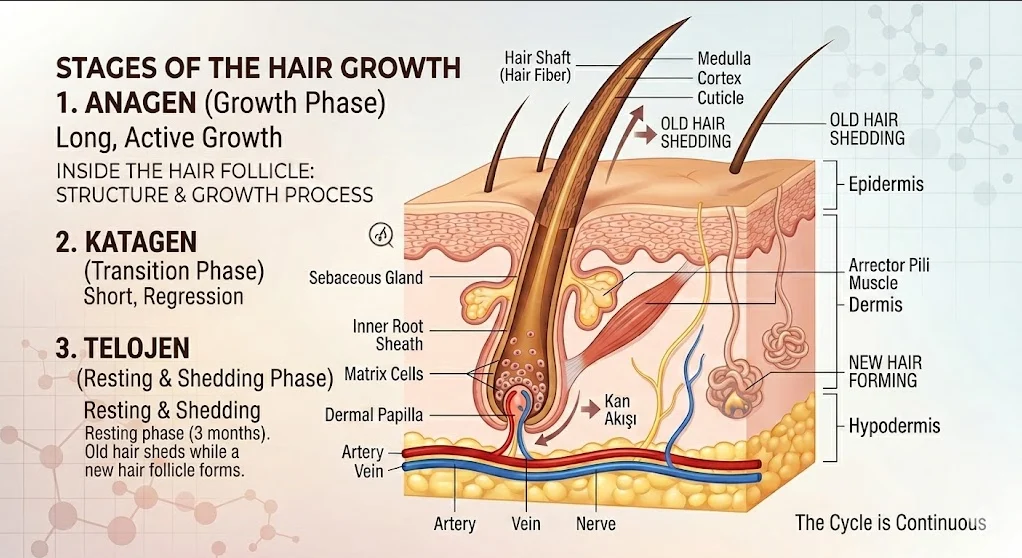
Scalp hair does not grow continuously. Every follicle follows its own cycle of growth, transition, rest, and shedding. In a healthy scalp, most follicles are actively growing while a smaller proportion are resting. Around 85% of scalp hairs are normally in the anagen phase, while approximately 15% are in telogen.
Understanding this cycle makes telogen effluvium much easier to understand.
Anagen (growth) phase
Anagen is the active growth stage. During this period, cells within the follicle divide and produce the hair shaft. Scalp follicles can remain in anagen for several years, which is why scalp hair can grow much longer than eyebrow or body hair.
At any given time, the large majority of healthy scalp follicles should be in this phase. When telogen effluvium occurs, more follicles than usual leave anagen and begin moving toward the resting stage.
Catagen (transition) phase
Catagen is a short transition between active growth and rest. Hair growth stops, and the lower portion of the follicle begins to change as it prepares for telogen.
Only a small percentage of scalp hairs are normally in catagen at one time. This stage is brief compared with anagen and telogen, but it forms an important bridge between active hair production and the resting period.
Telogen (resting) phase
During telogen, the follicle is resting and the existing hair remains in place for a period before it is shed. A new anagen hair can then begin growing beneath it.
Some daily shedding is therefore completely normal. Telogen effluvium becomes noticeable when far more follicles enter this resting stage together, causing a larger wave of hairs to be released several months later.
How telogen effluvium disrupts the hair cycle?
The unusual part of telogen effluvium is the timing. A triggering event may happen today, yet the person may not notice significant shedding until two to four months later. This delay occurs because hairs that leave anagen do not fall out immediately. They first pass through the cycle and remain in telogen before eventually being released.
This explains why someone may appear completely recovered from surgery, fever, a stressful event, or another illness when the shedding suddenly begins. Looking back over the previous few months is therefore an important part of assessing telogen phase hair loss.
Acute vs. chronic telogen effluvium
Acute telogen effluvium develops suddenly and generally lasts less than six months. A trigger such as childbirth, illness, surgery, major weight loss, or intense stress may be identifiable. Once the trigger ends, shedding usually slows and the normal hair cycle gradually resumes.
When increased shedding continues for more than six months, it is usually described as chronic telogen effluvium. Chronic cases can fluctuate for a longer period, and sometimes no single cause is found. They are reported more often in otherwise healthy adult women.
What causes telogen effluvium?
Telogen effluvium does not have one single cause. It is better understood as the hair follicle’s response to a significant internal or external change.
Sometimes the trigger is obvious. In other cases, several smaller factors may occur together. A medical history often focuses on events that happened two to four months before the shedding became noticeable.
Physical and emotional stress
Major surgery, high fever, injury, rapid weight loss, severe illness, and other forms of physical stress can shift more follicles into telogen. Psychological stress may also contribute, especially when it is severe or prolonged.
The connection is not always immediate. A difficult period may have ended before the first obvious signs of excessive shedding appear.
Childbirth and hormonal changes
Postpartum hair shedding is a classic example of telogen effluvium. During pregnancy, hormonal changes can keep more hairs in the growth stage. After delivery, falling estrogen levels allow many of these hairs to move through the cycle and shed within the following months.
The shedding can look dramatic, particularly around the temples and front of the scalp, but postpartum telogen effluvium is generally temporary. Hair fullness often improves as the growth cycle normalizes.
Nutritional deficiencies
Hair follicles are metabolically active structures, so inadequate nutrition can affect their normal cycle. Iron deficiency is one of the factors that may be investigated when unexplained diffuse shedding occurs. Significant calorie restriction, rapid weight loss, or an unbalanced diet may also contribute.
This does not mean every person with telogen effluvium needs multiple supplements. Nutritional treatment is most useful when an actual deficiency or dietary problem has been identified.
Medications
Certain medications can trigger telogen effluvium in some people. Shedding may begin several months after starting a drug or changing its dosage, which can make the association easy to miss.
Medication-related hair shedding should be reviewed medically. A prescribed treatment should not be stopped simply because hair shedding develops.
Illness and underlying conditions
Acute illnesses, especially those involving fever, can trigger telogen effluvium. Thyroid disease, iron deficiency, chronic metabolic illness, and some scalp conditions may also be associated with ongoing shedding.
When no recent trigger is obvious, investigating these possible causes becomes more important.
Who is affected by telogen effluvium?
Telogen effluvium can affect people of any age, sex, or racial background. Acute cases may occur after many different types of physical or emotional stress.
Women may encounter telogen effluvium more often because pregnancy and postpartum hormonal changes can act as triggers. Chronic telogen effluvium without a clear trigger is also seen more often in adult women, particularly between approximately 30 and 60 years of age.
Symptoms of telogen effluvium
The main symptom is increased diffuse hair shedding. People may notice more hair coming out while shampooing, brushing, drying, or simply running their fingers through their hair.
Overall density can decrease, yet the scalp usually appears healthy. There is generally no scarring. In active cases, short new hairs may also become visible as follicles begin returning to the growth phase.
What does telogen effluvium look like?
Telogen effluvium usually causes thinning across much of the scalp rather than creating one sharply defined bald area. The reduction in density may be most noticeable when the hair is wet, under bright lighting, or when the hair is tied back.
It does not usually cause complete baldness. New hairs may appear along the frontal hairline as recovery begins. In some people, telogen effluvium can also make previously mild genetic pattern hair loss more noticeable.
Telogen effluvium vs. androgenetic alopecia, what’s the difference?
The main difference lies in what happens to the follicles. Telogen effluvium causes increased shedding after a change in the hair cycle, while androgenetic alopecia gradually miniaturizes genetically sensitive hair follicles.
Telogen effluvium usually produces diffuse shedding and may recover after the trigger resolves. Androgenetic alopecia tends to follow a recognizable pattern, such as temple and crown thinning in men or widening of the central part in women. Both conditions can also occur at the same time, which may make diagnosis less straightforward.
How is telogen effluvium diagnosed?
Diagnosis usually begins with a detailed medical history and scalp examination. The timing of the shedding is particularly important because the trigger may have happened several months earlier.
A clinician may also examine the scalp with magnification and look for other forms of hair loss. Further testing is chosen according to the person’s symptoms, medical history, diet, and pattern of shedding.
The hair pull test
The hair pull test is a simple way to check whether active shedding is occurring. A small group of hairs is gently grasped and pulled. If an unusually high number are released, the test is considered positive.
The shed hairs can then be examined to determine whether they have the typical appearance of telogen hairs.
Blood tests
Blood testing is not identical for every patient. Tests may be considered when iron deficiency, thyroid disease, or another nutritional or medical problem is suspected.
Common investigations can include a complete blood count, ferritin and iron studies, thyroid tests, and selected nutrient levels based on the clinical picture.
Scalp biopsy
A scalp biopsy is rarely needed in a straightforward case. It may be considered when the diagnosis remains uncertain or another type of alopecia needs to be excluded.
In telogen effluvium, biopsy findings typically show an increased proportion of follicles in the telogen phase without the scarring expected in cicatricial alopecia.
Serial hair collection
Another method involves collecting shed hairs over several separate periods. One approach asks the patient to collect hair lost during a 24-hour period and repeat the process weekly.
Serial collections can help document excessive shedding and may show whether hair loss is beginning to decrease over time.
How long does telogen effluvium last?
Acute telogen effluvium usually improves after its trigger has resolved. Increased shedding commonly lasts for several months, while visible recovery takes longer because new hair grows gradually.
Many people notice shedding returning toward normal within three to six months. Restoring visible density may take six to nine months or longer, depending on hair length, the severity of the episode, and whether the original trigger is still active.
How is telogen effluvium treated?
Treatment begins with finding out why the hair cycle changed. In many acute cases, the trigger has already passed by the time shedding becomes noticeable.
Because the follicles are not permanently destroyed, specific hair-growth treatment is not always necessary. The priority is correcting any ongoing trigger and allowing enough time for the follicles to return to anagen.
Addressing the underlying cause
If iron deficiency, thyroid disease, nutritional restriction, or another medical problem is contributing to shedding, addressing that issue is central to treatment. Medication-related cases may also require medical review.
Removing or correcting the trigger does not stop shedding overnight. Hairs that have already entered telogen still need time to complete that stage of the cycle.
Minoxidil
Minoxidil is sometimes discussed when telogen effluvium is prolonged or when another form of hair loss is present at the same time. However, topical minoxidil has not been conclusively proven to speed recovery from uncomplicated acute telogen effluvium.
Whether minoxidil is appropriate depends on the diagnosis and the wider pattern of hair loss rather than the amount of shedding alone.
Nutritional supplements
Supplements should target a confirmed or strongly suspected deficiency rather than being used automatically. Iron, vitamin B12, folate, zinc, or other nutrients may be relevant when laboratory testing or dietary history indicates a problem.
Taking excessive amounts of vitamins or minerals is not a shortcut to faster hair growth. Some nutrients can cause problems when taken unnecessarily or at high doses.
Disguising visible thinning
While density is recovering, simple styling changes can make diffuse thinning less noticeable. Changing the part, choosing a shorter or more layered haircut, or using cosmetic hair fibers can temporarily reduce scalp visibility.
Hair should still be treated gently. Excessive pulling, harsh brushing, tight hairstyles, and unnecessary heat can make already-thinning hair harder to manage, even though normal washing does not cause telogen effluvium.
Can telogen effluvium be prevented?
Not every episode can be prevented. Childbirth, surgery, infections, and unexpected illnesses are not always avoidable. However, some triggers can be reduced by avoiding crash diets, maintaining adequate nutrition, managing known deficiencies, and seeking treatment for ongoing medical conditions.
Recognizing repeated episodes can also be useful. When telogen effluvium keeps returning, looking for a persistent trigger may be more helpful than repeatedly treating the hair itself.
Self-care tips for telogen effluvium
Recovery from telogen effluvium hair loss often requires patience more than aggressive treatment. Continue normal gentle washing, avoid hairstyles that place constant tension on the roots, eat a balanced diet with enough protein, and avoid beginning multiple hair supplements without knowing whether a deficiency exists.
It can also help to monitor progress with photographs taken under similar lighting instead of counting every shed hair. Hair grows slowly, so recovery may already be happening before the change becomes obvious in the mirror.
Persistent shedding beyond six months, sudden bald patches, scalp pain, redness, scaling, or progressive patterned thinning should be medically assessed. Telogen effluvium often recovers well, but confirming the diagnosis is important because not every form of hair loss follows the same course or requires the same treatment.
References
- Malkud S. Telogen Effluvium: A Review. Journal of Clinical and Diagnostic Research. 2015;9(9):WE01-3. PubMed
- Telogen Effluvium. StatPearls, NCBI Bookshelf, National Library of Medicine. NCBI Bookshelf
- Asghar F, Shamim N, Farooque U, Sheikh H, Aqeel R. Telogen Effluvium: A Review of the Literature. Cureus. 2020;12(5):e8320. PMC
