

Table of Contents
Thicker-looking hair can mean different things. Some people have fine strands but high density. Others have coarse strands but fewer hairs on the scalp. Hair may also look thinner because of shedding, breakage, genetics, aging, nutrition, scalp disease, or follicle miniaturization.
The right approach depends on the cause. Styling can create instant fullness, while treatments such as minoxidil, finasteride, PRP, and hair transplantation target specific types of hair loss.
What does “thick hair” actually mean?
“Thick hair” may describe the diameter of each hair shaft or the overall fullness of the scalp. Someone can have coarse strands but visible scalp because density is low. Another person may have fine strands yet look as though they have a lot of hair because many follicles are actively producing hair.
This matters when choosing a solution. Volumizing products can make fine strands look fuller, but they cannot reverse follicle miniaturization. Medical treatment may improve density over time, but it does not instantly change natural strand diameter.
Thick hair vs. hair density, what’s the difference?
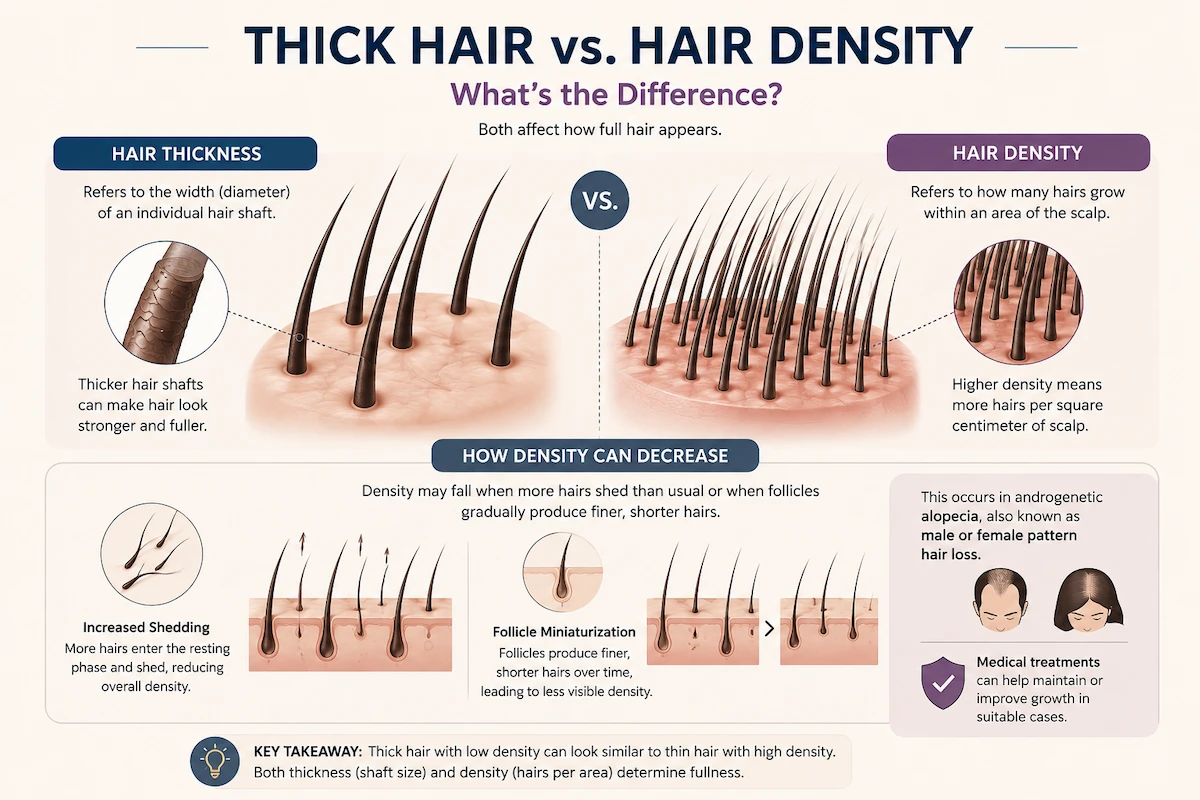
Hair thickness refers to the width of an individual shaft. Hair density refers to how many hairs grow within an area of the scalp. Both affect how full hair appears.
Density may fall when more hairs shed than usual or when follicles gradually produce finer, shorter hairs. This occurs in androgenetic alopecia, also called male or female pattern hair loss. Medical treatments can help maintain or improve growth in suitable cases.
Why does hair get thinner?
Hair can become thinner for several reasons, and factors may overlap.
- Genetics and aging can gradually shrink susceptible follicles, producing finer hairs.
- Hormonal changes, including thyroid disease and changes after pregnancy or menopause, may affect shedding.
- Deficiency of iron, zinc, protein, or certain other nutrients can contribute to hair loss.
- Major illness, surgery, rapid weight loss, or severe stress can trigger temporary shedding.
- Bleaching, high heat, tight hairstyles, and rough handling can cause breakage or traction-related loss.
- Scalp disease, some medications, and medical treatments can also affect density.
Similar-looking thinning can have different causes, so persistent hair loss deserves proper assessment.
Diet and nutrition for thicker hair
Hair follicles need energy, protein, vitamins, and minerals. A balanced diet cannot override genetic hair loss, but nutritional gaps can make shedding worse. Low levels of iron, zinc, protein, and some other nutrients have been linked with noticeable hair loss.
Zinc and iron
Iron and zinc are often discussed in connection with thinning hair because deficiencies can contribute to hair loss. The American Academy of Dermatology recommends supplementing iron or zinc when testing confirms a deficiency rather than taking high doses routinely. Excess intake can also be harmful.
Food sources include meat, legumes, leafy greens, fortified grains, dairy, nuts, seeds, and shellfish. People at risk of deficiency may need medical assessment rather than starting supplements without testing.
Vitamins that support hair growth
Normal levels of several vitamins support healthy body function and the hair cycle. Biotin is heavily marketed for stronger and thicker hair, but taking more does not automatically improve hair growth when no deficiency exists.
A varied diet with protein, vegetables, fruit, whole grains, and healthy fats is generally more useful than relying on one so-called hair vitamin. Nutritional treatment is most useful when it corrects a real deficiency.
Should you take supplements?
Supplements make the most sense when a deficiency has been identified through medical history, diet review, or blood testing. The AAD cautions that unnecessary high-dose supplements can cause harm and, in some cases, worsen hair loss.
If thinning is unexplained, investigate the cause first. Nutrient deficiency and hereditary hair loss require different approaches.
Scalp care habits that support thicker hair
A healthy scalp supports normal growth. Aggressive scrubs or daily “detox” products are not necessary. The aim is to control oil, product buildup, dandruff, and inflammation without repeatedly irritating the scalp.
How often should you wash your hair?
There is no universal washing schedule. Fine, straight hair and oily scalps may need more frequent washing, while thick, curly, or coily hair often needs less. Dermatology guidance recommends adjusting frequency to hair type, oil production, buildup, and scalp condition.
Dry shampoo can help between washes, but it should not replace regular cleansing with shampoo and water. Relying on dry shampoo for too long can leave oil and product residue on the scalp.
Scalp massage, does it work?
Evidence for major regrowth is limited. A small study of nine men found increased hair thickness after standardized daily scalp massage, but it did not establish massage as a proven treatment for hair loss.
Massage can still be gentle scalp care. Use fingertips rather than nails and avoid irritating pressure, especially when the scalp is already sensitive.
Treating dandruff and scalp buildup
Dandruff can cause itching and flaking. Medicated shampoos can help, but the correct product and schedule depend on hair type and scalp condition.
Persistent redness, thick scale, sores, or hair loss with inflammation should be examined rather than treated repeatedly with stronger shampoos.
Gentle hair care habits that prevent breakage
Hair may grow normally but break along the shaft. Reducing damage can improve visible fullness and make the ends appear denser.
Avoid harsh treatments and heat styling
Bleach, relaxers, perms, hot irons, and frequent blow-drying can weaken hair. Dermatologists recommend lower heat, less frequent hot-tool use, regular conditioner, and gentler handling to reduce damage and breakage.
When hair is already chemically processed, reducing the number of additional treatments often matters more than adding another repair product.
Protect your hair from sun and chlorine
Pool chemicals can leave hair dry and brittle. Wearing a swim cap, rinsing hair after swimming, and conditioning can help limit damage. Dermatology guidance also recommends protecting exposed or thinning areas of the scalp from strong sun.
Quit smoking
Smoking has been associated with androgenetic alopecia in research, although it is not the only cause of hair thinning. Reviews have explored several possible links, including oxidative stress and effects on follicles and circulation.
Quitting will not suddenly restore lost density, but it removes one avoidable factor while supporting general health.
Styling tricks that make hair look thicker instantly
Styling can create a fuller look immediately without changing follicle biology. These methods are especially useful when the goal is to reduce visible scalp or add body to fine hair.
Choose the right haircut
Blunt ends, shorter layers, and cuts that keep weight near the perimeter can make sparse ends look denser. Very long hair can sometimes emphasize low density because the lengths fall flatter and the ends appear thinner.
Use matte and lightweight products
Heavy oils, waxes, and glossy creams can separate fine strands and expose more scalp. Lightweight formulas help preserve movement and root lift, while matte finishes can create the impression of extra texture.
Style with your fingers
Using the fingers to lift roots and separate sections can keep fine hair from looking flat. Over-brushing can remove volume and make individual sections sit closer together.
Try mousse, dry shampoo, and texture spray
Mousse can add temporary body, while texture sprays increase grip. Dry shampoo can absorb oil and create lift, but regular shampooing with water remains important for scalp hygiene.
Use hair-building fibers
Hair fibers attach to existing strands and reduce the contrast between hair and scalp. They do not treat hair loss, but they can provide quick cosmetic coverage when enough existing hair remains.
Hair-thickening shampoos and conditioners, what to look for
Hair-thickening products cannot create new follicles, but they can improve texture and reduce breakage.
- Choose a gentle shampoo that cleans without leaving hair unusually dry.
- Look for lightweight conditioner that reduces friction and makes detangling easier.
- Volumizing polymers and proteins can temporarily coat strands and improve body.
- Do not rely on shampoo alone to treat progressive genetic hair loss.
- Be cautious with products promising permanent regrowth within days.
- Stop products that repeatedly cause burning, severe itching, or inflammation.
Medical treatments for thicker hair
When thinning has a medical cause, cosmetic products have limits. Treatment should match the diagnosis rather than simply target the appearance of thinning.
Minoxidil
Topical minoxidil is an established treatment for pattern hair loss and is available in formulations approved for men and women. It can help maintain growth and improve density in suitable patients, although several months of regular use may be needed.
Scalp irritation and temporary early shedding can occur. Benefits generally depend on continued use. Oral minoxidil is also prescribed off-label in selected patients and requires medical supervision.
Finasteride
Finasteride is a prescription 5-alpha-reductase inhibitor approved for male pattern hair loss. It lowers dihydrotestosterone, or DHT, a hormone involved in follicle miniaturization.
It is not suitable for everyone and can cause side effects. The FDA has also warned about adverse-event reports involving compounded topical finasteride, which is different from FDA-approved oral finasteride.
Platelet-rich plasma (PRP)
PRP uses a concentrated portion of the patient’s own blood and is injected into the scalp. Recent reviews suggest that PRP can improve hair density in androgenetic alopecia, although preparation methods, treatment schedules, and study quality vary.
PRP has encouraging evidence, but it is not a guaranteed cure and may require maintenance.
Hair transplant surgery
Hair transplantation moves follicles from a donor area, usually the back or sides of the scalp, into thinning or bald areas. It can provide long-term cosmetic improvement for suitable patients with adequate donor hair.
Modern transplantation can produce natural-looking, permanent results, with many patients beginning to see their final change between six and nine months after surgery. A transplant does not stop future loss in untreated native hair, so long-term planning matters.
Scalp micropigmentation
Scalp micropigmentation uses cosmetic tattooing to reduce the contrast between scalp and hair. It does not grow new hair or increase follicle density.
It can create an immediate fuller appearance and may be used alone or with other approaches.
When to see a dermatologist
See a dermatologist when thinning is sudden, patchy, painful, rapidly worsening, or accompanied by redness, scale, scarring, or severe itching. Assessment is also useful when shedding continues for months or the hairline, part, or crown keeps losing density.
A dermatologist can distinguish hereditary hair loss from telogen effluvium, alopecia areata, traction alopecia, scalp disease, nutritional causes, and other conditions. Finding the cause is the key first step because different forms of hair loss require different treatments.
Getting thicker hair is rarely about one miracle shampoo. Improvement may come from reducing breakage, correcting a deficiency, or treating pattern hair loss. The best plan combines gentle care, nutrition, scalp health, styling, and medical treatment when needed.
Sources
- American Academy of Dermatology Association. Hair loss, Who gets and causes.
- American Academy of Dermatology Association. Hair loss, Tips for managing.
- Dermatology Advisor (2025). FDA alerts health care providers, compounders and consumers of potential risks associated with compounded topical finasteride products.
- Kumar, A. et al. Role of Smoking in Androgenetic Alopecia, A Systematic Review. Journal of Cosmetic Dermatology.
- Zhang, X., Ji, Y., Zhou, M., Zhou, X., Xie, Y., Zeng, X., Shao, F., Zhang, C. (2023). Platelet-Rich Plasma for Androgenetic Alopecia, A Systematic Review and Meta-Analysis of Randomized Controlled Trials. Journal of Cutaneous Medicine and Surgery, 27(5), 504-508.
- Gupta, A. K. et al. Platelet-rich plasma as a therapy for androgenic alopecia, a systematic review and meta-analysis. Journal of the American Academy of Dermatology.
