


Table of Contents
Polycystic ovary syndrome can create what seems like a contradiction. Hair may become thinner on the scalp while darker, coarser hair starts appearing on the face or body. Both changes can happen because hair follicles respond differently to hormones depending on where they are located.
Androgens play a central role in this pattern. In some scalp follicles, increased androgen activity can shorten the growth phase and gradually produce finer hairs. In areas such as the chin or upper lip, the same hormonal environment can encourage fine hairs to become thicker and darker. This helps explain why PCOS hair loss and excess hair growth can develop at the same time.
What is PCOS?
Polycystic ovary syndrome, or PCOS, is a common hormonal and metabolic condition that affects people of reproductive age. It can involve irregular or absent ovulation, signs of increased androgen activity, and changes in ovarian appearance. PCOS may also be associated with acne, fertility problems, metabolic changes, hirsutism, and female pattern hair loss.
Diagnosis is based on a combination of clinical history, menstrual patterns, signs or laboratory evidence of androgen excess, and ovarian findings when needed. Importantly, having ovarian cysts is not required in every case. In adults who already have irregular menstrual cycles together with hyperandrogenism, the 2023 international guideline notes that ovarian ultrasound is not necessary to make the diagnosis.
How does PCOS affect hair?
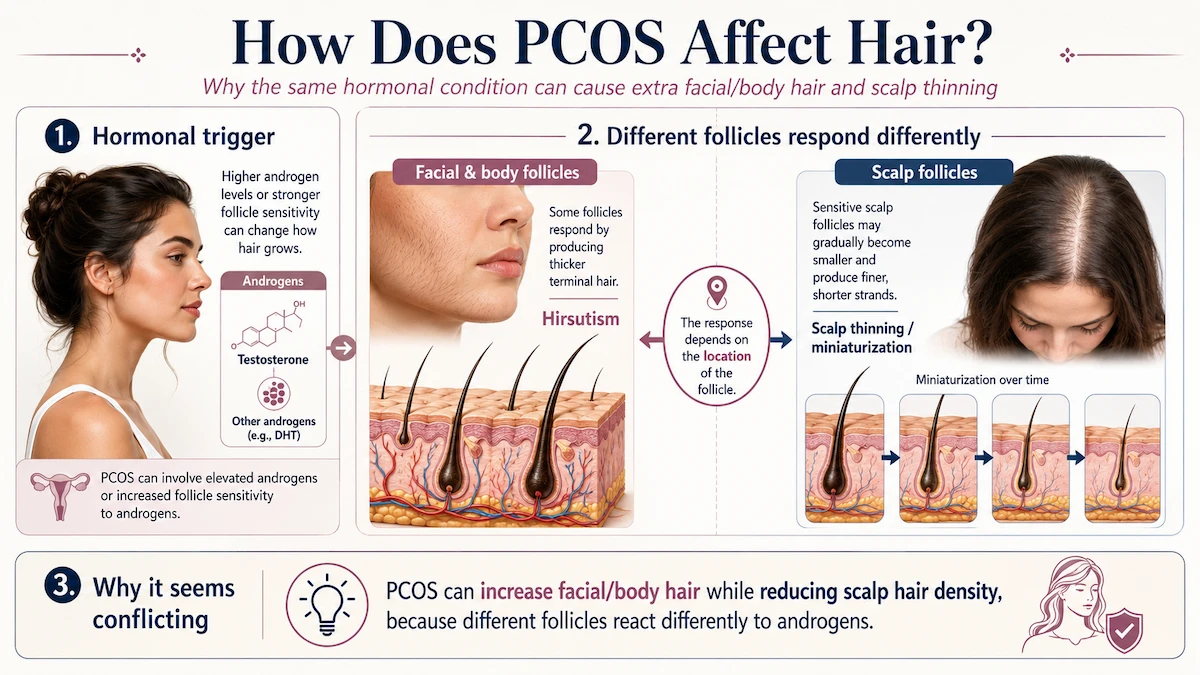
PCOS can influence hair through elevated androgen levels or increased sensitivity of individual follicles to androgens. Testosterone and related hormones are naturally present in women, but higher levels or stronger follicle responses can change how certain hairs grow.
The effect depends on the location of the follicle. Facial and body follicles may respond by producing thicker terminal hair, creating hirsutism. Genetically sensitive scalp follicles may respond in the opposite way and gradually become smaller, producing finer, shorter strands. This difference between follicles explains much of the apparently conflicting effect PCOS can have on hair.
PCOS and hair loss (androgenic alopecia)
Hair thinning associated with PCOS usually resembles female pattern hair loss, sometimes referred to as androgenetic or androgenic alopecia. Androgen activity can contribute to follicle miniaturization, meaning that each new hair cycle produces a strand that may be finer and shorter than the one before it.
PCOS does not automatically mean that scalp hair loss will occur. The international PCOS guideline notes that female pattern hair loss by itself is a relatively weak predictor of biochemical hyperandrogenism. Hair thinning should therefore be assessed rather than automatically blamed on PCOS.
What does PCOS hair loss look like?
PCOS-related female pattern thinning usually develops gradually. The central part may become wider, the top of the scalp can look less dense, and more scalp may become visible under bright light. The frontal hairline is often preserved compared with the classic receding pattern frequently seen in men.
Some people also experience increased shedding. This does not always come directly from PCOS. Iron deficiency, thyroid problems, stress, rapid weight changes, illness, and telogen effluvium can exist alongside PCOS and make thinning appear much worse.
PCOS and hirsutism (excess hair growth)
Hirsutism refers to the growth of coarse, pigmented terminal hair in areas that are more sensitive to androgens. It is one of the most recognizable signs of hyperandrogenism in PCOS. The 2023 international guideline considers hirsutism an important clinical sign when evaluating adults for PCOS.
Hirsutism is different from simply having more body hair than average. Genetics and ethnicity naturally influence body hair. In hirsutism, the pattern is linked to androgen-sensitive regions and the hairs tend to become darker, thicker, and more noticeable.
Where does hirsutism appear?
Common areas affected by PCOS-related hirsutism include:
- Upper lip and chin
- Jawline and sideburn area
- Chest and around the nipples
- Lower abdomen
- Upper thighs
- Lower back
- Buttocks
The amount of visible hair varies widely. Cosmetic hair removal can also hide the clinical severity, which is why personal reports of unwanted hair growth remain important during PCOS assessment.
Why does PCOS cause opposite hair problems at once?
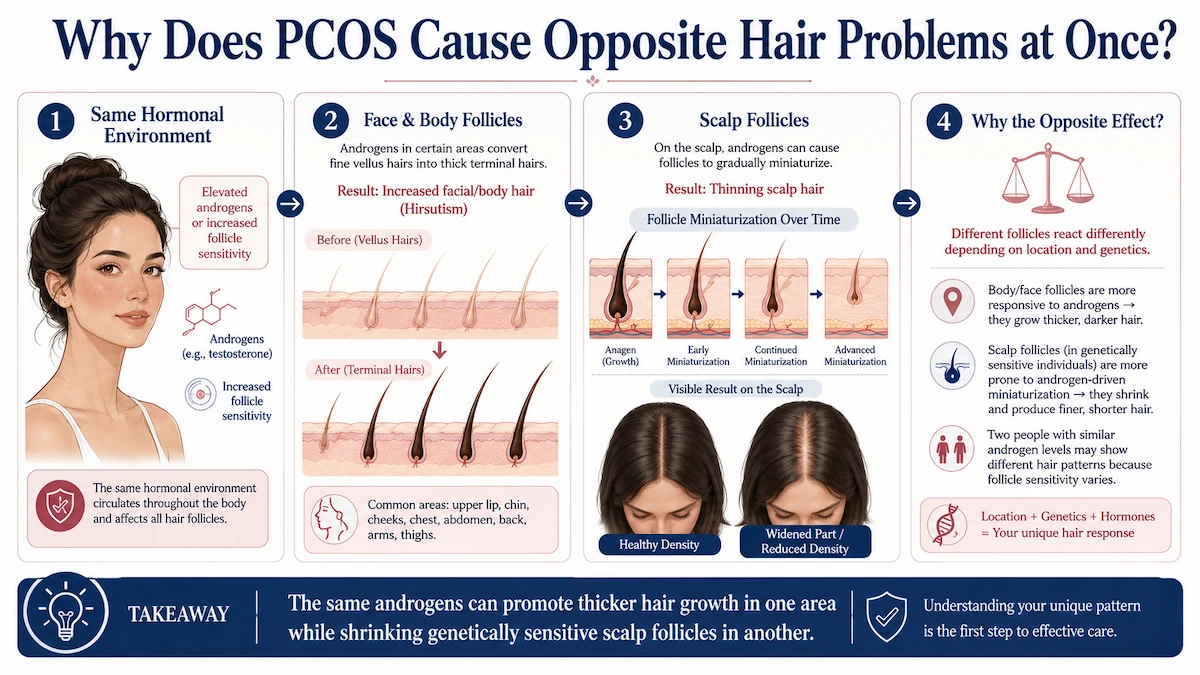
The answer comes down to follicle biology. Hair follicles from different areas of the body do not react to androgens in exactly the same way.
On the face and certain areas of the body, androgen exposure can transform fine vellus hairs into thicker terminal hairs. These strands become longer, darker, and more visible. On genetically sensitive parts of the scalp, androgen signaling can gradually shrink follicles instead.
As scalp follicles miniaturize, they spend less time producing strong terminal hairs. New strands may become finer with each cycle until scalp coverage declines. So the same hormonal environment can promote hair in one location while contributing to thinning somewhere else.
Genetics also matter. Two people with similar androgen levels may have very different hair patterns because follicle sensitivity varies.
How is PCOS-related hair loss diagnosed?
Diagnosis begins by looking at the pattern of thinning and the wider medical history. A dermatologist may examine hair density, the central part, hair shaft diameter, signs of miniaturization, scalp inflammation, and whether there are broken hairs or scarring.
The wider PCOS assessment may include menstrual history, acne, hirsutism, fertility history, medications, and signs of metabolic changes. Current international guidance recommends total and free testosterone when biochemical hyperandrogenism needs to be evaluated. Androstenedione or DHEAS may sometimes be considered when testosterone results do not explain the clinical picture.
Blood tests may also be used to look for other reasons for thinning, depending on symptoms. This can include thyroid or iron-related testing. New, rapidly worsening androgen symptoms require particular attention because conditions other than PCOS can sometimes produce marked androgen excess.
Treatment options for PCOS hair loss
Treating PCOS-related thinning often requires two goals at the same time. One is managing hormonal or metabolic features of PCOS. The other is directly protecting scalp follicles and encouraging stronger hair growth.
Hair responds slowly. Treatments that affect follicles generally need several months before changes in density become easy to see.
Managing the underlying hormone imbalance
Combined oral contraceptive pills can be used in reproductive-age adults with PCOS to manage hirsutism and irregular menstrual cycles. They reduce ovarian androgen production and increase sex hormone-binding globulin, which can lower the amount of biologically active androgen.
Metformin has an important role in PCOS, particularly for metabolic features, but it should not be considered a direct hair-regrowth treatment. The international guideline favors combined oral contraceptives over metformin when the main treatment goal is hirsutism, while metformin is used more for metabolic indications.
Minoxidil and topical treatments
Topical minoxidil is one of the main evidence-based treatments for female pattern hair loss. It can help prolong the growth phase of the follicle and improve scalp coverage when used consistently. Topical minoxidil products are available specifically for female pattern thinning.
Results are gradual rather than immediate. Some people notice increased shedding early in treatment before improvement becomes visible. Continued use is usually needed to maintain benefits.
Minoxidil does not correct the hormonal cause of PCOS. For this reason, it may form one part of a wider treatment plan rather than acting as a complete solution by itself.
Anti-androgen medications
Anti-androgen medications can reduce the effect of androgens on sensitive tissues. Spironolactone is commonly used in clinical practice for androgen-related symptoms, while other anti-androgen approaches may be considered in selected cases.
The 2023 PCOS guideline states that anti-androgens combined with a combined oral contraceptive may be trialed for female pattern hair loss, while also noting that direct evidence in the PCOS population remains limited.
Pregnancy prevention is particularly important when anti-androgens are used because these medicines can affect fetal development. The guideline recommends effective contraception whenever pregnancy is possible during anti-androgen treatment.
Treatment options for PCOS-related hirsutism
Hirsutism usually requires patience because existing terminal hairs do not disappear immediately when hormone levels change. Medical treatment aims to slow or reduce new androgen-driven growth, while cosmetic methods remove hairs that have already developed.
Hormonal treatments
Combined oral contraceptive pills are a common first-line medical option for hirsutism associated with PCOS. The international guideline recommends them as an option for reproductive-age adults who want treatment for excess hair growth or irregular menstrual cycles.
When the response remains inadequate after at least six months of oral contraceptive and/or cosmetic therapy, anti-androgen treatment may be considered alongside effective contraception.
Hormonal treatment takes time because hair follicles move through long growth cycles. Changes are usually judged over months rather than weeks.
Hair removal options
Shaving, waxing, threading, depilatory products, and electrolysis can remove existing unwanted hair without treating the underlying androgen signal. These methods can still be valuable because they provide faster cosmetic improvement while medical treatment takes effect.
Laser and light-based treatments can provide longer-lasting reduction. International PCOS guidance specifically recommends considering laser and light therapy for facial hirsutism and notes that people with PCOS may require more sessions than those with idiopathic excess hair growth.
Hair and skin color influence the choice of device. Laser is generally much less effective for blond, white, or grey hair, and suitable settings are important for reducing the risk of burns or pigment changes.
Lifestyle changes that may help
Lifestyle care is part of long-term PCOS management, particularly because PCOS can involve insulin resistance and metabolic changes. Current guidelines recommend healthy eating and physical activity for everyone with PCOS, including those who are not trying to lose weight.
Useful habits include:
- Eating a balanced diet that provides adequate protein, iron, zinc, fiber, and essential nutrients
- Exercising regularly in a form that can be maintained long term
- Avoiding crash diets and rapid weight loss, which can trigger extra shedding
- Getting regular sleep and managing long-term stress
- Working toward weight management when medically appropriate
- Avoiding smoking
- Using gentle hair care to limit breakage while scalp density is recovering
There is no single “PCOS diet” proven to be better than all others. The international guideline recommends sustainable healthy eating rather than one specific diet composition. Benefits from healthy lifestyle habits can occur even without weight loss.
Lifestyle changes should not be expected to restore significantly miniaturized scalp follicles on their own, but they can support metabolic health and form an important part of broader PCOS care.
When to see a doctor
Medical assessment is worthwhile when scalp hair is becoming progressively thinner, the central part continues to widen, or excess facial and body hair is increasing. Irregular or absent periods, persistent acne, fertility problems, or other signs of androgen excess can provide additional reasons to investigate PCOS.
Rapidly developing hirsutism deserves particular attention, especially when it appears together with major voice changes, rapid scalp hair loss, or other signs of marked androgen excess. Current PCOS guidance recommends further investigation when severe androgen-related symptoms begin suddenly or worsen quickly, because causes other than PCOS need to be ruled out.
PCOS can affect scalp and body hair in opposite ways, but both changes may share the same hormonal background. Effective care therefore starts by identifying what is happening at the follicles and treating both the underlying PCOS features and the specific hair concern. With the right diagnosis, scalp thinning and unwanted hair growth can be approached separately rather than treated as one unavoidable problem.
Sources
- Teede, H. J. et al. (2023). Recommendations From the 2023 International Evidence-based Guideline for the Assessment and Management of Polycystic Ovary Syndrome. The Journal of Clinical Endocrinology and Metabolism.
- Yip, L., Rufaut, N., Sinclair, R. (2019). Female Pattern Hair Loss and Androgen Excess, A Report From the Multidisciplinary Androgen Excess and PCOS Committee. The Journal of Clinical Endocrinology and Metabolism.
- Vujovic, A., Del Marmol, V. (2014). The Female Pattern Hair Loss, Review of Etiopathogenesis and Diagnosis. International Journal of Endocrinology.
- Bhat, Y. J. et al. Female Pattern Hair Loss, An Update. Indian Dermatology Online Journal.
