


Table of Contents
Batana oil has become one of the most talked-about natural oils for hair growth. Social media posts often claim that it can restore thinning areas, reverse baldness, strengthen weak strands, and even block DHT. The reality is less dramatic. Batana oil may be useful as a conditioning oil, but there is currently no good clinical evidence showing that it can regrow hair or treat a medical form of hair loss.
That does not make batana oil useless. Oils can reduce dryness, improve the feel of damaged hair, lower friction, and make strands less likely to break. The important point is knowing where cosmetic hair care ends and actual hair-loss treatment begins.
What is batana oil?
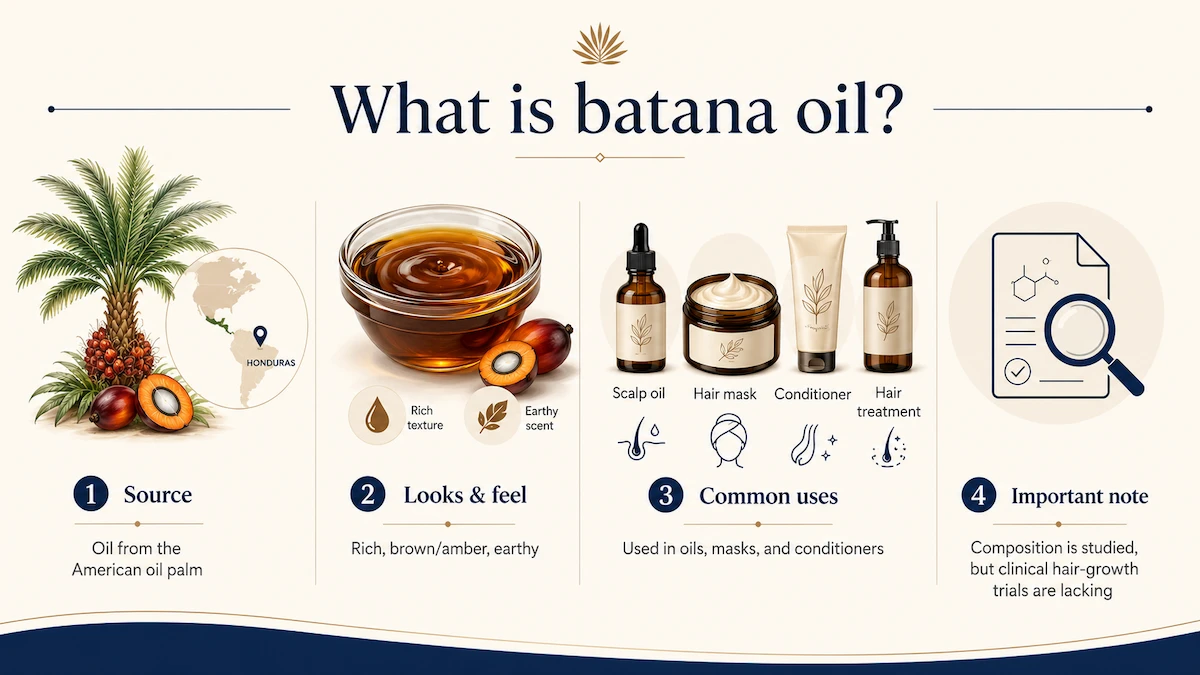
Batana oil is associated with the American oil palm, Elaeis oleifera, a palm species native to Central and South America. It is especially linked with traditional use in Honduras and has gained wider attention as an ingredient in scalp oils, masks, conditioners, and hair treatments.
Unlike lightweight hair serums, traditional batana oil may have a rich texture, a brown or amber appearance, and a noticeable roasted or earthy scent depending on how it has been processed. Products sold under the name batana oil are not necessarily standardized, so their appearance and composition can vary.
Scientific research on Elaeis oleifera confirms that oils from this palm contain significant amounts of unsaturated fatty acids and other lipid compounds. However, research on the plant or its oils should not be confused with clinical research showing that commercial batana oil grows human hair. At present, those hair-growth trials are lacking.
What’s in batana oil?
The exact fatty-acid profile depends on the part of the fruit used, processing method, growing conditions, and the final product. Research into Elaeis oleifera oils has found substantial levels of oleic acid along with linoleic and saturated fatty acids. Studies of American oil palm populations show considerable natural variation in fatty-acid composition.
The plant is also studied for compounds such as tocopherols and tocotrienols, forms of vitamin E. These compounds have antioxidant properties, but their presence does not automatically translate into faster hair growth when an oil is placed on the scalp.
For hair care, the fatty acids are probably more relevant to the feel of the hair shaft. Oils can coat the strand, improve softness, reduce friction, and make dry ends appear smoother.
Does batana oil actually help hair grow?
There is currently no convincing human clinical trial showing that batana oil stimulates new hair growth, reverses androgenetic alopecia, or restores inactive follicles. Reviews of available information on batana oil continue to point out the absence of direct clinical evidence for hair regrowth.
This distinction matters because reduced breakage can easily look like faster growth. If an oil makes dry hair softer and less likely to snap, more length may remain over several months. Hair can therefore look longer or fuller even though the follicle itself is not growing faster.
Anyone using batana oil for conditioning may still find it useful. It simply should not be presented as a proven treatment for progressive hair loss.
The claimed benefits of batana oil
Most of the realistic benefits of batana oil relate to conditioning and protecting the existing hair rather than creating new follicles.
Moisturizing the scalp and hair
Plant oils can form an occlusive layer over the hair and skin, slowing water loss and improving softness. Batana oil’s fatty-acid content may therefore make dry or coarse hair feel smoother.
People with very fine or oily hair may find rich oils heavy, while curly, coily, bleached, or dry hair may tolerate them better. Scalp use should also be reduced if an oil causes itching, clogged follicles, or irritation.
Protecting against breakage
A hair strand that repeatedly rubs against clothing, brushes, pillowcases, and other strands gradually accumulates surface damage. An oil can reduce friction and make detangling easier.
That can help with length retention. Less breakage means fewer short, snapped strands and fuller-looking ends. This cosmetic improvement is useful, but it should not be described as follicle regrowth.
The scalp massage effect
Batana oil is often massaged into the scalp, which introduces another factor. A small human study involving standardized scalp massage found an increase in hair thickness after 24 weeks, although it was a very small study and does not establish massage as a reliable treatment for hair loss.
Massage can still be relaxing and may make applying an oil easier. Use the fingertips rather than nails and avoid aggressive rubbing, especially on an inflamed or sensitive scalp.
The linoleic acid and DHT theory
One popular theory claims that fatty acids in batana oil reduce DHT by blocking 5-alpha-reductase, the enzyme involved in converting testosterone into dihydrotestosterone. DHT is important in androgenetic alopecia because genetically sensitive follicles gradually become smaller under its influence.
Laboratory research has shown that certain unsaturated fatty acids can inhibit 5-alpha-reductase under experimental conditions. However, these findings do not prove that batana oil applied to the scalp lowers DHT enough to treat pattern hair loss. No clinical study has established batana oil as a topical DHT blocker.
The jump from an ingredient showing activity in a laboratory experiment to an oil reversing baldness in humans is therefore much larger than online claims often suggest.
Can batana oil reverse balding?
Batana oil has not been shown to reverse male or female pattern baldness. In androgenetic alopecia, follicles progressively miniaturize and produce thinner, shorter hairs. Treating this process generally requires therapies that have been studied directly in people with hair loss.
An oil may improve the appearance of the hair that remains, especially when dryness and breakage are contributing to poor density. It cannot be expected to rebuild a receding hairline or restore an advanced bald area.
The earlier progressive thinning is diagnosed, the more opportunity there may be to protect follicles that are still producing hair.
Batana oil vs. rosemary oil, which one actually works?
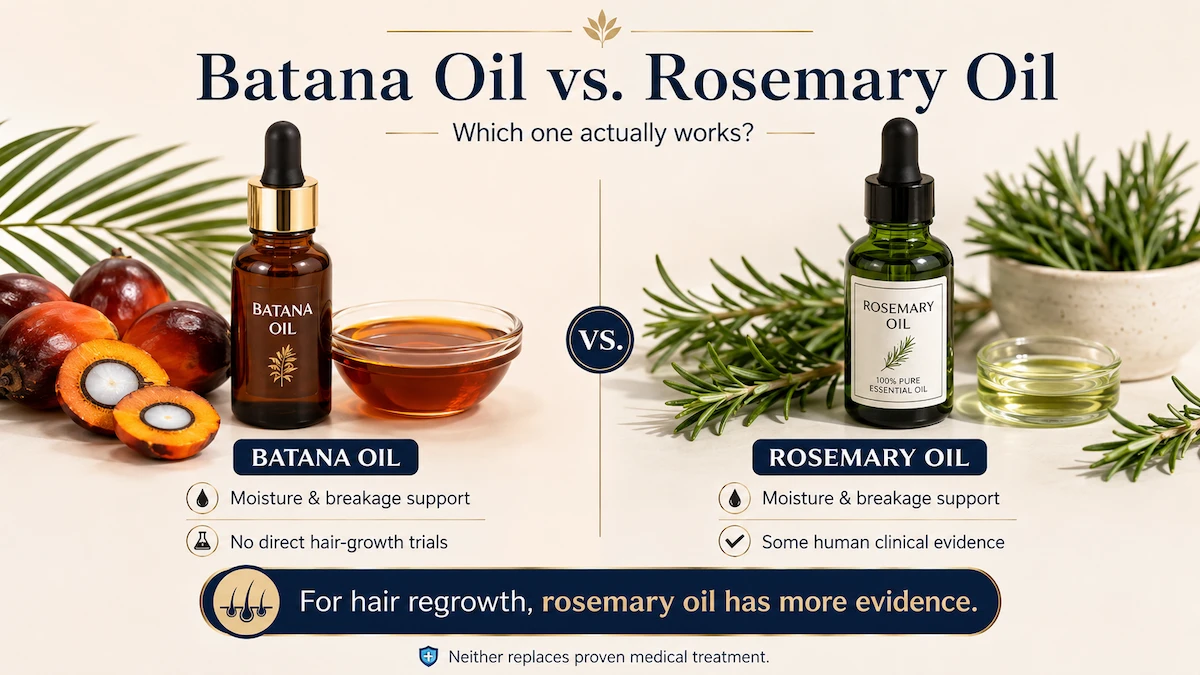
Rosemary oil has more direct evidence than batana oil, although its evidence base is still limited compared with established medical treatments.
A randomized trial involving 100 people with androgenetic alopecia compared rosemary oil with 2% topical minoxidil over six months. Hair counts increased significantly in both groups by the six-month assessment, with no significant difference between them in that study.
That single study does not prove rosemary oil is universally equivalent to minoxidil. It does, however, mean rosemary has at least some direct human clinical research for pattern hair loss. Batana oil currently does not.
For moisturizing and breakage control, either oil may work as part of a hair-care routine. For actual hair regrowth, batana oil should not be treated as a proven alternative to medical therapy.
How to use batana oil?
How batana oil is used depends mainly on whether the goal is scalp conditioning, reducing dry ends, or protecting damaged lengths.
As an overnight scalp mask
A small amount can be worked between the fingers and gently spread through the scalp and hair before washing. Leaving a heavy oil on overnight is not necessary for everyone. A shorter pre-shampoo treatment may provide similar conditioning with less buildup.
People with dandruff, seborrheic dermatitis, folliculitis, or an easily irritated scalp should be more cautious about prolonged oil application.
On wet hair with conditioner
Batana oil can also be used primarily on the hair shaft. A tiny amount may be added to a conditioning routine or applied to damp lengths after washing.
Using it on damp hair can help reduce the rough feeling common in bleached, curly, or high-porosity hair. Start with a small amount because too much can leave the hair flat or greasy.
On dry ends between washes
Dry ends usually need far less oil than the scalp. A drop warmed between the hands and smoothed over the ends may reduce frizz and improve shine between washes.
This approach is particularly useful when the goal is length retention rather than treating hair loss.
How to tell if your batana oil is real?
Because batana products are not standardized like prescription medicines, labels deserve careful attention.
- Look for Elaeis oleifera or a clearly identified American palm-derived oil on the ingredient list.
- Prefer products that clearly state whether they are pure batana oil or a blend containing other oils.
- Check the manufacturer, batch details, ingredient list, country of origin, and contact information.
- Be cautious when a product makes claims such as “guaranteed baldness reversal” or promises major regrowth within days.
- Do not assume color or smell alone proves authenticity because processing can alter both.
There is no simple home test that can reliably prove a bottle is authentic batana oil.
Side effects and who should avoid batana oil
Natural oils can still cause unwanted reactions. Scalp products should be stopped when they cause persistent symptoms.
- Avoid using batana oil on broken, infected, bleeding, or severely inflamed skin.
- Stop use if redness, burning, itching, swelling, or a rash develops.
- People with known palm-derived ingredient allergies should avoid the product.
- Heavy application may worsen greasy buildup or some scalp conditions.
- A patch test can be sensible before widespread use, especially with a new product.
- Do not let batana oil replace medical assessment for sudden, patchy, painful, or rapidly progressing hair loss.
Proven alternatives for hair loss
Hair-loss treatment should be based on the diagnosis. Androgenetic alopecia, alopecia areata, telogen effluvium, traction alopecia, and scarring forms of hair loss are different conditions and do not respond to the same treatment.
Minoxidil
Topical minoxidil has a much stronger evidence base than batana oil and is approved for certain forms of pattern hair loss. FDA records include topical minoxidil products for male and female androgenetic alopecia.
Treatment usually requires consistent use for several months. Temporary shedding or scalp irritation can occur, and continued treatment is generally necessary to maintain results.
Finasteride and dutasteride
Finasteride reduces the conversion of testosterone to DHT. Oral finasteride 1 mg is FDA-approved for male pattern hair loss, and clinical benefit generally requires several months of continued treatment.
Dutasteride blocks both type I and type II 5-alpha-reductase and has also been studied for androgenetic alopecia. Comparative research suggests strong efficacy, but its use for hair loss is off-label in the United States.
Both medicines require medical assessment because they are not appropriate for everyone.
Microneedling with PRP
Microneedling and platelet-rich plasma are frequently discussed as procedures for pattern hair loss. Research suggests microneedling can improve outcomes when combined with treatments such as minoxidil, while evidence reviews report moderate support for PRP in improving hair density in androgenetic alopecia.
PRP uses a concentrated portion of the patient’s own blood. Treatment protocols vary, and neither procedure should be viewed as a guaranteed replacement for established medical therapy.
Laser therapy
Low-level light therapy, also called photobiomodulation, uses specific wavelengths of red or near-infrared light. Research and an evidence-based 2025 consensus statement support photobiomodulation as a treatment option for androgenetic alopecia.
Results depend on device quality, treatment schedule, diagnosis, and consistency. Home devices should not all be assumed to provide identical energy or clinical results.
When to see a dermatologist?
A dermatologist should assess hair loss that develops suddenly, creates round or irregular bald patches, causes pain or burning, or comes with redness, scaling, sores, or scarring. Progressive thinning at the temples, crown, or central part also deserves attention because it may represent androgenetic alopecia.
Medical assessment is especially important when shedding continues for months or is accompanied by other symptoms such as fatigue, major weight changes, menstrual changes, or signs of nutritional deficiency.
Batana oil can still have a place in a hair-care routine. Its most reasonable role is as a conditioning oil that may improve softness, reduce friction, and help damaged hair retain length. What it cannot currently claim is proven regrowth. For true hair loss, identifying the cause and choosing a treatment backed by human evidence remains the more reliable path.
Sources
- Sadgrove, N., Simmonds, M. S. J. et al. Palm Oil (Elaeis guineensis), A Journey through Sustainability, Processing, and Utilization. Foods, MDPI.
- Panahi, Y., Taghizadeh, M., Marzony, E. T., Sahebkar, A. (2015). Rosemary oil vs minoxidil 2% for the treatment of androgenetic alopecia, a randomized comparative trial. SKINmed.
- Afifi, L. et al. (2017). Low-level laser (light) therapy (LLLT) for treatment of hair loss. Lasers in Surgery and Medicine.
- U.S. Food and Drug Administration, referenced via Low-Level Laser Therapy (LLLT) for Hair Loss. ISHRS.
- Zhang, X., Ji, Y. et al. (2023). Platelet-Rich Plasma for Androgenetic Alopecia, A Systematic Review and Meta-Analysis of Randomized Controlled Trials. Journal of Cutaneous Medicine and Surgery.
