


Table of Contents
Understanding hair types can make everyday hair care far less confusing. Two people can use the same shampoo, styling cream, or conditioning treatment and end up with completely different results simply because their hair types have different needs. Straight hair may become oily quickly, while curly or coily hair often needs more help retaining moisture. Wavy hair can sit somewhere in between, changing from one wash day to the next.
Knowing where your hair falls within the commonly used hair typing system gives you a useful starting point. It can help you choose better products, avoid unnecessary damage, understand frizz, improve curl definition, and build a routine that actually works with your natural pattern rather than against it.
What is a hair type?
A hair type describes the natural shape or pattern your strands form. The most widely recognized system divides hair into four main categories: straight, wavy, curly, and coily. These categories are then divided into subtypes based on how loose, defined, or tightly formed the pattern appears.
Hair types are useful because the shape of a strand affects the way natural scalp oils travel through the hair. Oils can move relatively easily down straight strands, for example, while the bends and turns in curly and coily hair make that journey more difficult. This is one reason different hair patterns often need different levels of cleansing and moisture.
Hair typing is not a strict scientific diagnosis. Think of it as a practical guide for understanding your hair’s behavior.
Hair type vs. hair texture, what’s the difference?
Hair type and hair texture are often used interchangeably, but they describe different characteristics.
Your hair type refers primarily to your natural curl pattern. It tells you whether your hair is straight, wavy, curly, or coily. Hair texture, meanwhile, usually refers to the thickness or diameter of an individual strand.
That means someone can have Type 3 curly hair with fine strands, while another person may have the same curl pattern with coarse strands. Their curls can look similar at first glance, yet their ideal products and styling techniques may be quite different.
Porosity and density add another layer. Together, hair type, texture, porosity, and density provide a much clearer picture than curl pattern alone.
What determines your hair type?
Genetics plays the biggest role in determining natural hair type. The shape of the hair follicle influences how each strand grows. More circular follicles tend to produce straighter strands, while oval or curved follicles are associated with increasingly wavy, curly, or coily patterns.
Your hair type can also be influenced by hormones, age, health changes, environmental conditions, and chemical processing. Heat styling does not normally change the type of hair growing from the follicle, but repeated high heat can weaken the strand and temporarily alter how its natural pattern appears.
Humidity, product buildup, damage, and even haircut shape can also make the same head of hair look noticeably different from day to day.
How to identify your hair type at home
The easiest time to identify natural hair types is when the hair is clean and free from heavy styling products. Allow it to dry without straightening, curling, brushing it smooth, or manipulating the pattern too much.
Look at several areas rather than judging your entire head from a single section.
- Hair that dries without a visible bend generally falls within Type 1.
- Hair with loose S-shaped curves is typically Type 2.
- Hair that forms defined spirals or ringlets usually belongs to Type 3.
- Hair with very tight coils, zigzags, or compact bends is generally Type 4.
Check the roots, sides, crown, and ends separately. Many people discover that their pattern is not completely uniform.
What are the four hair types?
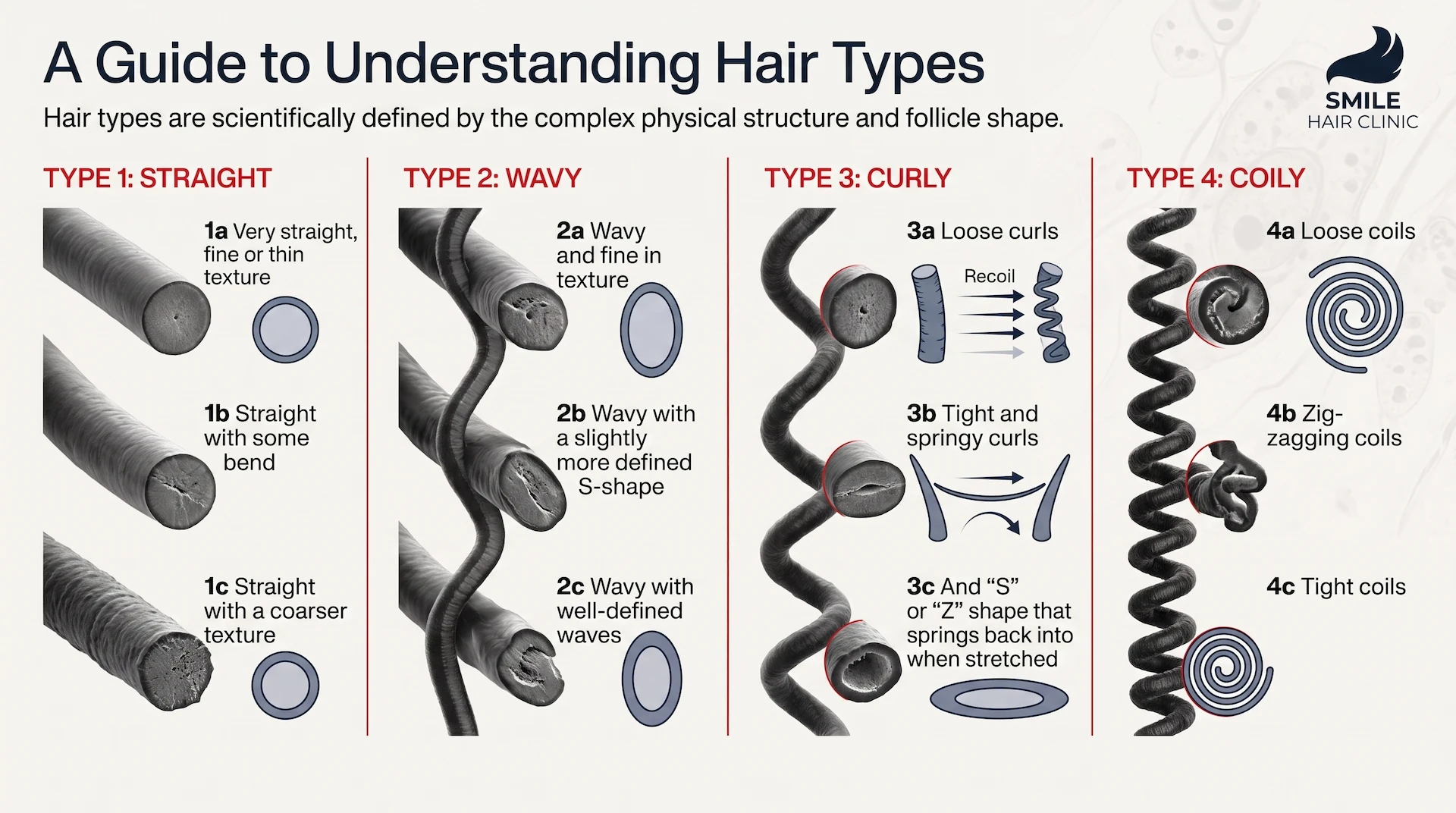
The four main hair types are Type 1 straight, Type 2 wavy, Type 3 curly, and Type 4 coily. Each category includes three commonly recognized subtypes—A, B, and C—which describe differences in pattern intensity.
Type 1: Straight
Type 1 hair grows without a noticeable curl pattern. Natural oils can usually move down the strand easily, so straight hair often looks shiny. The same characteristic can also make the roots appear oily relatively quickly.
Type 1A
Type 1A is extremely straight and usually fine. It tends to lie flat against the scalp and may struggle to hold curls or voluminous styles. Lightweight products are often preferable because rich creams can quickly make this hair look heavy.
Type 1B
Type 1B remains straight but generally has slightly more body than Type 1A. Individual strands may be medium in thickness, and the hair can hold volume more easily while maintaining a smooth appearance.
Type 1C
Type 1C is straight with noticeable body and sometimes a slight bend. The strands are often thicker or more resistant to styling. Humidity may cause some puffiness or frizz even though the hair does not develop a defined wave pattern.
Type 2: Wavy
Type 2 hair develops an S-shaped pattern instead of lying completely straight. Wavy hair types can be particularly sensitive to styling technique because heavy products may flatten the waves while insufficient moisture can create frizz.
Type 2A
Type 2A has a loose, subtle wave that is often most visible from the mid-lengths downward. Lightweight mousse, sprays, and gentle scrunching can help encourage the natural movement without weighing it down.
Type 2B
Type 2B features more obvious S-shaped waves. The pattern often begins closer to the roots and may become frizzy in humid conditions. Balanced moisture and lightweight definition products tend to work well.
Type 2C
Type 2C sits near the border between wavy and curly hair. Waves are strong and defined, and some sections may form loose spirals. This subtype typically benefits from more moisture than Types 2A and 2B while still requiring care with heavy products.
Type 3: Curly
Type 3 hair forms visible curls or spirals. Because natural oils have more difficulty traveling along curved strands, curly hair types commonly experience dryness through the mid-lengths and ends.
Type 3A
Type 3A produces large, loose curls with plenty of movement. The pattern can become stretched by heavy styling products, so curl-enhancing creams or gels with a lighter consistency are often effective.
Type 3B
Type 3B curls are tighter, springier, and generally more compact. Moisture becomes increasingly important, particularly at the ends. Styling products that combine hydration with hold can help maintain definition.
Type 3C
Type 3C hair has tight, densely packed corkscrew curls. Shrinkage is often more noticeable, and dryness or tangling may occur easily. Gentle handling and consistent conditioning are especially helpful.
Type 4: Coily
Type 4 hair has the tightest natural curl patterns. Strands may form tiny coils, compact S shapes, or sharper zigzag patterns. Coily hair types can be extremely versatile but are also vulnerable to dryness and mechanical breakage.
Type 4A
Type 4A typically forms small, clearly visible coils. When properly moisturized, the curl pattern can appear highly defined. Creams, leave-in conditioners, and gentle styling methods can help maintain softness.
Type 4B
Type 4B often follows a tighter Z-shaped pattern rather than forming completely rounded coils. Shrinkage can be substantial, making the hair appear much shorter than its stretched length.
Type 4C
Type 4C has a very tight pattern that may be less visibly defined without styling. It commonly experiences significant shrinkage and requires particularly gentle detangling. Regular moisture and protective handling can reduce unnecessary breakage.
What is the Rarest Hair Type?
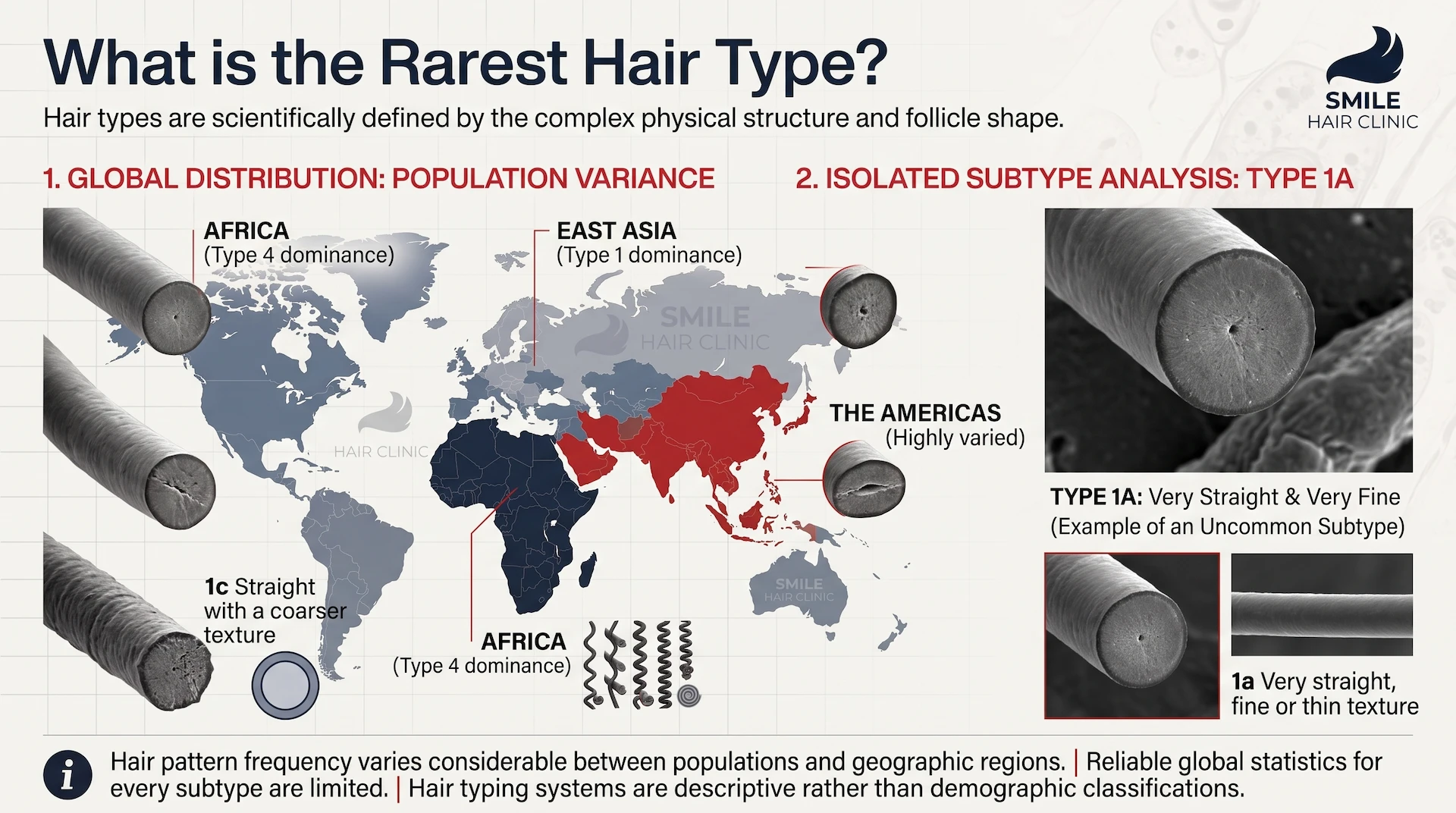
There is no universally accepted scientific ranking that identifies one subtype as the rarest hair type worldwide. Hair pattern frequency varies considerably between populations and geographic regions.
Type 1A is sometimes described as relatively uncommon because completely straight, very fine hair without noticeable bends represents a narrower combination of characteristics. However, describing any single subtype as definitively the rarest can be misleading.
Hair typing systems are descriptive rather than demographic classifications, and reliable global statistics for every subtype are limited.
Can you have more than one hair type?
Yes. Having several hair types on the same head is extremely common.
You might notice loose waves near the front, stronger curls around the crown, and almost straight sections underneath. Genetics, follicle shape, damage, styling habits, and exposure to the environment can all contribute to these differences.
Instead of forcing your entire head into one category, pay attention to what individual sections need. You may even find that different areas respond better to slightly different amounts of product or styling techniques.
How to style and care for each hair type?
A good routine should support your natural pattern while responding to practical concerns such as dryness, oiliness, tangling, or lack of definition. Hair type provides a starting point, but texture and porosity should also influence product choices.
Straight hair care routine
Straight hair often benefits from regular cleansing because natural oils can travel down the strand quickly. Apply conditioner mainly through the mid-lengths and ends if your roots become oily easily.
For volume, choose lightweight formulas and avoid layering several rich leave-ins or oils. Heat protectant is important whenever using straighteners, curling tools, or blow-dryers.
Wavy hair care routine
Wavy hair needs enough hydration to control frizz without so much product that the pattern becomes flat.
Use a lightweight conditioner and apply styling products while the hair is damp. Scrunching can encourage wave formation, while excessive brushing after drying may pull the pattern apart. A lightweight mousse or gel can provide definition without sacrificing movement.
Curly hair care routine
Curly hair usually performs best when moisture is maintained consistently. Gentle cleansing, regular conditioning, and detangling while the hair has plenty of slip can minimize unnecessary stress.
Applying curl cream or leave-in conditioner followed by gel can improve definition and hold. Sleeping on a smooth pillowcase or protecting curls at night may also reduce friction and help styles last longer.
Coily hair care routine
Moisture retention and gentle handling are especially important for coily hair types. Detangling should generally be done carefully in sections rather than aggressively brushing through dry hair.
Leave-in conditioner, moisturizing creams, and suitable oils can help reduce moisture loss. Protective styles may also limit daily manipulation, although styles should never feel painfully tight or place excessive tension on the scalp.
What is hair texture (thickness)?
Hair texture describes the diameter of an individual strand rather than its curl pattern. It is typically categorized as fine, medium, or thick, sometimes called coarse.
Understanding thickness can explain why two people with the same hair type respond very differently to one product.
Fine hair
Fine strands have a relatively small diameter. They can feel soft and silky but may become weighed down easily.
Lightweight shampoos, conditioners, mousses, and styling sprays often suit fine hair better than rich butters or large amounts of oil. Fine strands may also be more vulnerable to certain forms of heat and mechanical damage.
Medium hair
Medium hair sits between fine and coarse textures and often handles a broad range of products. It generally has enough structure to hold styles while remaining relatively easy to manage.
Product choice should still be adjusted according to curl pattern, porosity, oil production, and styling habits.
Thick (coarse) hair
Coarse hair refers to individual strands with a larger diameter. It can feel strong, but that does not mean it is immune to damage.
Thicker strands frequently tolerate richer creams and conditioners well, particularly when the hair is also curly or coily. Consistent conditioning can help improve softness and manageability.
How porosity affects your hair type?
Porosity describes how easily your hair absorbs and retains moisture. It can have almost as much influence on your routine as your natural hair type.
Low-porosity hair has a tightly arranged cuticle layer and may resist absorbing water or products. Heavy formulas can sit on the surface and create buildup. High-porosity hair absorbs moisture quickly but may also lose it rapidly, especially when the cuticle has been affected by chemical treatments, heat, or environmental damage.
Medium-porosity hair generally absorbs and retains moisture more predictably.
This is why choosing products based solely on hair types sometimes produces disappointing results. A Type 3B curl with low porosity may need a very different routine from a Type 3B curl with high porosity.
How density affects your hair type?
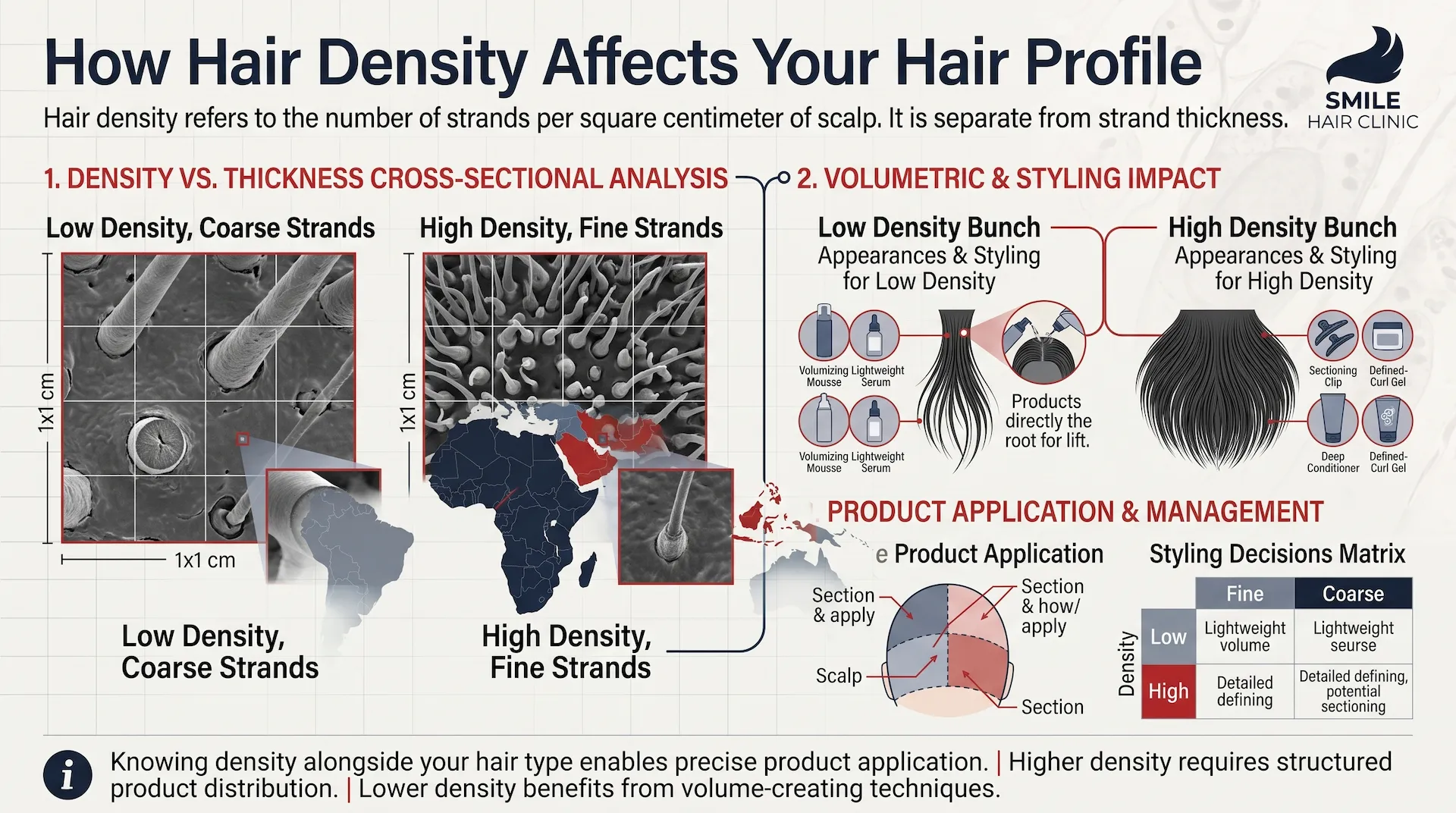
Hair density refers to the number of strands growing within a particular area of the scalp. It is different from strand thickness.
Someone can have fine individual strands but extremely high density, creating the appearance of very full hair. Another person can have coarse strands but lower density.
Density influences styling choices. Higher-density hair may require sectioning to distribute products evenly, while lower-density hair may look fuller with lightweight products and techniques that create volume around the roots.
Knowing density alongside your hair type can make product application much more precise.
Does hair type change over time?
Hair type can change during different stages of life. Hormonal shifts associated with puberty, pregnancy, menopause, aging, or certain health changes can affect the shape and behavior of newly growing strands.
Chemical treatments and repeated heat exposure may also change how existing hair looks. Straightening treatments can loosen curls, while damage may leave once-defined hair appearing inconsistent or frizzy.
It is worth reassessing your routine when your hair begins behaving differently rather than automatically continuing with products that worked several years ago.
Common hair concerns by type
Although certain concerns are associated with particular hair types, there are no absolute rules. Straight hair can be dry, and coily hair can experience buildup. Understanding why the issue is happening is more useful than relying solely on the category printed on a product label.
Dryness and frizz
Dryness and frizz are particularly common in wavy, curly, and coily hair because scalp oils have a more difficult path along strands with bends and curves.
Regular conditioning, reduced exposure to excessive heat, gentle drying, and appropriate leave-in products can help. Frizz does not always mean the hair is unhealthy, however. Some degree of frizz is completely normal for textured hair.
Oiliness and buildup
Straight and fine hair types may show oil more noticeably because sebum moves easily along the strand. Frequent use of styling products can also create buildup on any hair type.
Cleansing frequency should be based on scalp condition rather than following a rigid schedule. If your scalp feels oily, uncomfortable, or coated with product, it may simply be time to wash.
Lack of curl definition
Poor curl definition can result from buildup, excessive product, insufficient moisture, damage, or styling techniques that disrupt the pattern.
Experimenting with how much product you apply can make a surprisingly large difference. Curl definition is often better when styling products are distributed evenly through damp or wet hair and the pattern is allowed to set without excessive touching during drying.
Damage and breakage
Every hair type can experience breakage. Common causes include excessive heat, chemical processing, rough detangling, tight hairstyles, friction, and repeated manipulation.
Curly and coily hair can be particularly vulnerable because each bend in the strand creates another point where mechanical stress may occur. Fine hair may also break easily despite having a completely different curl pattern.
Ultimately, understanding hair types is less about fitting yourself into a perfect category and more about recognizing patterns in how your hair behaves. Once you combine your natural curl pattern with strand thickness, porosity, density, and everyday concerns, choosing a routine becomes much easier. Your hair may not fit neatly into one box—and it does not need to. The best hair care routine is the one that responds to the hair you actually have.
