


Table of Contents
Derma rollers have become a common part of hair-growth routines, often used alongside minoxidil, scalp serums, or PRP. The idea is simple: tiny needles create controlled micro-injuries in the scalp, which may trigger repair signals and support hair follicles. The research is promising, but microneedling is not a guaranteed solution for every type of hair loss.
Evidence is strongest for androgenetic alopecia, also known as male or female pattern hair loss, especially when microneedling is combined with established treatments. Technique, needle depth, hygiene, and diagnosis still matter. Used too aggressively, a derma roller can irritate the scalp, increase infection risk, and worsen some skin conditions.
What is a derma roller?
A derma roller is a handheld device with a rotating cylinder covered in very small needles. As it moves over the scalp, the needles create many tiny punctures. Microneedling devices can also use flat stamps or pen-shaped systems.
The FDA distinguishes between products that only affect the skin surface and medical microneedling devices that penetrate living skin layers. Deeper devices can reach nerves and blood vessels, which is one reason professional training and careful technique matter.
How does microneedling work for hair growth?
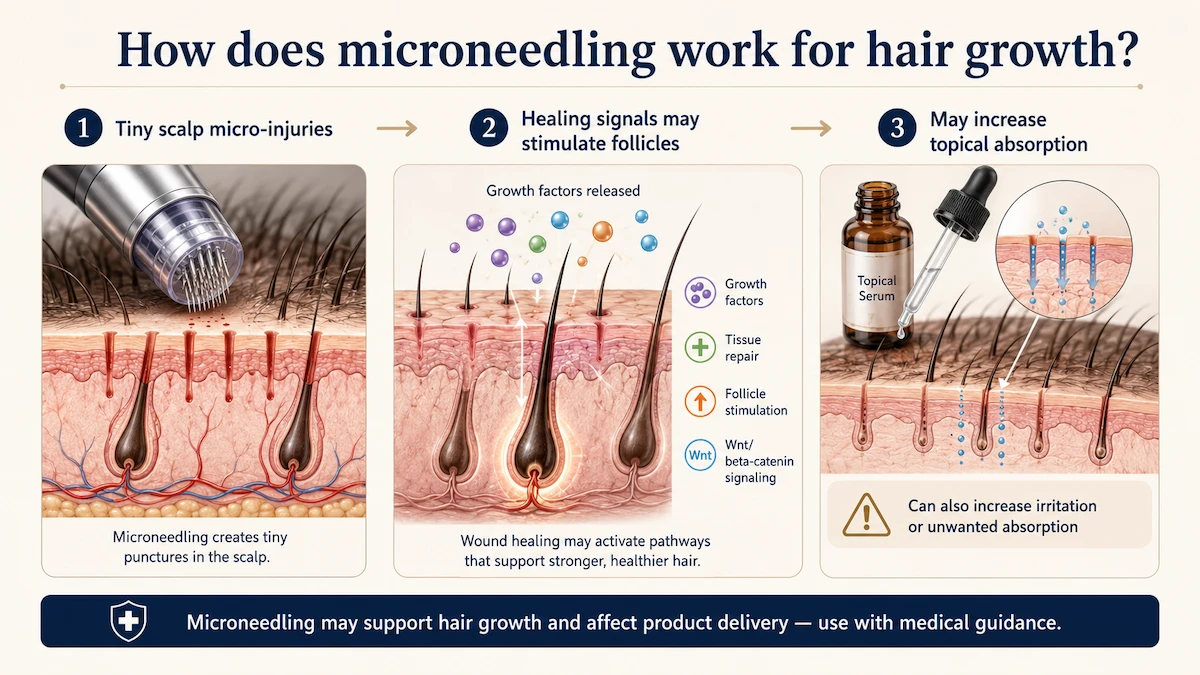
Microneedling creates controlled mechanical stimulation in the scalp. These tiny punctures begin a wound-healing response involving growth factors, tissue repair, and signaling pathways that may influence follicle activity. Research has also explored pathways such as Wnt/β-catenin as a possible part of the response.
Researchers also study microneedling because it may change how topical treatments pass through the skin. That may improve delivery, but it can also increase irritation or unwanted absorption. Applying medication immediately after needling should therefore not be treated as a routine step without medical guidance.
Does derma rolling actually work for hair growth?
Clinical studies suggest that microneedling combined with topical minoxidil can improve hair-density outcomes in androgenetic alopecia more than minoxidil alone. A meta-analysis also supported this combination, while noting differences in devices, schedules, needle depths, and study methods.
Evidence for microneedling alone is weaker. Most research combines it with minoxidil, PRP, or another treatment, making it difficult to know how much improvement comes from the needling itself.
Derma roller vs. derma stamp, what’s the difference?
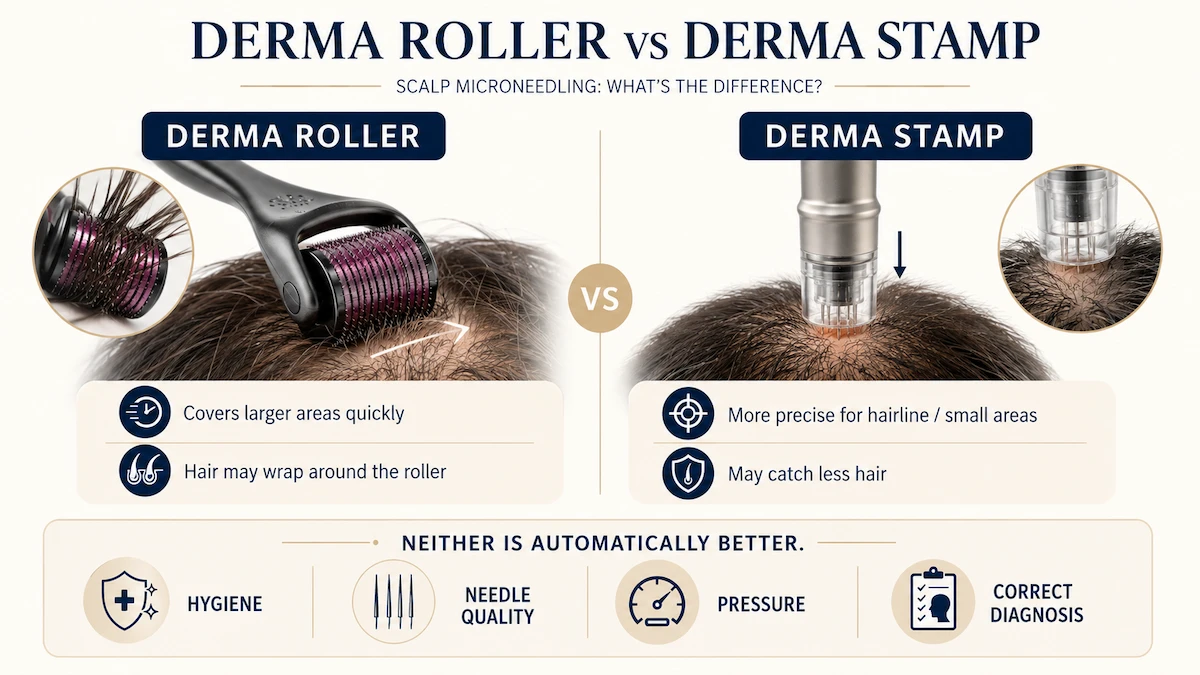
A derma roller moves a cylinder across the scalp, while a derma stamp presses needles straight down onto a smaller area. Stamps can offer better control around a hairline or localized thinning area and may catch less hair.
Rollers cover larger areas quickly, but long hair can wrap around the cylinder and pressure may be less consistent. Neither design is automatically better. Hygiene, needle quality, pressure, and correct diagnosis matter more.
Who is a derma roller for?
Most hair-growth research has focused on androgenetic alopecia. Someone with gradual thinning at the temples, crown, or central part may therefore be a more relevant candidate than someone with sudden shedding, inflamed patches, or scarring hair loss.
Hair loss has many possible causes. A dermatologist can examine the scalp and determine whether the problem is related to hereditary hair loss, inflammation, infection, shedding, or another condition before deciding whether microneedling belongs in the treatment plan.
Choosing the right derma roller
The best device is not simply the one with the longest needles. It should match the treatment goal, scalp condition, and level of medical supervision.
Needle length, what size do you need?
Studies on androgenetic alopecia have used several needle depths, including around 0.6 mm and deeper settings. There is no single ideal depth for everyone. Deeper is not automatically better and can increase pain, bleeding, and injury risk.
Home users should not copy clinical protocols directly from research papers. Professional treatments may involve controlled equipment, careful scalp assessment, infection-control measures, and medical follow-up. If the goal is treating hair loss rather than simple surface skin care, needle depth should be discussed with a dermatologist.
Needle material, titanium vs. stainless steel
Titanium and stainless steel are both common materials. Titanium is often marketed for durability, while stainless steel is widely used in medical instruments. Material alone does not guarantee that a roller is safe or well made.
Needle condition matters more. Bent, dull, rusty, or damaged needles should never be used on the scalp.
Features to look for
- Clearly labeled needle length and manufacturer information.
- Straight, evenly spaced, undamaged needles.
- A design that can be cleaned as directed by the manufacturer.
- Protective storage that keeps needles away from dirty surfaces.
- A secure handle that allows controlled pressure.
- Clear cleaning, replacement, and disposal instructions.
How to use a derma roller for hair growth?
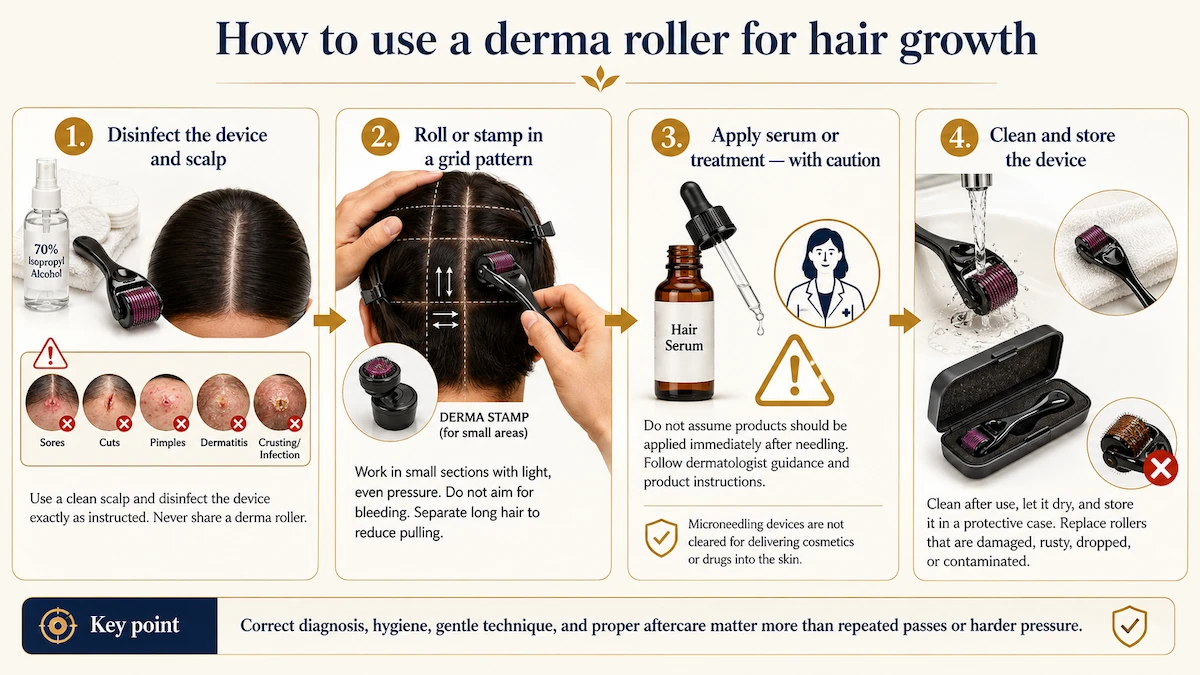
At-home needling carries more risk than ordinary hair care because it can break the skin. Diagnosis should come first, followed by careful use according to the device instructions.
Step 1: Disinfect the device and scalp
Start with a clean scalp and clean device. Follow the manufacturer’s cleaning and disinfection instructions exactly. Never share a derma roller, since sharing microneedling products can spread infection.
Do not roll over sores, active dermatitis, cuts, crusting, pimples, or signs of infection. A painful or inflamed scalp should be assessed before microneedling.
Step 2: Roll or stamp in a grid pattern
Work through the thinning area in small sections with light, even pressure. The goal is not to make the scalp bleed. Repeated passes or harder pressure do not mean better results.
Long hair should be separated carefully to reduce pulling and tangling. A stamp may be easier to control in smaller areas.
Step 3: Apply your serum or treatment
This step requires caution. The FDA states that microneedling devices are not cleared for delivering cosmetics, topical medications, drugs, or blood products into the skin. The agency has also not cleared microneedling devices for use with another product.
Do not assume that minoxidil, acids, essential oils, or concentrated serums should be applied immediately after needling. Follow the timing given by a dermatologist and the instructions for the treatment being used.
Step 4: Clean and store the device
After use, clean the device as directed and allow it to dry before storage. Keep it in a protective case so the needles remain clean and straight. The FDA advises cleaning home-use products between sessions according to manufacturer instructions.
Replace a roller that is damaged, dropped, rusty, or visibly contaminated. Reusing poorly cleaned equipment raises infection risk.
How often should you derma roll?
There is no universal schedule. Clinical studies have used protocols ranging from weekly sessions to treatments spaced several weeks apart. Frequency also depends on needle depth because deeper treatment generally requires more recovery time.
More frequent microneedling is not automatically more effective. Persistent redness, tenderness, crusting, or irritation suggests that the scalp has not recovered properly.
Combining derma rolling with other treatments
Microneedling is often studied as an add-on treatment rather than a stand-alone option. This distinction matters when looking at impressive before-and-after results.
Derma rolling and minoxidil
Several randomized studies have reported better outcomes when microneedling was combined with topical minoxidil than with minoxidil alone in androgenetic alopecia. Similar findings have also been reported in female pattern hair loss.
That does not mean both should automatically be used at the same moment. Needling changes the skin barrier and may increase irritation or absorption. The FDA has not cleared microneedling devices for delivering topical drugs, so timing should be discussed with a dermatologist.
Derma rolling and PRP
PRP uses a platelet-rich portion of a person’s own blood. Some studies have investigated PRP together with microneedling for androgenetic alopecia and reported encouraging results.
Protocols vary, and PRP is a professional medical treatment. The FDA also notes that microneedling devices are not cleared for delivering blood products such as PRP into the skin.
Safety and side effects
Temporary redness, tightness, itching, peeling, bruising, discomfort, and minor bleeding can occur after microneedling. Less common problems include pigment changes and infection.
Who should avoid derma rolling
- People with an active bacterial, viral, or fungal scalp infection.
- People with uncontrolled diabetes, immune suppression, or certain bleeding disorders.
- Anyone taking blood-thinning medication without medical clearance.
- People with active eczema, psoriasis, or inflammation in the treatment area.
- Anyone with a history of problematic keloid scarring.
- People who are pregnant or breastfeeding should seek medical advice first.
- Anyone with unexplained, sudden, painful, or scarring hair loss should get a diagnosis before needling.
These precautions are consistent with FDA guidance on who may not be suitable for medical microneedling.
Signs you’re being too aggressive
Ongoing pain, significant bleeding, prolonged redness, swelling, crusting, pus, or increasing tenderness are warning signs. Repeated irritation can work against the goal of creating a healthier scalp environment.
Stop treatment if the scalp is not recovering normally. Possible infection or severe inflammation requires medical assessment.
Is at-home derma rolling FDA-approved?
Not for hair growth. More precisely, as of the FDA’s October 15, 2025 guidance, the agency has not cleared any microneedling device for treating hair loss. Certain medical microneedling devices are cleared for specific cosmetic uses, including facial acne scars, facial wrinkles, and abdominal scars, but those clearances do not include scalp hair growth.
The FDA also states that it has not authorized microneedling medical devices for over-the-counter sale. Some short or blunt home rollers may fall outside medical-device regulation when they only claim to exfoliate or improve skin appearance, but that is different from an FDA-cleared hair-loss treatment.
Professional microneedling vs. at-home derma rolling
Professional microneedling offers more control. A trained clinician can identify the type of hair loss, choose an appropriate device and depth, use proper infection-control methods, monitor healing, and coordinate treatment with other therapies.
At-home rollers are cheaper and convenient, but they make it easier to use the wrong depth, treat too often, contaminate the device, or needle a scalp condition that needs different care. The American Academy of Dermatology recommends checking with a dermatologist before using a microneedling device for hair loss.
When to see a dermatologist
A dermatologist should evaluate hair loss that begins suddenly, causes smooth bald patches, produces scalp pain or burning, leaves scars, or comes with heavy scaling or inflammation. Assessment is also useful when shedding continues for months or thinning keeps progressing.
For pattern hair loss, early diagnosis can make treatment planning easier. Microneedling may become one part of the plan, but it should not replace finding out why the hair is thinning in the first place. Dermatologists may use scalp examination, hair testing, blood tests, or biopsy when needed to identify the cause.
Derma rolling has moved beyond internet hype because clinical research does show potential, particularly when microneedling is combined with minoxidil for androgenetic alopecia. Still, promising does not mean proven for everyone or risk-free. Better results begin with the right diagnosis, careful technique, realistic expectations, and a plan that protects the scalp rather than simply needling it more often.
Sources
- U.S. Food and Drug Administration. Microneedling Devices.
- Abdi, P., Awad, C., Anthony, M. R. et al. (2023). Efficacy and safety of combinational therapy using topical minoxidil and microneedling for the treatment of androgenetic alopecia, a systematic review and meta-analysis. Archives of Dermatological Research.
- Pei, Y. et al. (2024). Efficacy and safety of combined microneedling therapy for androgenic alopecia, A systematic review and meta-analysis of randomized clinical trials. Journal of Cosmetic Dermatology.
- Kumar, M. K., Inamadar, A. C., Palit, A. (2018). A randomized controlled, single-observer blinded study to determine the efficacy of topical Minoxidil plus microneedling versus topical Minoxidil alone in the treatment of androgenetic alopecia. Journal of Cutaneous and Aesthetic Surgery, 11(4), 211-216.
- American Academy of Dermatology Association. Hair Loss Resource Center.
