

Table of Contents
Hair thinning can sometimes be one of the first visible clues that thyroid hormone levels are out of balance. Both an underactive thyroid and an overactive thyroid can affect the normal hair growth cycle, leading to increased shedding, lower density, dry or fragile strands, and changes in eyebrow hair.
Thyroid hair loss usually looks different from classic pattern baldness. Rather than producing one isolated bald area, thyroid problems often cause diffuse thinning across much of the scalp. The encouraging part is that this type of hair loss can often improve once thyroid hormone levels are brought under control. Recovery is gradual, however, because follicles need time to return to their normal growth cycle.
Can thyroid problems cause hair loss?
Yes. Both hypothyroidism and hyperthyroidism can cause hair loss, with hair shedding reported in roughly half of people with hyperthyroidism and about a third of those with hypothyroidism (Hussein et al., Cureus, 2023). Thyroid hormones influence metabolism throughout the body, including processes involved in hair follicle growth and cycling.
When thyroid hormone levels become significantly too low or too high, more follicles may leave the active growth stage and enter a resting phase. Those hairs do not necessarily fall immediately. Increased shedding may become noticeable several weeks or months after the hormonal disturbance begins.
This delay can make the connection difficult to recognize. Someone may notice excessive hair in the shower long after other thyroid symptoms first appeared.
Mild thyroid abnormalities do not always produce noticeable thinning. Hair loss is more often associated with significant or prolonged thyroid dysfunction.
How the thyroid affects the hair growth cycle?

Every scalp follicle moves through a repeating cycle. During anagen, the follicle actively produces a growing strand. It later passes through a short transition stage before entering telogen, the resting phase. Eventually the older hair is released and a new cycle begins.
Thyroid hormones help regulate cell activity and metabolism, so abnormal levels can disturb this timing. When a large number of follicles enter the resting stage around the same period, diffuse shedding can develop.
This pattern resembles telogen effluvium. Instead of losing all hair from one specific area, density decreases more evenly across the scalp.
The hair shaft itself may also change. People with thyroid disease sometimes describe their hair as dry, coarse, fine, fragile, or easier to break. These changes can make overall volume appear even lower.
Hypothyroidism and hair loss
Hypothyroidism occurs when the thyroid gland does not produce enough thyroid hormone. Hashimoto’s disease, an autoimmune condition that damages thyroid tissue, is the most common cause of hypothyroidism in areas with adequate dietary iodine (Kaur & Jialal, StatPearls, NCBI Bookshelf).
Low thyroid hormone levels slow many body processes. Hair follicles can be affected as part of this wider metabolic change. Increased shedding may develop gradually, and the hair can become dry or brittle.
Thinning is not always the first symptom. Fatigue, feeling unusually cold, constipation, dry skin, weight gain, and changes in menstrual periods may appear before the hair begins to change.
What hypothyroidism hair loss looks like
Hair loss related to hypothyroidism is usually diffuse. Instead of a sharply defined bald patch, the entire scalp may feel less dense. A ponytail can become smaller, the part may appear wider, and more hair may be visible on brushes, clothing, or during washing.
Eyebrows can also become thinner. Loss around the outer portion of the eyebrow has traditionally been associated with hypothyroidism, although this sign is not specific enough to diagnose a thyroid disorder on its own.
The texture of the remaining hair may change as well. Dryness and fragility can increase breakage, creating a combination of follicle shedding and damaged strands.
Hyperthyroidism and hair loss
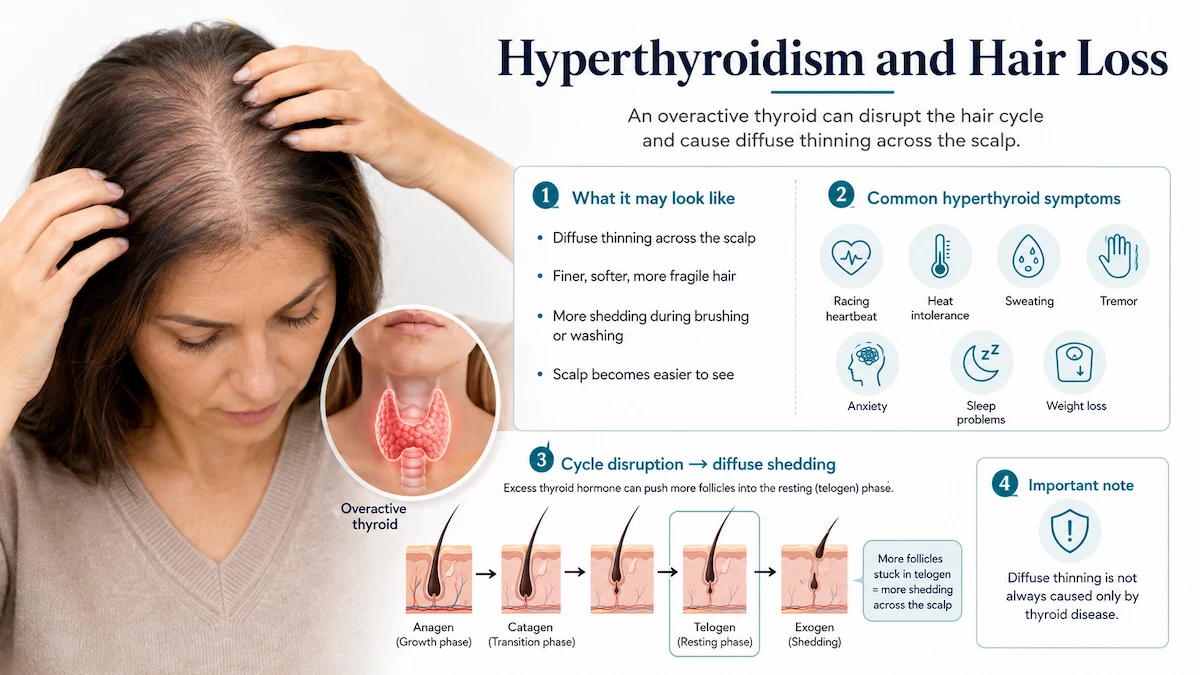
Hyperthyroidism develops when the thyroid produces excessive amounts of thyroid hormone. Graves’ disease is the most common cause, accounting for the large majority of hyperthyroid cases, although thyroid nodules and other conditions can also lead to overactivity (Pokhrel & Bhusal, StatPearls, NCBI Bookshelf).
Too much thyroid hormone increases metabolic activity throughout the body. Symptoms can include a racing heartbeat, heat intolerance, increased sweating, tremor, anxiety, difficulty sleeping, weight loss despite a normal or increased appetite, and changes in bowel habits.
Hair can become finer and more fragile. Some people develop diffuse shedding as the normal follicle cycle becomes disrupted.
What hyperthyroidism hair loss looks like?
Hyperthyroid hair loss also tends to affect the scalp broadly rather than producing one typical bald patch. The hair may feel noticeably finer, softer, or less substantial than it did previously.
More strands may appear during brushing and shampooing, while the scalp gradually becomes easier to see. Because hair diameter can decrease as well as density, the reduction in volume may look more dramatic than the actual number of hairs being shed.
Hyperthyroidism can occur at the same time as another type of hair loss, so diffuse thinning should not automatically be attributed to thyroid disease without assessment.
Thyroid hair loss vs. other types of hair loss
Thyroid-related shedding usually produces widespread thinning. Male and female pattern hair loss follow a more recognizable distribution. Men often develop recession around the temples and thinning at the crown, while women commonly notice a widening central part and reduced density over the top of the scalp.
Alopecia areata behaves differently again. It often causes sudden smooth patches where hair disappears from clearly defined areas. The eyebrows or eyelashes may also be affected.
Traction alopecia tends to occur where hairstyles repeatedly pull on the follicles, particularly around the hairline. Scarring alopecia may cause pain, burning, redness, scale, or smooth areas where follicle openings disappear.
Telogen effluvium can be much harder to separate from thyroid hair loss because the appearance may be almost identical. Illness, surgery, childbirth, rapid weight loss, severe stress, nutritional deficiency, and thyroid dysfunction can all trigger diffuse shedding.
Other symptoms that point to a thyroid problem
Hair loss alone cannot confirm thyroid disease. Other symptoms can make thyroid testing more relevant.
Persistent tiredness, weakness, or unexplained changes in energy Feeling unusually cold or unusually hot Unexplained weight gain or weight loss Dry skin or increased sweating Constipation or more frequent bowel movements Changes in heart rate or noticeable palpitations Trembling hands, anxiety, or unusual nervousness Changes in menstrual periods Muscle weakness or aches Changes in sleep Thinning eyebrows together with diffuse scalp shedding A feeling of fullness or swelling in the neck
These symptoms can have many other causes. Blood testing is needed to determine whether thyroid function is actually abnormal.
The link between thyroid disorders and alopecia areata
Thyroid disease and alopecia areata have an important connection because both can involve autoimmune activity.
Alopecia areata develops when the immune system attacks hair follicles, commonly causing smooth patches of sudden hair loss. Autoimmune thyroid diseases such as Hashimoto’s disease and Graves’ disease involve an abnormal immune response against thyroid tissue or thyroid-related targets.
People with alopecia areata have higher rates of thyroid disease and thyroid autoimmunity than the general population, a link confirmed across multiple studies in a systematic review and meta-analysis (Kinoshita-Ise et al., Journal of Dermatology, 2019). This does not mean thyroid disease directly causes every case of alopecia areata. Instead, some people appear to have a greater tendency to develop autoimmune conditions.
Thyroid assessment may therefore be considered when alopecia areata occurs alongside symptoms or a medical history that suggests thyroid disease.
How is thyroid-related hair loss diagnosed?

Diagnosis involves looking at both the scalp and thyroid function. A doctor may ask when shedding started, whether it developed suddenly or gradually, what areas are affected, and whether other symptoms appeared around the same time.
The scalp can be examined for diffuse density loss, follicle miniaturization, smooth bald patches, inflammation, breakage, or scarring. This is important because thyroid disease may exist alongside androgenetic alopecia or another hair disorder.
Thyroid testing usually includes thyroid-stimulating hormone, or TSH. Free T4 is commonly measured as well when thyroid dysfunction is suspected or when TSH is abnormal. Other laboratory tests may be added depending on the clinical situation.
Testing for thyroid antibodies may help identify autoimmune thyroid disease in selected patients.
Doctors may also investigate other causes of diffuse shedding. Iron deficiency, severe dietary restriction, medications, recent illness, hormonal changes, and rapid weight loss can create similar hair changes.
Treatment options
Treatment depends on whether thyroid hormone levels are too low or too high. The main goal is to restore normal thyroid function rather than treating the hair alone.
Hair improvement generally follows more slowly than improvement in other symptoms because follicles need time to change phases and produce new strands.
Treating the underlying thyroid condition
The first step is identifying why thyroid hormone levels are abnormal. Hypothyroidism and hyperthyroidism require different treatments, and thyroid medication doses need to be monitored with blood tests.
Correcting thyroid function removes an important trigger for excessive shedding. It does not produce immediate regrowth, but it gives affected follicles an opportunity to return toward a healthier cycle.
Other causes of hair thinning should still be considered when density does not improve after thyroid levels have stabilized.
Levothyroxine for hypothyroidism
Levothyroxine is the standard thyroid hormone replacement used for hypothyroidism. It is a synthetic form of thyroxine, or T4, and replaces hormone that the thyroid is no longer producing adequately (Eghtedari & Correa, StatPearls, NCBI Bookshelf).
The dose is adjusted according to factors such as thyroid blood tests, age, medical history, and response to treatment. Regular monitoring is important because both too little and too much thyroid hormone can cause problems.
Hair recovery should not be judged during the first few weeks. The follicle cycle works slowly, and visible improvement can lag behind normalization of thyroid blood tests.
Antithyroid medication for hyperthyroidism
Antithyroid medicines reduce the thyroid gland’s ability to produce new thyroid hormone. Methimazole is the most commonly used first-line option, while propylthiouracil may be selected in certain situations such as early pregnancy (Awosika et al., StatPearls, NCBI Bookshelf).
Hyperthyroidism can also be treated with radioactive iodine or thyroid surgery depending on the cause, severity, age, pregnancy considerations, and other medical factors.
As thyroid hormone levels return toward normal, excessive shedding may gradually improve. Hair texture and density can take additional time to recover.
Supporting hair regrowth during treatment
Eat enough protein and avoid severe calorie restriction or crash diets. Correct iron, vitamin, or mineral deficiencies when testing confirms one. Use conditioner regularly if thyroid-related dryness makes the hair fragile. Limit bleaching, chemical straightening, and frequent high-temperature styling while the hair is recovering. Avoid tight hairstyles that place constant tension on weakened follicles. Handle wet hair gently to reduce breakage. Track density with photographs every few months instead of judging changes day by day. Discuss persistent pattern thinning with a dermatologist because another hair-loss condition may need separate treatment.
Hair supplements are not automatically necessary. Large amounts of biotin are especially worth mentioning to a doctor because high-dose biotin supplements can distort thyroid laboratory results on several common testing platforms, sometimes mimicking or masking real thyroid dysfunction (Zhang et al., Medicine, 2020).
Is thyroid hair loss reversible?
In many cases, thyroid-related hair loss is reversible because the follicles are not permanently destroyed. Once thyroid hormone levels are controlled, follicles can gradually return to a more normal growth cycle.
Recovery takes patience. A follicle entering a new growth phase initially produces a very short hair that may take months to become noticeable. Restoring visible volume can take longer still.
Some people continue to experience thinning after their thyroid levels have normalized. This may indicate another problem, such as androgenetic alopecia, iron deficiency, chronic telogen effluvium, alopecia areata, or hair shaft damage.
The duration of the thyroid disorder also matters. Long-standing thinning may take longer to improve than a recent episode of shedding.
When to see a doctor
Medical assessment is recommended when diffuse shedding continues for several months, hair density is clearly decreasing, or thinning develops alongside symptoms such as unexplained weight changes, fatigue, heat or cold intolerance, heart palpitations, constipation, menstrual changes, or neck swelling.
Sudden bald patches, eyebrow or eyelash loss, scalp pain, burning, heavy scaling, redness, or scarring should also be examined. These features may point toward another form of hair loss rather than uncomplicated thyroid-related shedding.
Thyroid hair loss can be distressing, but it is often a sign that the hair cycle has been disrupted rather than permanently destroyed. Identifying and treating the thyroid disorder is the most important step. Once hormone levels are controlled, hair growth can gradually recover, while continued thinning should prompt a closer look for other causes.
Sources
- Hussein RS, Atia T, Bin Dayel S. “Impact of Thyroid Dysfunction on Hair Disorders.” Cureus, 2023. ncbi.nlm.nih.gov
- Kaur J, Jialal I. “Hashimoto Thyroiditis.” StatPearls, NCBI Bookshelf, 2026. ncbi.nlm.nih.gov
- Pokhrel B, Bhusal K. “Graves Disease.” StatPearls, NCBI Bookshelf, 2023. ncbi.nlm.nih.gov
- Kinoshita-Ise M, Martinez-Cabriales SA, Alhusayen R. “Chronological association between alopecia areata and autoimmune thyroid diseases, a systematic review and meta-analysis.” Journal of Dermatology, 2019. PubMed
- Eghtedari B, Correa R. “Levothyroxine.” StatPearls, NCBI Bookshelf, 2023. ncbi.nlm.nih.gov
- Awosika AO, Singh G, Correa R. “Methimazole.” StatPearls, NCBI Bookshelf, 2026. ncbi.nlm.nih.gov
- Zhang Y, Wang R, Dong Y, Huang G, Ji B, Wang Q. “Assessment of biotin interference in thyroid function tests.” Medicine, 2020. ncbi.nlm.nih.gov
