

Table of Contents
This article written by Dr. Mehmet Erdoğan, M.D. and Dr. Gökay Bilgin, M.D., hair transplant doctors at Smile Hair Clinic, Istanbul.
Most men who type “why is my hairline moving” into search engines end up looking at the same seven black-and-white illustrations. That chart is the Norwood scale, and for nearly fifty years it has been the closest thing the hair restoration field has to a shared language. A surgeon in Istanbul and a dermatologist in Chicago can look at the same patient, agree on a stage number, and both know roughly what they are dealing with.
What the chart does not do is tell you what comes next. Two men can land on an identical stage and walk away from a consultation with completely different recommendations, because the number only captures part of the picture. This guide breaks down what each stage actually looks like, what tends to work at each point, and where the scale itself runs out of useful information.
What is the Norwood Scale?
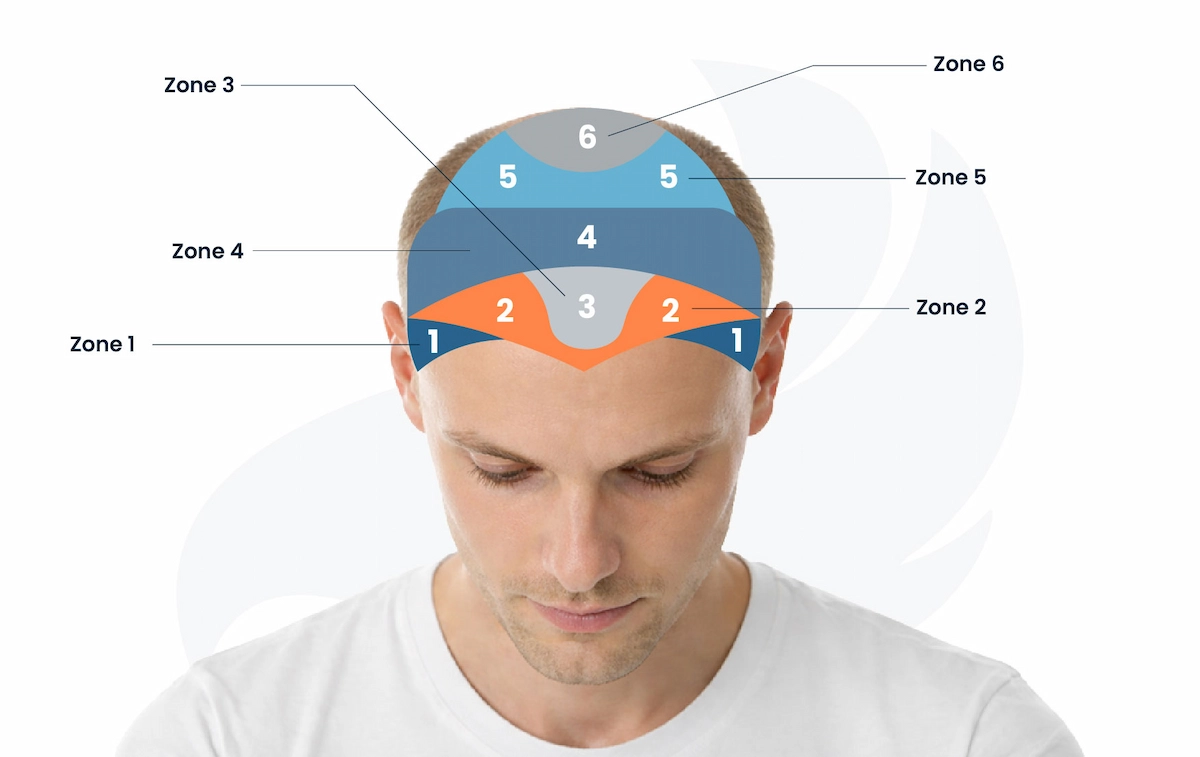
Dermatologist James Hamilton first mapped out the pattern of male hair loss in 1951, and surgeon O’Tar Norwood expanded it into the version still in clinical use today, published in 1975. Together their work produced a seven-point scale that tracks how androgenetic alopecia typically unfolds: recession creeping back from the temples, thinning spreading across the crown, and eventually the two areas meeting in the middle.
The scale earns its place in nearly every consultation because it gives a doctor and patient a common reference point in under a minute. Say “Stage 4” to a hair transplant surgeon anywhere in the world and they will picture roughly the same thing: an advanced frontal recession paired with a separate bald patch at the crown.
Where people tend to misuse the scale is treating it as a forecast. It is not one. A stage number is a snapshot of today, not a projection of where things are headed, and it says nothing about how fast a person got there or how fast they will keep going. Two patients can sit in the same Stage 3 chair and need entirely different treatment plans once a surgeon factors in their hair thickness, the density of their donor area, how curly or straight their hair is, and how loose or tight their scalp sits.
The scale was also built around male hair loss specifically. Women lose hair in a different pattern, a diffuse thinning that spreads from the centre part outward rather than receding at the temples, and that pattern is measured using the Ludwig or Sinclair scale instead. Trying to fit a woman’s hair loss onto the Norwood chart simply does not work, since the underlying biology is different.
“Patients walk in already knowing their stage number from an online quiz,” says Dr. Gökay Bilgin. “My job in that first meeting is to explain that the number opens the conversation. It doesn’t finish it. Two men at Stage 4 can leave my office with completely different surgical plans once we’ve looked at their donor hair and their age.“
Hair Loss Stages According to the Norwood Scale
Each stage below describes the typical pattern, what tends to be achievable, and how surgeons approach treatment at that point.
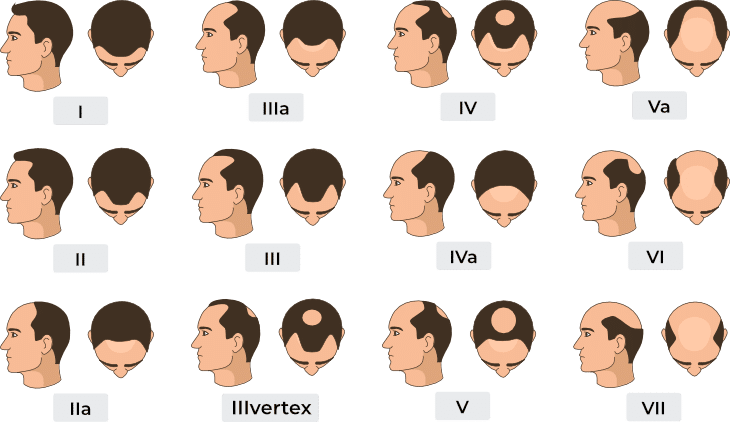
Norwood Stage 1
Nothing has visibly changed yet. The hairline still sits where it did in the patient’s twenties, density is even across the scalp, and there is no clinical reason to recommend surgery.
If a man at this stage has a strong family history of baldness, or a trichoscopy reveals early miniaturisation under magnification, starting finasteride or minoxidil now can buy years before anything becomes visible. Beyond that, the only real instruction at Stage 1 is to leave the donor area alone. There is nothing to harvest from yet, and nothing that needs harvesting.
Norwood Stage 2
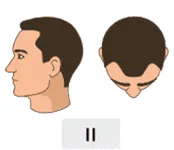
A faint triangular notch shows up at one or both temples. It is subtle enough that most people other than the patient himself would never notice it in passing.
This is the stage where awareness tends to kick in, and unfortunately also the stage where treatment gets postponed the most, simply because the change still feels minor. That delay is a missed opportunity, because medical therapy works best exactly here. Finasteride taken consistently can stop, and in some cases partially reverse, the miniaturisation happening under the surface. Minoxidil adds support by keeping follicles in their growth phase longer. PRP injections can be layered on top of either for added follicle stimulation.
For men who want the hairline sharpened rather than simply held in place, a modest FUE or DHI session, typically under 1,000 grafts, can do that without much downtime. Donor hair at this point is almost always plentiful, so there is no real planning constraint to worry about.
Norwood Stage 3
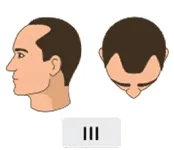
The temple recession has become obvious now, carving out a clear M or V shape at the front. Two recognised variants branch off from here. Stage 3A describes a pattern where the entire front hairline moves straight back as one uniform band, without the temple points forming a clear M shape, more of an even retreat across the whole forehead. Stage 3 Vertex (3V) takes the opposite direction: the classic M-shaped temple recession stays, but early thinning also opens up at the crown, so two separate zones are losing density at once.
Stage 3 is where most consultations actually happen. It is also where the question of whether a patient’s hair loss has stabilised or is still actively progressing starts to carry real weight, especially in patients under thirty.
From a surgical standpoint, this stage tends to produce some of the best outcomes on the entire scale. The donor area is still dense, the scalp still holds plenty of healthy follicles, and the distance between the current hairline and a natural-looking target hairline is relatively short. A well-executed FUE or DHI procedure, usually somewhere between 1,500 and 2,500 grafts, can rebuild that frontal line convincingly. Patients who continue medication after surgery protect the native hair still surrounding the new graft lines, since the transplant addresses what has already been lost while the medication holds the line on what hasn’t happened yet.
Norwood Stage 4
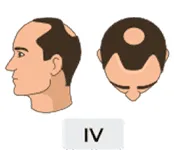
The frontal recession deepens further, and now a separate bald or thinning patch opens up at the crown, usually still divided from the front by a strip of remaining hair. Two zones need attention simultaneously for the first time, which is also when donor planning starts to genuinely matter rather than being an afterthought. A variant, Stage 4A, follows the same logic as 3A one step further: the entire frontal hairline continues its uniform retreat without a true M shape ever forming, and without the distinct crown patch that defines standard Stage 4.
Both zones are realistically treatable at this stage, with graft counts typically landing somewhere between 2,500 and 4,000 depending on the scalp’s exact dimensions. Surgeons usually prioritise the frontal area first, since it does the most work visually in framing the face, then move to the crown if donor supply allows.
Dr. Bilgin points out that patients arriving at Stage 4 have often been watching their hairline shift for several years already. “The conversation that actually matters isn’t just what we can build today,” he explains. “It’s whether that hairline still makes sense fifteen years from now. A result that looks great at 40 has to hold up at 55 too.”
Norwood Stage 5
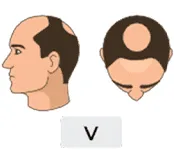
The bald zones at the front and crown keep expanding until they nearly touch, leaving only a narrow bridge of hair separating them. The total area needing coverage is now substantially larger than at Stage 4, which pushes donor demand up and introduces a real risk: take too many grafts from the back and sides, and that area itself starts to look thin.

A solid frontal frame combined with partial crown coverage is generally achievable. Full, dense crown restoration in one sitting usually is not, and depending on how much donor hair is available, might not be fully achievable across multiple sittings either. Graft counts here often run from 3,500 up to 5,000 or beyond, and the specific hair calibre and curl pattern end up mattering enormously, since they determine how far that graft count can actually stretch visually. In cases where scalp donor supply alone won’t cover the plan, body hair can be brought in to supplement it.
Norwood Stage 6
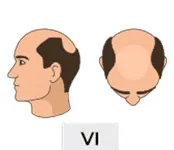
The front and crown have now merged into one continuous bald region, leaving a horseshoe-shaped band of hair running along the sides and back. That remaining band is the entire donor supply at this point, nothing more.
Full transplant-based restoration is no longer realistic here, so the conversation shifts toward making the most of a limited donor resource. The usual priority is rebuilding a believable frontal frame to restore facial balance, with whatever mid-scalp coverage the donor area can support layered in afterward. Full crown density is generally off the table without risking visible thinning in the donor zone. Scalp micropigmentation often enters the conversation at this stage too, either on its own or paired with transplantation to create the visual impression of more density than is actually there.

Norwood Stage 7
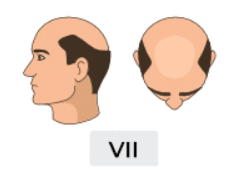
Only a thin perimeter of hair remains, tracing the edges of the scalp. This marks the far end of the scale, where the gap between available donor hair and the area needing coverage is too wide for transplantation to close on its own.
Most patients at Stage 7 are better served by non-surgical solutions: scalp micropigmentation to mimic an evenly shaved head, or hair systems for those wanting fuller visible coverage. A small, conservative FUE session to soften the front edge can occasionally make sense for patients with unusually strong donor quality, but it is rarely the headline recommendation.
“These are the consultations that require the most honesty,” says Dr. Mehmet Erdoğan. “Patients often walk in with expectations shaped by before-and-after photos of men who started at a much earlier stage. Part of the work is resetting that picture and helping them find confidence in what’s actually achievable for them specifically.“
How do Hair Transplant Doctors Use the Norwood Scale?
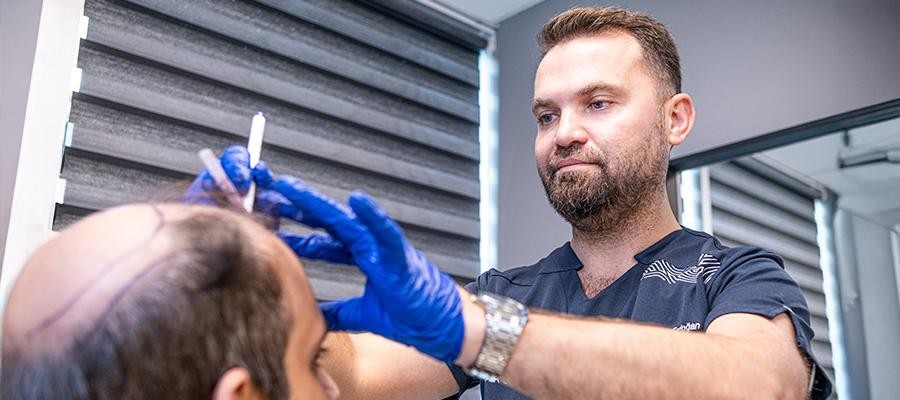
In an actual consultation room, the stage number functions as a starting point, not a formula that spits out a graft count. Age matters more than people expect: a 22-year-old already at Stage 3 may still have decades of progression ahead with no way to know where it will settle, which is why most surgeons hold off on large procedures before roughly age 25 to 28.
Patients who notice recession later in life, in their mid-forties say, tend to have a more predictable trajectory, since the rate of progression has already shown itself.
The rest comes down to what the stage number can’t show. Coarse, thick hair covers more surface area per graft than fine hair, so two men at the same stage can need very different graft totals for the same visual density. Donor density sets a hard ceiling on how much can be harvested without thinning the donor zone itself, and scalp laxity affects how efficiently that harvesting goes. Technique follows a similar logic: DHI tends to suit earlier stages well since it disturbs less native hair, while FUE and Sapphire FUE handle larger Stage 4 to 6 sessions more efficiently.
“Men come in having already calculated their own graft number from some chart online,” Dr. Bilgin notes. “That number usually needs adjusting once we look at their scalp under magnification. What matters isn’t the stage average. It’s the number we calculate from their individual donor capacity.“
Which Norwood Stage Should You Seek Hair Loss Treatment?
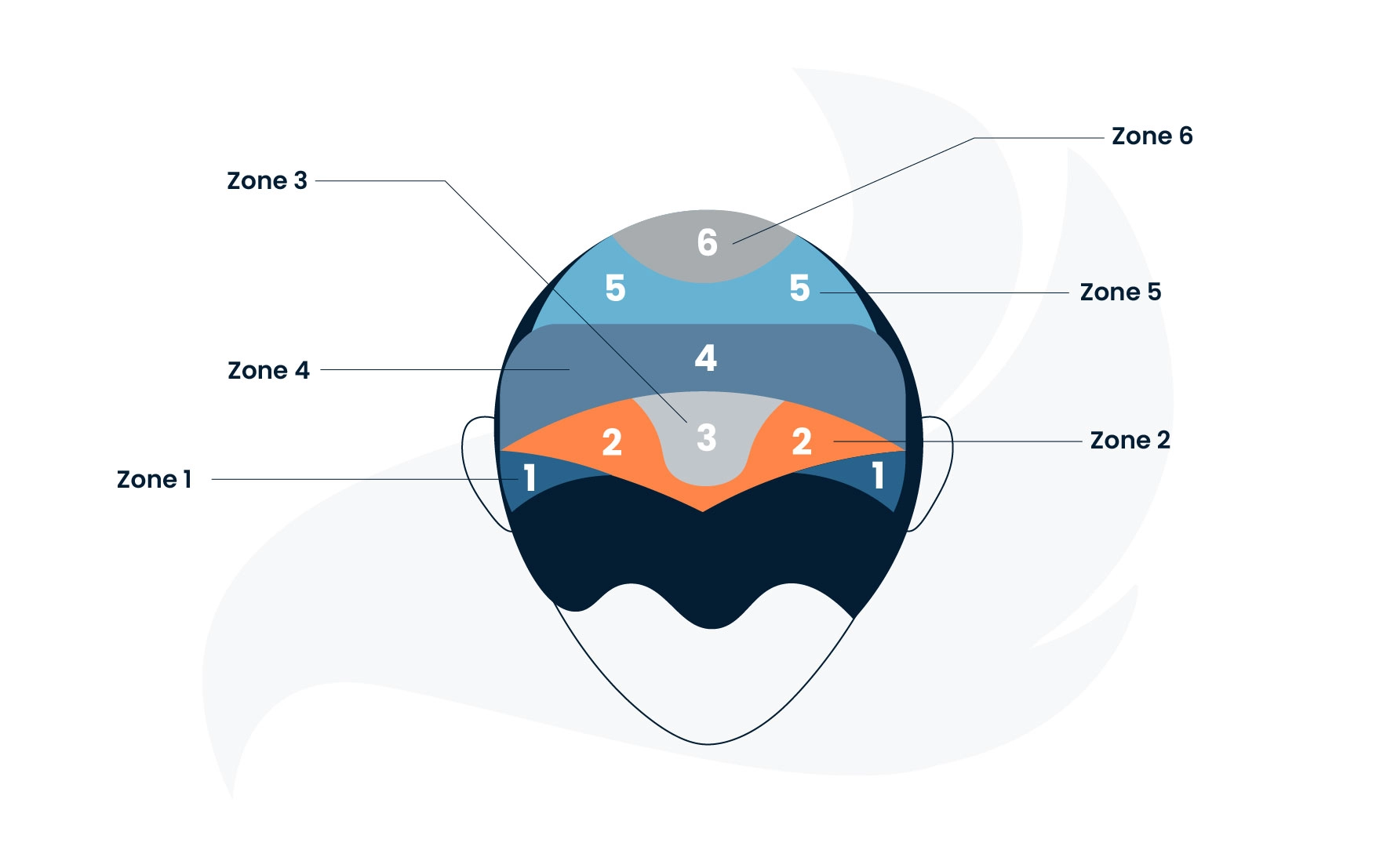
A handful of signs suggest it’s time to stop watching and start acting: visible thinning creeping in at the temples or crown, shedding that feels heavier than the usual daily amount, a close family member with significant baldness, or hair thin enough that scalp becomes visible through it at the front.
Acting earlier simply keeps more doors open. At Stages 1 and 2, medication alone carries the strongest evidence and the goal is holding the line rather than rebuilding anything. Surgery starts making sense from Stage 3 onward for most men, and Stages 3 through 5 tend to offer the best ratio between what’s achievable and what the donor area can supply. By Stages 6 and 7, donor hair becomes the bottleneck, and the conversation naturally shifts away from full restoration toward realistic framing, often bringing scalp micropigmentation or hair systems into the plan.
Age and how fast someone is progressing matter as much as the raw stage number does. A genuine clinical evaluation goes well past comparing a photo to a chart on a wall. It involves measuring donor density under trichoscopy, estimating where the pattern is likely to go from here, and building a recommendation, whether medical, surgical, or a mix of both, around the individual rather than a generic stage average. Booking a consultation is the only way to get that specific a read on your own situation and donor capacity.
One last note for women reading this: the Norwood scale simply does not map onto your pattern of hair loss. Female hair thinning typically spreads diffusely from the centre part rather than receding at the temples, and is measured using the Ludwig or Sinclair scale instead. A specialist evaluation is the only reliable way to get an accurate read on what’s actually happening.
Female Hair Loss and the Norwood Scale — Why It Does Not Apply?
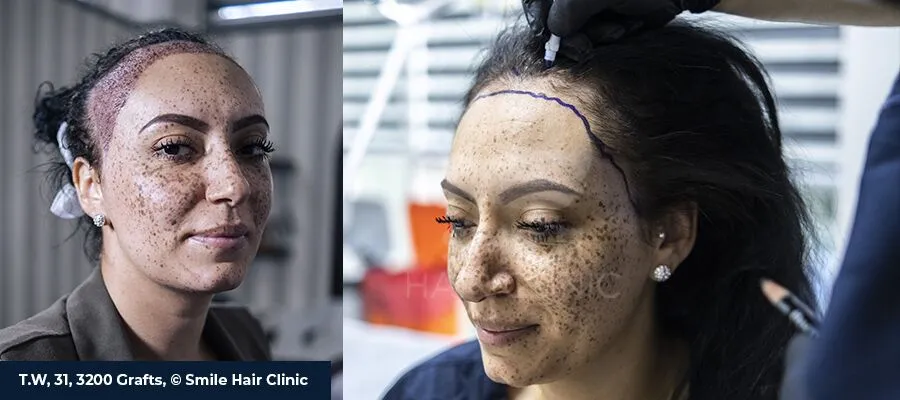
The Norwood scale was developed specifically for male androgenetic alopecia and is not an appropriate classification tool for women.
Female pattern hair loss follows a different distribution. Rather than receding from the temples and crown, women typically experience diffuse thinning across the central scalp — often beginning at the part line and gradually widening — while the frontal hairline is usually preserved. This pattern is classified using the Ludwig scale or the Sinclair scale, both of which were developed specifically for female presentations.
Women who use the Norwood scale to assess their own hair loss are applying a framework that does not match their biology. A woman at what visually resembles “Norwood Stage 3” based on frontal appearance may actually have a completely different underlying pattern and require a completely different treatment approach.
If you are a woman experiencing hair thinning, a specialist assessment at Smile Hair Clinic can determine the correct classification, identify the underlying cause, and build a treatment plan suited to your specific pattern. Book a free consultation to get a precise diagnosis and understand your options.
FAQs on Norwood Scale and Hair Restoration
What is the difference between the Norwood scale and the Ludwig scale?
The Norwood scale classifies male pattern hair loss. The Ludwig scale classifies female pattern hair loss, which follows a different distribution and requires different treatment planning.
At what Norwood stage should I consider a hair transplant?
Surgery becomes a realistic option from Stage 3 onward for most patients. Stages 3 through 5 generally offer the best balance between achievable coverage and available donor supply. Age and progression rate are equally important considerations alongside the stage itself.
Can the Norwood scale predict how much hair I will lose?
No. It describes current loss, not future progression. Progression rate depends on genetics, age at onset, and hormonal factors — none of which the stage alone can quantify.
I am in my early twenties and at Norwood Stage 3. Should I have a transplant now?
Early onset hair loss in young men requires particularly careful evaluation before surgery. Medical therapy is typically the priority at this age. A transplant may be appropriate in selected cases, but the plan must account for the likelihood of continued progression and the need to preserve donor hair for the future.
Can medication reverse a Norwood stage?
In some cases, particularly in the early stages, finasteride and minoxidil can produce visible regrowth in miniaturized areas, effectively improving the apparent stage. This is more likely in Stages 1–3 than in later stages where loss is more established.
How is donor density assessed?
Donor density is measured using trichoscopy — a clinical tool that magnifies the scalp and allows the surgeon to count follicular units per square centimetre in the permanent donor zone. This assessment is a standard part of any surgical consultation and cannot be accurately estimated from photos alone.
Is Norwood Stage 7 treatable?
Full restoration is not achievable at Stage 7. Realistic options include scalp micropigmentation, hair systems, or very limited FUE to create a subtle frontal frame in patients with adequate donor quality.
Sources
- Norwood OT. Male pattern baldness: classification and incidence. Southern Medical Journal. 1975;68(11):1359–1365. PubMed: https://pubmed.ncbi.nlm.nih.gov/1188424/
- Hamilton JB. Patterned loss of hair in man; types and incidence. Annals of the New York Academy of Sciences. 1951;53(3):708–728. https://pubmed.ncbi.nlm.nih.gov/14819896/
- Olsen EA. Female pattern hair loss and its relationship to permanent/cicatricial alopecia: a new perspective. Journal of Investigative Dermatology Symposium Proceedings. 2005;10(3):217–221. https://pubmed.ncbi.nlm.nih.gov/16382672/
