


Table of Contents
If you have noticed more hair in the shower drain since starting a GLP-1 weight loss medication, you are not imagining it — and you are far from alone. Hair loss is one of the most commonly discussed side effects among people taking Ozempic, Mounjaro, and Saxenda, and the question has attracted serious scientific attention over the past two years.
The short answer is nuanced: none of these drugs has been shown to directly damage hair follicles, but the rapid weight loss they trigger can set off a well-documented temporary condition called telogen effluvium. Whether the drugs themselves play any additional role is still under active investigation.
This article walks through what the clinical evidence actually shows — including data from the major trials — and what you can do about it.
Understanding GLP-1 Medications: What They Are and How They Work
Before looking at the hair loss data, it helps to understand what these drugs do in the body.
Ozempic and Wegovy both contain semaglutide, a GLP-1 (glucagon-like peptide-1) receptor agonist developed by Novo Nordisk. Ozempic is approved for type 2 diabetes management; Wegovy contains a higher dose and is approved specifically for weight loss. Both work by mimicking GLP-1, a hormone that signals satiety to the brain, slows gastric emptying, and stimulates insulin release. The result is a significant reduction in appetite and, over time, substantial weight loss.
Mounjaro and Zepbound contain tirzepatide, developed by Eli Lilly. Tirzepatide is a dual agonist — it activates both GLP-1 and GIP (glucose-dependent insulinotropic polypeptide) receptors simultaneously. This dual mechanism makes it particularly effective for weight reduction, with participants in clinical trials losing a higher percentage of body weight on average than those on semaglutide-only treatments.
Saxenda contains liraglutide, an older GLP-1 agonist also produced by Novo Nordisk. It requires daily injection rather than the weekly schedule of semaglutide and tirzepatide, and tends to produce more modest weight loss.
All three medications achieve their effect primarily through appetite suppression. That suppression — and the caloric deficit it creates — is central to understanding why some users experience hair loss.
The Drug vs. the Weight Loss: A Critical Distinction
This is probably the most important point in this article, and it is one that is frequently lost in general media coverage.
Hair follicles are metabolically active structures. They require a continuous supply of protein, iron, zinc, biotin, and vitamins D and B12 to maintain normal growth.
When caloric intake drops sharply — as it does on a GLP-1 medication — the body enters a mild stress response. In this state, it prioritises essential functions (organ maintenance, immune activity, core metabolism) over what it classifies as non-essential ones. Hair growth is considered non-essential.
The result is telogen effluvium: a temporary shift in the proportion of hair follicles from the active growth phase (anagen) to the resting phase (telogen), followed by shedding approximately 2 to 4 months later. Crucially, telogen effluvium does not damage the follicle itself. Once the physiological stress resolves — typically when weight stabilises and nutritional intake normalises — the follicles re-enter the growth phase and hair returns.
This same phenomenon is well-documented after bariatric surgery, crash dieting, serious illness, childbirth, and other forms of rapid physiological change. It is not specific to GLP-1 drugs.
That said, the picture is not entirely settled. Recent pharmacovigilance analyses suggest there may be an additional signal beyond weight loss alone — particularly for semaglutide and tirzepatide — that warrants further investigation. More on that below.
Ozempic and Hair Loss: What the Data Shows
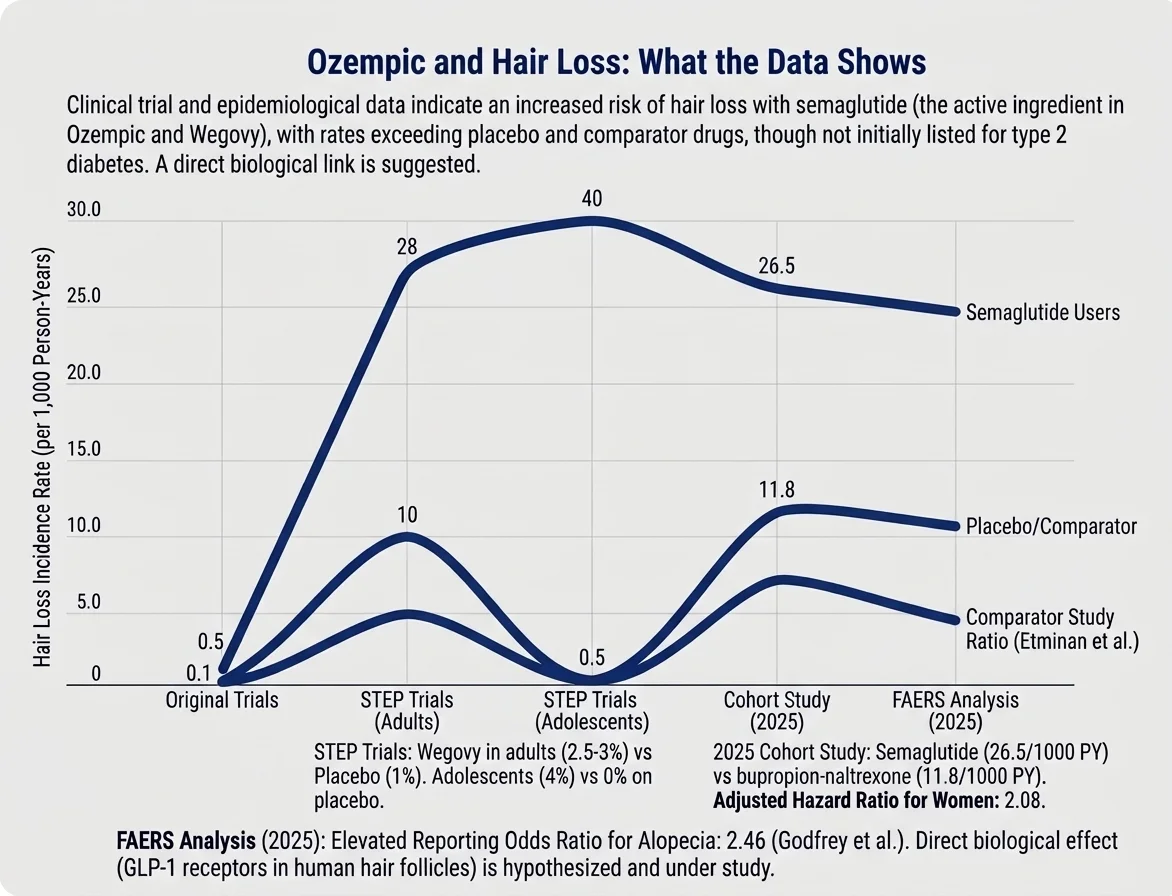
Hair loss does not appear in Ozempic’s official prescribing information as a listed side effect, because the original diabetes indication trials (the SUSTAIN series) did not document it at a clinically significant rate.
However, when semaglutide was studied at higher doses for obesity under the Wegovy brand, a different picture emerged. In the STEP (Semaglutide Treatment Effect in People with obesity) clinical trial programme, hair loss was reported in 2.5% to 3% of adults taking Wegovy, compared to approximately 1% in the placebo group. In adolescents aged 12 and older, the figure was 4% versus 0% on placebo.
A 2025 cohort study published on medRxiv (Etminan et al., University of British Columbia) found that the incidence rate of hair loss among semaglutide users was 26.5 per 1,000 person-years, compared to 11.8 per 1,000 among users of bupropion-naltrexone. The adjusted hazard ratio for women specifically was 2.08 (95% CI: 1.17–3.72) — a statistically meaningful difference.
Separately, a disproportionality analysis of the FDA Adverse Event Reporting System (FAERS) by Godfrey et al., published in the Journal of the European Academy of Dermatology and Venereology (2025), found an elevated reporting odds ratio for alopecia with semaglutide of 2.46 (95% CI: 2.14–2.83). This does not prove causation, but it does indicate that semaglutide users are reporting hair loss at a higher rate than would be expected by chance.
The working hypothesis among researchers is that most of this signal is attributable to the speed and magnitude of weight loss. But some scientists have noted that GLP-1 receptors are expressed in human hair follicles, raising the possibility of a direct biological effect — one that has not been ruled out.
Mounjaro and Hair Loss: The Tirzepatide Evidence
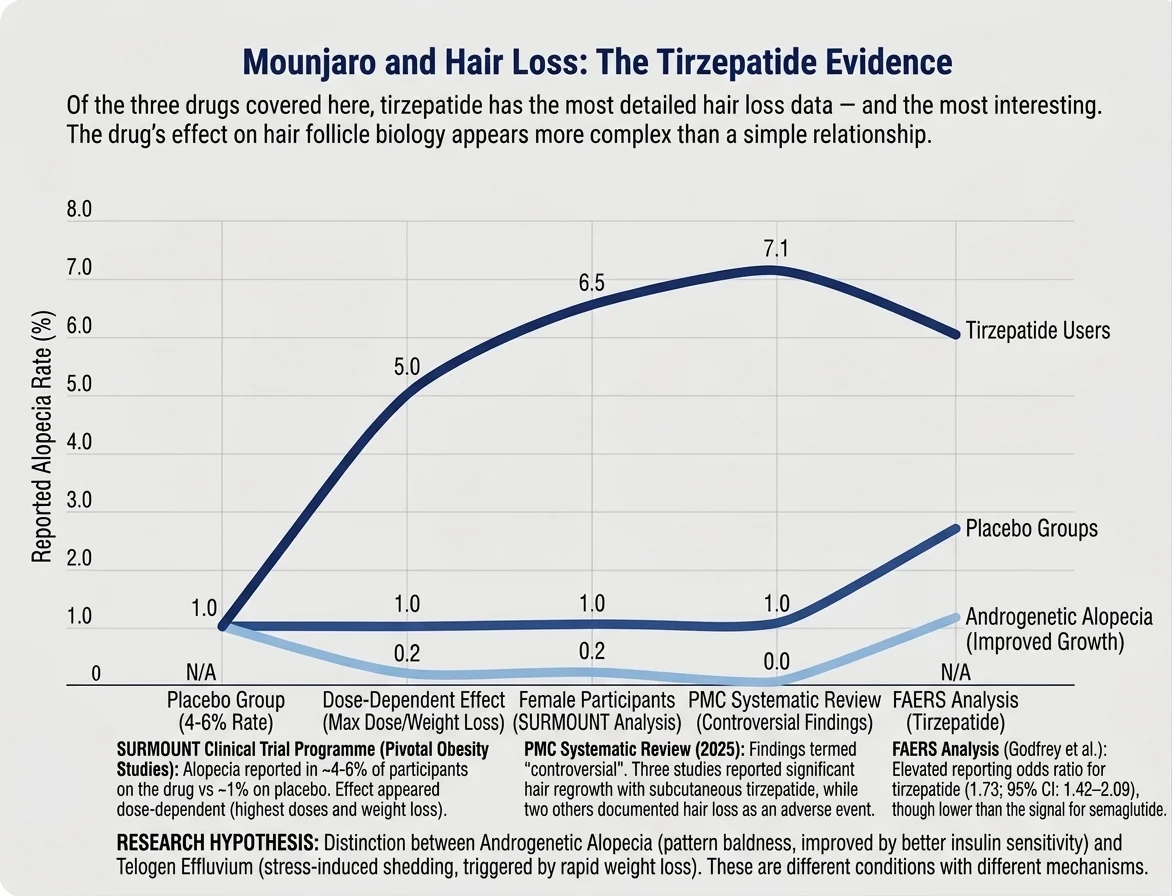
Of the three drugs covered here, tirzepatide has the most detailed hair loss data — and the most interesting.
Across the SURMOUNT clinical trial programme (the pivotal obesity studies evaluating tirzepatide), alopecia was reported in approximately 4% to 6% of participants receiving the drug, compared to around 1% in the placebo groups. The effect appeared dose-dependent: participants on the highest doses and those who lost the most weight were more likely to report hair shedding. Women were disproportionately affected, with some analyses showing rates approaching 7.1% in female participants versus under 1% in men.
The FAERS analysis by Godfrey et al. also found an elevated reporting odds ratio for tirzepatide (1.73; 95% CI: 1.42–2.09), though lower than the signal for semaglutide.
There is a complicating factor that makes tirzepatide particularly interesting from a research standpoint: some case reports and small studies have described improved hair growth in patients using tirzepatide for type 2 diabetes with concurrent androgenetic alopecia. A 2025 systematic review published in PMC (Hair Loss Associated With GLP-1 Receptor Agonist Use) found that three studies reported significant hair regrowth with subcutaneous tirzepatide, while two others documented hair loss as an adverse event. The reviewers concluded that findings are “controversial” and that the drug’s effect on hair follicle biology may be more complex than a simple positive or negative relationship.
This may reflect the distinction between androgenetic alopecia (pattern baldness, which can be improved by better insulin sensitivity and reduced androgen activity) and telogen effluvium (stress-induced shedding, which tirzepatide may trigger through rapid weight loss). These are different conditions with different mechanisms.
Saxenda and Hair Loss: The Liraglutide Picture
Liraglutide presents a different profile. The SCALE (Satiety and Clinical Adiposity – Liraglutide Evidence) programme, which enrolled over 5,000 participants across multiple international studies, did not identify hair loss as a statistically significant adverse event. It does not appear in the drug’s official Summary of Product Characteristics (SmPC) as a listed side effect, and the European Medicines Agency assessment reports do not flag it.
Post-marketing surveillance via the UK’s MHRA Yellow Card scheme has received isolated reports of alopecia associated with liraglutide, but at rates consistent with background incidence in the general population.
The FAERS analysis by Godfrey et al. notably did not find an elevated reporting odds ratio for liraglutide — in contrast to semaglutide and tirzepatide. This was also noted in a 2025 commentary in the Journal of the European Academy of Dermatology and Venereology (Buontempo et al.), which suggested the absence of a signal for once-daily liraglutide compared to once-weekly semaglutide and tirzepatide may reflect differences in dosing frequency, magnitude of weight loss, or drug-specific receptor dynamics.
In practical terms: Saxenda users are less likely to experience hair shedding than Ozempic or Mounjaro users, likely because liraglutide tends to produce slower, more modest weight loss that places less acute stress on the body.
The Biological Mechanisms: Why Hair Sheds During Weight Loss
Several distinct pathways have been proposed to explain GLP-1-associated hair loss. They are not mutually exclusive.
Telogen effluvium via nutritional stress. As described above, rapid caloric restriction depletes protein, iron, zinc, biotin, and vitamin D — all of which the hair follicle depends on. A 2025 review published in PMC (Alopecia and Semaglutide: Connecting the Dots for Patient Safety, Branyiczky et al., International Journal of Dermatology) specifically highlights micronutrient depletion — particularly iron, zinc, vitamin D, and biotin — as a primary pathway, noting these are “well-recognised triggers for telogen effluvium.”
Hormonal disruption. The same review notes that GLP-1 receptor agonists may cause subtle thyroid hormone fluctuations. Thyroid hormones play a central role in the hair follicle cycle, and even subclinical shifts can affect hair growth phases.
Direct follicular effects. GLP-1 receptors have been identified in human hair follicles. What their activation does — and whether it promotes or inhibits growth — is not yet clear, but this finding has been cited as a reason to investigate beyond the weight-loss hypothesis.
Insulin and androgen pathways. Improved insulin sensitivity from GLP-1 therapy may alter androgen production or follicular androgen sensitivity. This could theoretically be protective against androgenetic alopecia in some patients (which may explain the hair regrowth cases), or it may accelerate it in others depending on individual hormonal context.
Will the Hair Loss Be Permanent?
For the vast majority of people, no. Telogen effluvium is a temporary condition by definition. Once the physiological stress resolves — meaning weight stabilises, nutritional deficits are corrected, and the body adapts to its new metabolic state — hair follicles return to the growth phase. Visible regrowth typically begins within three to six months of stabilisation, though it may take considerably longer to reach pre-treatment density.
The important qualifier is this: GLP-1-associated hair shedding does not damage the follicle itself. There is no scarring, no follicular destruction. The equipment is intact; the factory simply went on pause.
However, if a person has an underlying predisposition to androgenetic alopecia (pattern hair loss), rapid weight loss may accelerate the progression of that condition — which, unlike telogen effluvium, does involve a degree of permanent follicular miniaturisation. In such cases, shedding may not fully reverse even after weight stabilises.
What You Can Do: Practical Measures
If you are taking a GLP-1 medication and experiencing hair thinning, there are several evidence-informed steps worth considering.
Prioritise protein intake. Hair is made of keratin, a protein. During rapid weight loss, protein intake often falls below what the follicle needs. Aim for adequate daily protein — your prescribing physician can advise on specific targets based on your weight and activity level.
Monitor key micronutrients. Iron, ferritin, zinc, vitamin D, and biotin levels are all worth checking with a blood test if you are experiencing noticeable shedding. Correcting a deficiency can often halt and reverse telogen effluvium.
Do not panic at the timeline. Shedding typically begins two to four months after the triggering event — meaning the hair you lose in month three is responding to what happened in month one. This delay causes many people to incorrectly attribute the loss to something current.
Consider a dermatology consultation. If shedding is severe, patchy, or has persisted for more than six months, a dermatologist can confirm the diagnosis and rule out other causes (thyroid disease, iron deficiency anaemia, androgenetic alopecia) that may require separate treatment.
Other Weight Loss Medications and Hair Loss
While this article focuses on GLP-1 drugs, it is worth noting briefly that hair loss has been associated with several other weight loss medications, each through slightly different mechanisms.
Phentermine (and the combination drug phentermine-topiramate/Qsymia) can trigger telogen effluvium through rapid weight loss and has been associated with changes in nutrient balance. Orlistat (Alli, Xenical) inhibits fat absorption and can reduce levels of fat-soluble vitamins A, D, E, and K, all of which contribute to follicular health. Naltrexone-bupropion (Contrave) has isolated case reports of hair loss, though the mechanism is unclear. In all cases, the common thread is either nutritional depletion or metabolic stress — the same underlying dynamics seen with GLP-1 drugs.
Can You Have a Hair Transplant If You Are on Ozempic, Mounjaro, or Saxenda?
This is a question our clinic receives with increasing frequency. The general answer is: it depends on your current health status, and the timing matters.
A hair transplant is a surgical procedure that requires a period of physiological stability. If you are still in the active, rapid weight-loss phase of GLP-1 therapy, your body is under metabolic stress, and your nutritional reserves may be suboptimal. These are not ideal conditions for surgical recovery or for the survival of transplanted grafts.
Once weight has stabilised — typically after six to twelve months on a maintenance dose — and nutritional markers (protein, iron, vitamin D) have been corrected, a transplant becomes a realistic option. For those whose hair loss has not fully reversed despite weight stabilisation, FUE transplantation can restore density permanently and naturally.
If you are considering this and are currently on a GLP-1 medication, we recommend a consultation to assess your current situation in detail.
Expert Commentary: Dr. Gökay Bilgin, Smile Hair Clinic
Co-founder and Hair Transplant Doctor, Smile Hair Clinic, Istanbul
“We have seen a notable increase in consultations from patients who are on or have recently completed GLP-1 therapy over the past two years. The pattern is consistent: diffuse shedding starting two to four months after significant weight loss begins, frequently accompanied by low ferritin or vitamin D on blood work.
In most cases, this is telogen effluvium — temporary, and manageable with nutritional correction and patience. But I want to be clear that ‘temporary’ still means months of visible thinning for many patients, which has a real impact on quality of life and confidence.
Where it gets more complex is when a patient has an underlying androgenetic alopecia predisposition that the rapid weight loss has unmasked or accelerated. In those cases, the shedding may not fully resolve on its own, and a more comprehensive approach — including possible transplantation once the patient is stable — may be appropriate.
My advice to anyone on these medications: get your iron and vitamin D checked early, don’t wait until you are seeing significant shedding. Prevention is considerably easier than reversal.”
Frequently Asked Questions
Does Ozempic directly cause hair loss?
Ozempic (semaglutide) is not believed to directly damage hair follicles. The most likely cause of hair loss in Ozempic users is telogen effluvium — a temporary shedding triggered by rapid weight loss and the nutritional stress it places on the body. However, recent pharmacovigilance analyses suggest there may be an additional drug-related signal, which is still under investigation.
How common is hair loss with Mounjaro?
In the SURMOUNT clinical trials, alopecia was reported in approximately 4% to 6% of tirzepatide-treated participants, compared to around 1% in placebo groups. It was more common in women and in those on higher doses who lost more weight.
Does hair grow back after stopping Ozempic or Mounjaro?
For most people, yes. Telogen effluvium does not damage follicles — once the metabolic stress resolves and nutritional status improves, regrowth typically begins within three to six months. If hair loss has not resolved after six months of weight stability, it is worth consulting a dermatologist to assess whether other factors are involved.
Why is Saxenda less associated with hair loss than Ozempic?
Saxenda (liraglutide) was not associated with elevated hair loss rates in the SCALE trials or in FDA pharmacovigilance data, in contrast to semaglutide and tirzepatide. Researchers have suggested this may relate to liraglutide’s daily dosing schedule, the generally more modest and gradual weight loss it produces, or differences in receptor dynamics.
When is the right time for a hair transplant after GLP-1 therapy?
Generally, once weight has been stable for at least six months, nutritional markers have been corrected, and any active shedding has resolved. The stability of your physiology matters considerably for graft survival and outcome quality.
References & Sources
- Branyiczky, Z. et al. (2025). Effects of GLP-1 Receptor Agonists on Hair Loss and Regrowth: A Systematic Review. International Journal of Dermatology. https://doi.org/10.1111/ijd.70133
- Godfrey, et al. (2025). Exploring the hair loss risk in glucagon-like peptide-1 agonists: Emerging concerns and clinical implications. Journal of the European Academy of Dermatology and Venereology. https://doi.org/10.1111/jdv.20512
- Etminan, M. et al. (2025). Risk of Hair Loss with Semaglutide for Weight Loss. medRxiv (preprint). https://doi.org/10.1101/2025.02.23.25322568
- PMC / NCBI. (2025). Alopecia and Semaglutide: Connecting the Dots for Patient Safety. PMC11909624. https://www.ncbi.nlm.nih.gov/pmc/articles/PMC11909624/
- PMC / NCBI. (2025). Hair Loss Associated With Glucagon-Like Peptide-1 (GLP-1) Receptor Agonist Use: A Systematic Review. PMC12530271. https://pmc.ncbi.nlm.nih.gov/articles/PMC12530271/
- PMC / NCBI. (2025). Alopecia as an Emerging Adverse Effect Associated With GLP-1 Receptor Agonists for Weight Loss: A Scoping Review. Cureus / PMC12431796. https://www.ncbi.nlm.nih.gov/pmc/articles/PMC12431796/
- Jastreboff, A.M. et al. (2022). Tirzepatide Once Weekly for the Treatment of Obesity (SURMOUNT-1). New England Journal of Medicine. https://doi.org/10.1056/NEJMoa2206038
- Kim, S. et al. (2024). Hair loss during tirzepatide treatment for type 2 diabetes and obesity: a systematic review. Diabetes, Metabolic Syndrome and Obesity. PMC10821865. https://pmc.ncbi.nlm.nih.gov/articles/PMC10821865/
- Ali, A. et al. (2024). Alopecia as a Side Effect of GLP-1 Receptor Agonists: A Systematic Review and Meta-analysis. Cureus. PMC10866037. https://pmc.ncbi.nlm.nih.gov/articles/PMC10866037/
- Burke, J. et al. / PMC / NCBI. (2025). Benefit-Risk Assessment of GLP-1 Receptor Agonists: Implications for Dermatologists and Plastic Surgeons. PMC12549488. https://pmc.ncbi.nlm.nih.gov/articles/PMC12549488/
