


Table of Contents
An itchy scalp, greasy flakes, redness, and stubborn dandruff can all be signs of seborrheic dermatitis on the scalp. The condition often improves with treatment, only to return weeks or months later. That pattern can be frustrating, but it is also typical. Seborrheic dermatitis is a chronic, relapsing skin condition, so treatment usually focuses on controlling flare-ups and keeping symptoms quiet rather than providing a permanent cure.
Medicated shampoos are the main starting point for scalp symptoms. Ketoconazole, zinc pyrithione, selenium sulfide, salicylic acid, and coal tar are commonly used ingredients. More inflamed or persistent cases may require prescription antifungals or short courses of anti-inflammatory medication.
What is seborrheic dermatitis?
Seborrheic dermatitis is an inflammatory skin condition that tends to develop in areas with more sebaceous glands. The scalp is one of the most commonly affected areas, but symptoms may also occur around the eyebrows, sides of the nose, ears, beard, and upper chest.
Scalp seborrheic dermatitis can cause white or yellowish flakes, greasy scale, itching, irritation, and visible redness. Symptoms range from mild dandruff-like flaking to thicker patches with considerable inflammation.
The condition is not caused simply by poor hygiene. Washing habits may influence symptoms, but seborrheic dermatitis involves a more complex interaction between skin oil, microorganisms on the skin, and the inflammatory response.
What causes seborrheic dermatitis on the scalp?
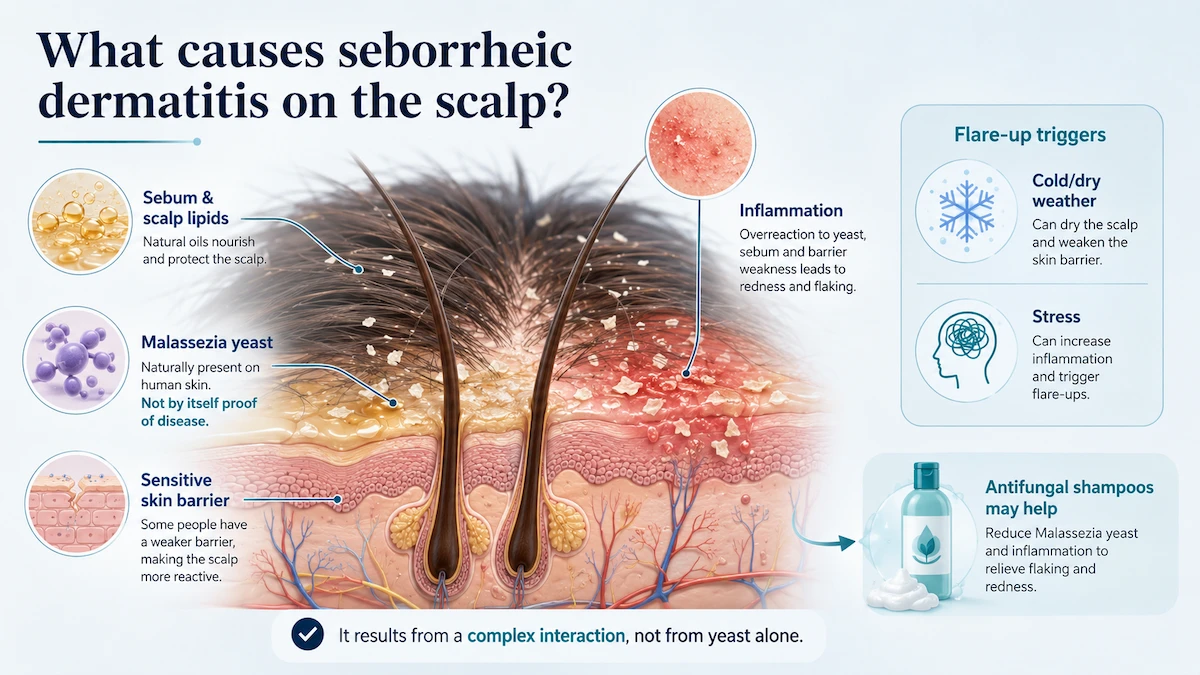
The exact cause is not completely understood. Research points to an interaction between sebum, individual skin susceptibility, inflammation, the skin barrier, and yeasts from the Malassezia genus. Malassezia normally lives on human skin, so its presence alone does not mean someone has seborrheic dermatitis.
The yeast can use lipids found in sebum. In susceptible skin, substances produced during this process may contribute to irritation and inflammation. This helps explain why antifungal shampoos can reduce symptoms even though seborrheic dermatitis is not simply a conventional fungal infection.
Symptoms can also fluctuate over time. Cold or dry weather, stress, and changes in skin condition may be associated with flare-ups in some people.
Seborrheic dermatitis vs. dandruff, what’s the difference?
Dandruff and seborrheic dermatitis are often considered part of the same spectrum. Dandruff is generally limited to the scalp and mainly causes visible flaking, usually without the obvious inflammation associated with seborrheic dermatitis.
Seborrheic dermatitis can cause more noticeable redness, irritation, itching, and greasy or thicker scale. It may also extend beyond the scalp to other oil-rich areas of the face and body.
This difference matters when selecting treatment. Mild dandruff may respond to regular anti-dandruff shampoo, while an inflamed seborrheic dermatitis flare may require antifungal treatment combined with short-term anti-inflammatory therapy.
Over-the-counter treatments
Medicated shampoos are usually the first treatment considered for mild to moderate scalp seborrheic dermatitis. Different ingredients work in different ways, so switching or rotating shampoos may sometimes be useful when one option does not provide enough control.
Ketoconazole shampoo
Ketoconazole is an antifungal medication that reduces Malassezia activity. It is one of the better-studied treatments for scalp seborrheic dermatitis. Ketoconazole shampoos are available in different strengths depending on the country and product.
A randomized trial comparing 2% ketoconazole with 1% zinc pyrithione found both improved severe dandruff and scalp seborrheic dermatitis, but ketoconazole produced greater improvement in that study.
Treatment schedules vary. Ketoconazole shampoo is commonly used several times per week during an active flare and then less often for maintenance. It needs enough contact time with the scalp to work, rather than being rinsed away immediately.
Zinc pyrithione shampoo
Zinc pyrithione has antifungal and anti-dandruff activity and has long been used in medicated shampoos. In the United States, the FDA OTC monograph lists pyrithione zinc at concentrations of 0.3% to 2% for dandruff control.
Research supports its ability to improve dandruff and seborrheic dermatitis symptoms, although some comparative studies have found ketoconazole more effective in severe disease.
Zinc pyrithione can be a practical maintenance option for people who tolerate it well. Product availability and permitted formulations vary between countries.
Selenium sulfide shampoo
Selenium sulfide reduces scalp flaking and has activity against organisms associated with dandruff and seborrheic dermatitis. Controlled trials have shown that selenium sulfide shampoos can significantly improve scaling and itching compared with placebo.
A more recent comparison also found selenium disulfide shampoo effective for scalp seborrheic dermatitis, with results comparable to ketoconazole in the studied group.
Some people experience dryness, irritation, or an unpleasant smell with selenium-containing products. Following the product instructions and rinsing thoroughly can reduce unnecessary irritation.
Salicylic acid and coal tar shampoo
Salicylic acid acts mainly as a keratolytic, meaning it helps loosen and remove accumulated scale. It can be useful when thick flakes make it difficult for other treatments to reach the scalp. The FDA OTC monograph includes salicylic acid among active ingredients used in products for dandruff, seborrheic dermatitis, and related scaling disorders.
Coal tar helps reduce scaling and excessive skin-cell turnover. It is also used in certain anti-dandruff products. Neither ingredient directly targets Malassezia as strongly as antifungal shampoos, so they may work better as part of a broader scalp routine rather than as the only treatment for inflamed seborrheic dermatitis.
How to use medicated shampoo correctly?
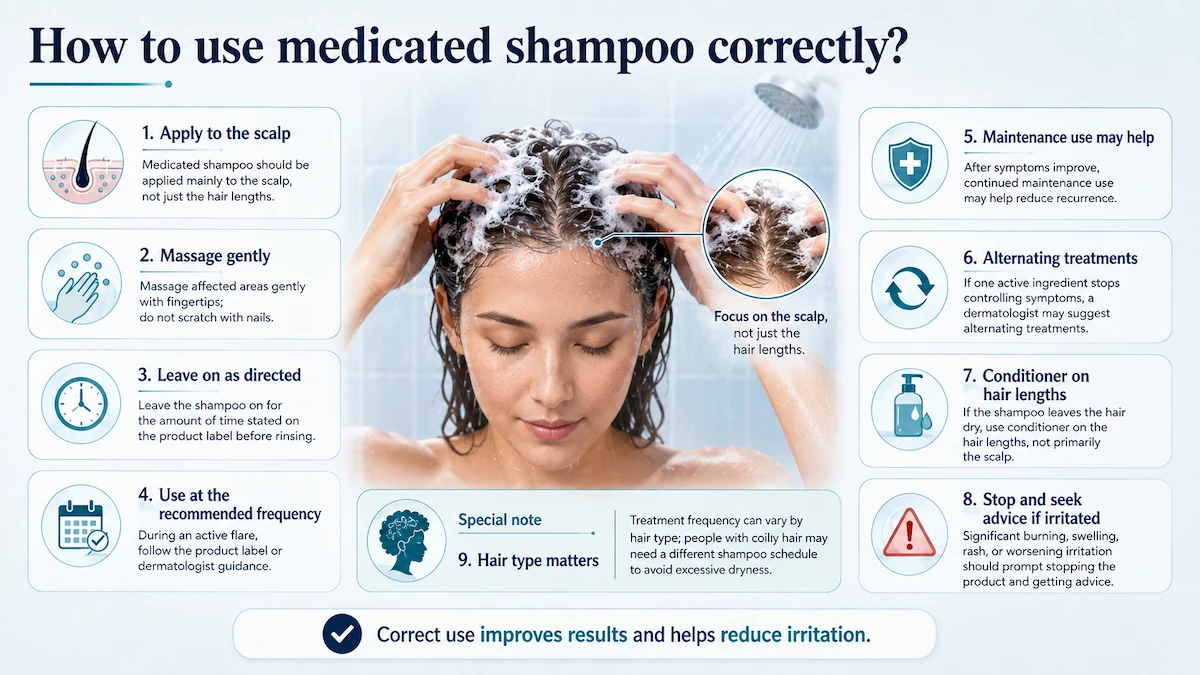
Using the right shampoo incorrectly can limit the result. General principles include:
- Apply medicated shampoo mainly to the scalp, not just the hair lengths.
- Massage it gently over affected areas without scratching with the nails.
- Leave it on for the amount of time stated on the product label before rinsing.
- During an active flare, use it at the frequency recommended on the label or by a dermatologist.
- Once symptoms improve, maintenance use may help reduce recurrence.
- If one active ingredient stops controlling symptoms, a dermatologist may suggest alternating treatments.
- Use conditioner on the hair lengths when medicated shampoos leave the hair feeling dry.
- Stop a product and seek advice if it causes significant burning, swelling, rash, or worsening irritation.
Treatment frequency should also take hair type into account. The AAD notes that people with coily hair may need a different shampoo schedule to avoid excessive dryness.
Prescription treatments for stubborn cases
When anti-dandruff shampoos are not enough, treatment can be stepped up. The goal may be to reduce inflammation rapidly, improve scale, or control Malassezia more strongly.
Topical corticosteroids
Topical corticosteroids can calm redness, itching, and inflammation during a significant flare. For the scalp, they may be prescribed as solutions, lotions, foams, oils, or shampoos that are easier to apply through hair.
They are generally used for short periods rather than continuously. Long-term or inappropriate corticosteroid use can lead to adverse skin effects, so treatment strength and duration should be selected carefully. Current expert recommendations support adding short-term topical corticosteroids when scalp inflammation is moderate or severe.
Calcineurin inhibitors
Tacrolimus and pimecrolimus are non-steroid anti-inflammatory medications known as topical calcineurin inhibitors. Studies support their use in seborrheic dermatitis, particularly on facial areas where repeated corticosteroid exposure may be undesirable.
They are not usually the first choice for widespread scalp disease because creams and ointments can be difficult to distribute through hair, and their use for seborrheic dermatitis is generally off-label. They may still have a role in selected areas or when steroid-sparing treatment is needed.
Oral antifungals
Oral antifungal drugs such as itraconazole have been studied for moderate, severe, or difficult-to-control seborrheic dermatitis. Research suggests that oral antifungal therapy can reduce symptoms, but the available studies use different drugs and treatment schedules, making it difficult to identify one standard regimen.
Oral antifungals are not routine treatment for ordinary dandruff. They can cause side effects and interact with other medicines, so they should only be used after medical assessment.
Light therapy
Narrow-band UVB phototherapy has been studied as an option for severe seborrheic dermatitis. One clinical study reported considerable improvement, but recurrence after treatment was common.
Evidence is far smaller than it is for medicated shampoos and topical treatment. Phototherapy is therefore not a standard first-line choice for scalp seborrheic dermatitis and is generally considered only in selected difficult cases.
Which treatment works best, what the research shows?
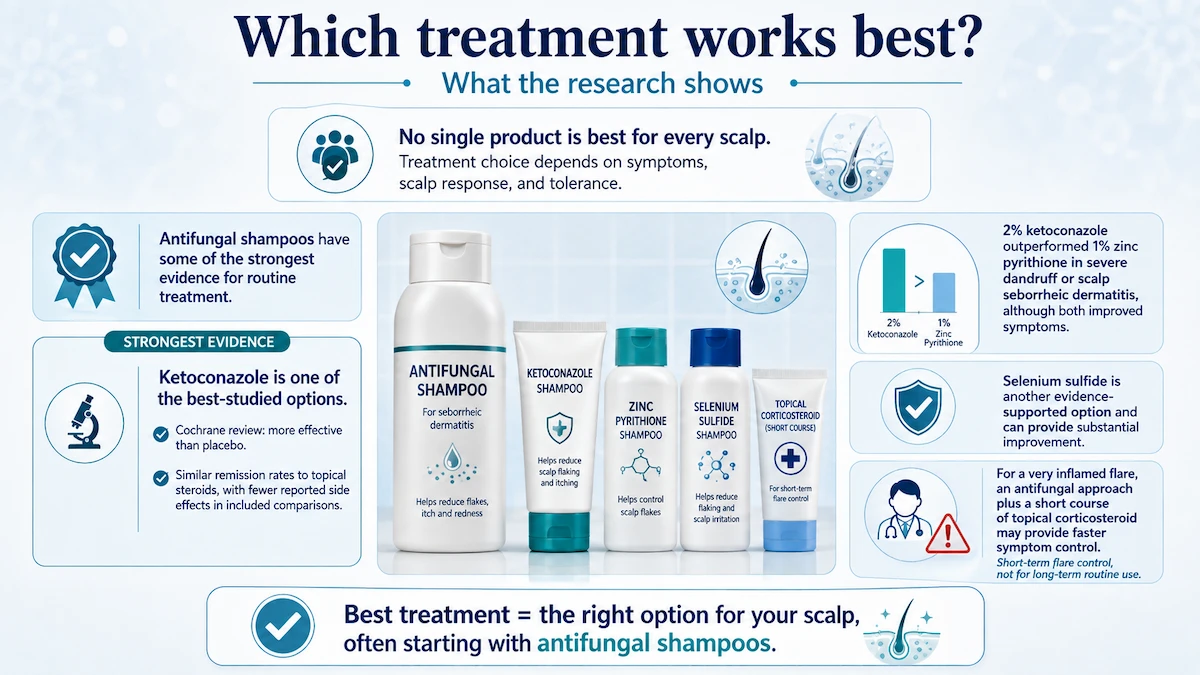
There is no single product that is best for every scalp. Overall, antifungal shampoos have some of the strongest evidence for routine seborrheic dermatitis treatment.
Ketoconazole has been particularly well studied. A Cochrane review found that ketoconazole was more effective than placebo and produced similar remission rates to topical steroids, with fewer reported side effects in the included comparisons.
Direct comparisons have also found 2% ketoconazole superior to 1% zinc pyrithione in severe dandruff or scalp seborrheic dermatitis, although both treatments improved symptoms. Selenium sulfide is another evidence-supported option and can provide substantial improvement.
For a very inflamed flare, combining an antifungal approach with a short course of topical corticosteroid may provide faster symptom control.
Lifestyle changes that help manage flare-ups
Daily scalp habits can make treatment easier and may reduce recurring symptoms:
- Wash the scalp often enough to control oil, flakes, and product buildup.
- Avoid scratching or picking at scales, which can damage the skin.
- Rinse shampoo and styling products thoroughly.
- Choose hair products that do not repeatedly trigger burning or irritation.
- Reduce heavy product buildup when it makes the scalp greasy or difficult to clean.
- Manage stress when possible, especially if flare-ups repeatedly appear during stressful periods.
- Continue maintenance shampoo after symptoms settle if recommended, since seborrheic dermatitis commonly returns.
A maintenance routine is often more useful than waiting for severe symptoms to return before restarting treatment.
Can seborrheic dermatitis cause hair loss?
Seborrheic dermatitis does not usually destroy hair follicles. However, a severe flare can create inflammation, itching, and repeated scratching that may contribute to temporary shedding or hair breakage.
Hair density generally has the potential to recover when inflammation is controlled and follicles remain intact. Persistent or progressive thinning should not automatically be blamed on seborrheic dermatitis because androgenetic alopecia, telogen effluvium, alopecia areata, nutritional problems, and other scalp conditions can occur at the same time.
Visible scarring or permanent-looking bald areas are not typical of ordinary seborrheic dermatitis and require further evaluation.
When to see a dermatologist?
A dermatologist should evaluate scalp symptoms that remain active despite several weeks of correctly used medicated shampoo. Medical assessment is also important when redness becomes severe, the scalp is painful, crusted, bleeding, swollen, or producing drainage.
An examination may be needed when the diagnosis is uncertain. Psoriasis, fungal infections, contact dermatitis, and several other scalp disorders can produce symptoms that resemble seborrheic dermatitis.
Professional assessment is especially useful when there is significant hair loss, because thinning may have another cause that requires separate treatment. Seborrheic dermatitis is often manageable, but successful long-term control usually comes from matching the treatment to the severity of the flare and continuing a simple maintenance routine once the scalp improves.
Sources
- Okokon, E. O., Verbeek, J. H., Ruotsalainen, J. H., Ojo, O. A., Bakhoya, V. N. (2015). Topical antifungals for seborrhoeic dermatitis. Cochrane Database of Systematic Reviews.
- Cleveland Clinic / Seborrheic Dermatitis. StatPearls, NCBI Bookshelf, National Library of Medicine.
- Tynes, B. E. et al. (2024). Ketoconazole Shampoo for Seborrheic Dermatitis of the Scalp, A Narrative Review. Cureus.
- Wikramanayake, T. C. et al. (2019). Seborrheic dermatitis, Looking beyond Malassezia. Experimental Dermatology.
- Seborrheic Dermatitis Revisited, Pathophysiology, Diagnosis, and Emerging Therapies (2025). Full text. Biomedicines.
- American Academy of Dermatology Association. Seborrheic dermatitis, Diagnosis and treatment.
