

Table of Contents
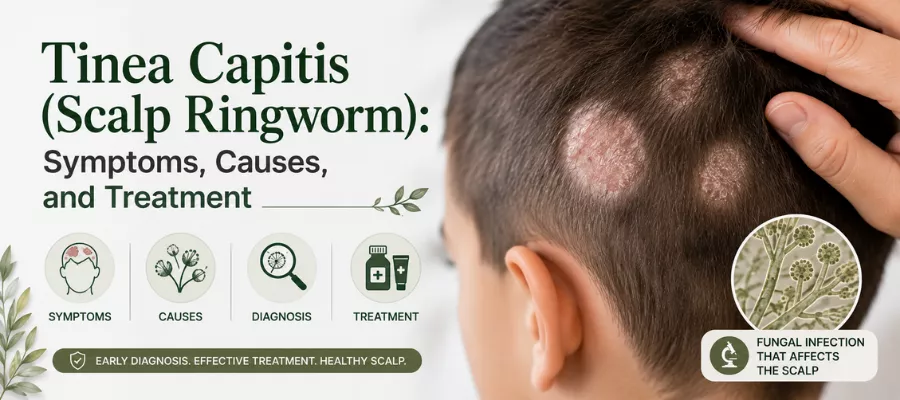
Tinea capitis, commonly called scalp ringworm, is a fungal infection that affects the scalp and hair. Despite its name, ringworm has nothing to do with worms. It is caused by dermatophyte fungi that can invade the skin and hair shafts, leading to scaling, itching, broken hairs, and areas of hair loss.
The condition is particularly common in children, although teenagers and adults can also develop it. Tinea capitis deserves proper treatment because scalp creams alone are usually not enough to clear the infection. Oral antifungal medication is generally required, especially when the fungus has entered the hair shaft.
Early diagnosis is also important. Most hair grows back once the infection has been treated, but severe inflammation, particularly a kerion, can occasionally damage follicles and leave permanent scarring.
What is tinea capitis?
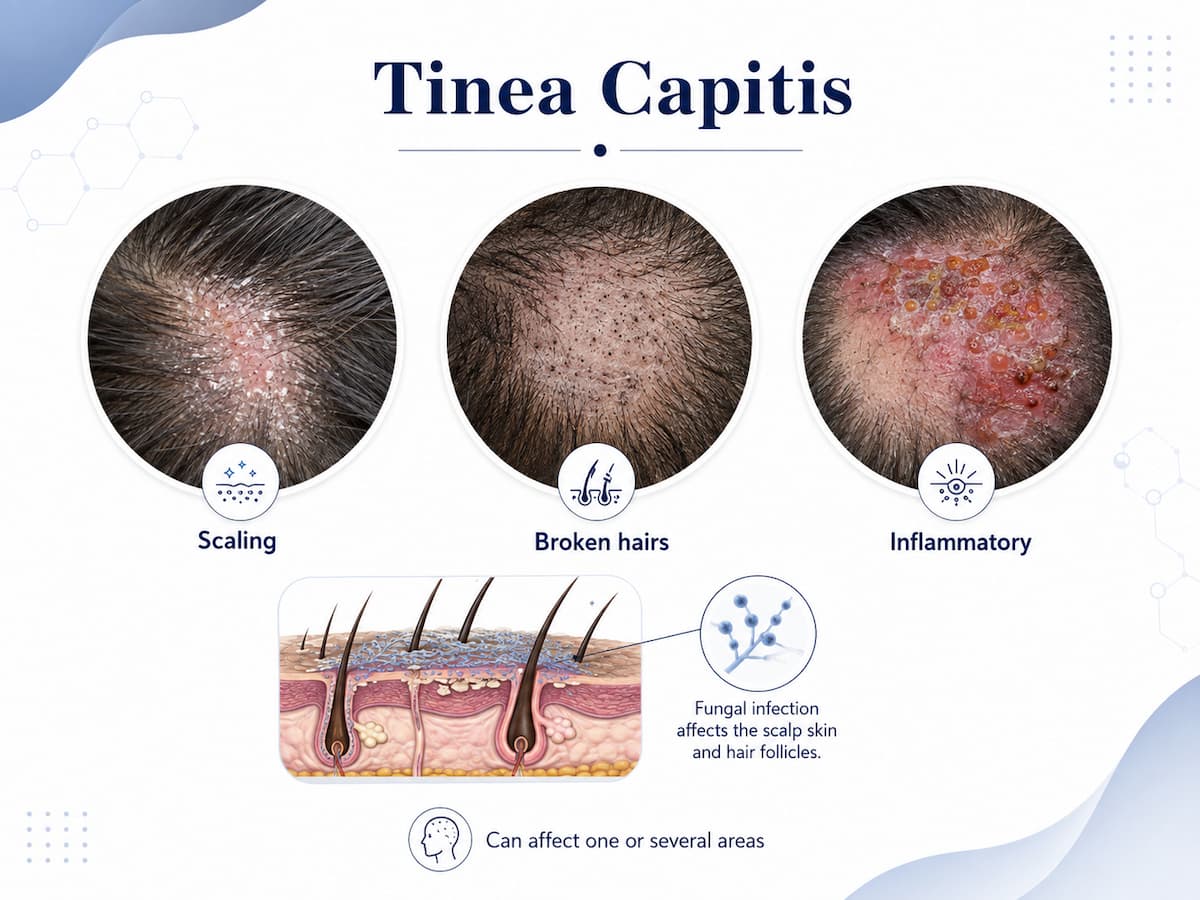
Tinea capitis is a dermatophyte infection involving the scalp skin and hair follicles. It can affect a small section of the scalp or appear across several areas at once.
The infection does not always produce the classic ring-shaped patch associated with ringworm elsewhere on the body. Some people develop dry, flaky areas that resemble dandruff, while others experience black dots, broken hairs, pustules, crusts, or noticeable patches of hair loss.
The way tinea capitis appears depends partly on the fungal species involved and the immune response to the infection. Mild cases may cause little more than scaling, while inflammatory forms can become painful and swollen.
What causes tinea capitis?
Tinea capitis is caused by dermatophytes, a group of fungi that live on keratin, the protein found in hair, skin, and nails. Species belonging mainly to the Trichophyton and Microsporum genera are responsible.
Some dermatophytes are adapted mainly to humans and spread from person to person. Others are associated with animals and can pass from infected pets or other animals to humans.
The organisms reach the scalp and begin growing in the outer skin and hair. Once they invade the hair shaft, topical creams have difficulty reaching the full infection. This is why treatment usually requires medication that works from within the body.
Geography also influences which fungal species are most common, so the preferred antifungal treatment may differ depending on the organism involved.
Is tinea capitis contagious?
Yes. Tinea capitis is contagious and can spread relatively easily, particularly among children who spend time in close contact at home, school, sports activities, or childcare settings.
Transmission can occur through direct head-to-head or skin contact with an infected person. Fungal spores can also survive on objects such as combs, brushes, hats, towels, pillowcases, helmets, hair accessories, and bedding.
Animals can also carry dermatophytes. Cats and dogs are possible sources, and infected animals do not always have dramatic symptoms. A pet with patchy fur, scaling, or suspicious skin lesions should be assessed by a veterinarian.
Because spores can remain in the environment, treating the person without addressing contaminated items or infected household contacts can increase the chance of reinfection.
Symptoms of tinea capitis
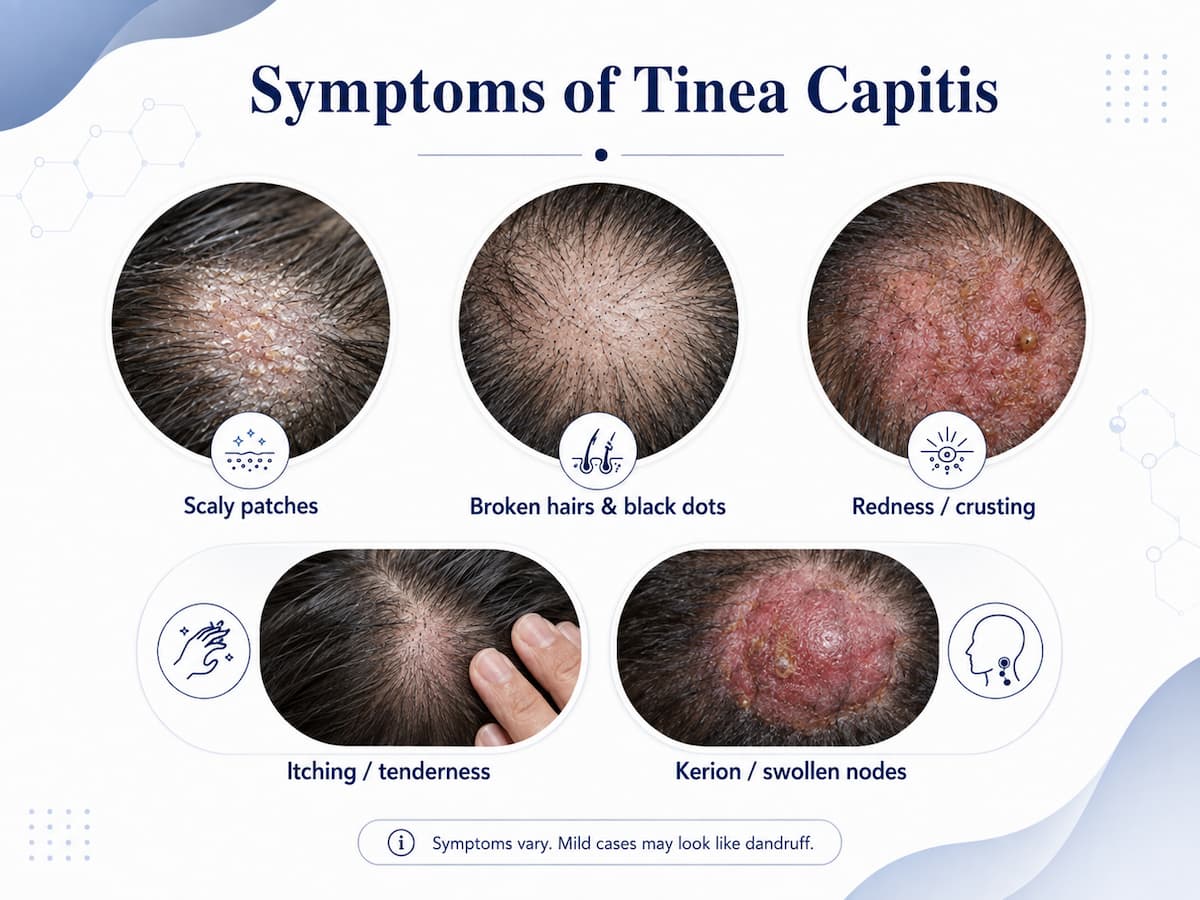
Common tinea capitis symptoms include:
- Dry or scaly patches on the scalp
- Persistent scalp itching
- Round or irregular areas of hair loss
- Broken hairs close to the surface of the scalp
- Small black dots where hairs have broken
- Redness or inflammation
- Crusting or small pustules
- Tender or swollen areas in more inflammatory infections
- Enlarged lymph nodes around the neck in some cases
- Soft, swollen, painful lesions when a kerion develops
Not every person develops all these symptoms. Mild tinea capitis can easily be mistaken for dandruff or another scalp condition.
Scaly, itchy patches
Scaling is one of the most common signs of scalp ringworm. Affected skin may appear dry, flaky, slightly red, or covered with fine scale. Itching can range from mild to persistent.
The scale may initially look similar to dandruff, particularly when hair loss is minimal. Unlike ordinary dandruff, however, tinea capitis may also cause localized broken hairs and irregular areas of reduced density.
Scratching should be kept to a minimum. Repeated scratching can further irritate the skin and increase the chance of secondary bacterial infection.
Black dot pattern and broken hairs
The black dot form develops when infected hairs become fragile and break close to the scalp surface. The small remaining sections can appear as dark dots within areas of hair loss.
This pattern can be particularly noticeable when multiple hairs break at a similar level. Other hairs may look bent, twisted, or unusually short.
Hair breakage is an important clue because scalp ringworm affects the shaft itself. Conditions that cause hair to fall from the follicle may create smooth patches without the same pattern of broken strands.
Kerion (severe inflammatory form)
A kerion is a severe inflammatory reaction to tinea capitis. Instead of a relatively flat scaly patch, the scalp can develop a soft, swollen, boggy mass containing pustules or crusts.
A kerion may be painful and can sometimes release pus. Nearby lymph nodes can become enlarged. Because it can resemble a bacterial abscess, it is occasionally treated incorrectly with antibiotics alone.
Prompt antifungal treatment is important. Severe or prolonged inflammation can damage follicles and increase the risk of scarring and permanent hair loss.
Who is most at risk?
Tinea capitis occurs most often in prepubertal children. Close contact at school, childcare, sports activities, and within households can make transmission easier at this age.
People living with someone who has scalp ringworm are also at increased risk, particularly when combs, brushes, towels, hats, pillows, or other personal items are shared.
Contact with infected animals creates another route of exposure. Children who frequently play with cats, dogs, or farm animals may acquire dermatophytes from an infected animal.
Adults can develop tinea capitis as well. Risk may be higher in older adults and people with weakened immune defenses. Crowded living conditions and environments where personal hair-care items are frequently shared can also make transmission easier.
Tinea capitis vs. similar scalp conditions
Scalp ringworm is not always easy to recognize from appearance alone. Dandruff, seborrheic dermatitis, psoriasis, alopecia areata, and bacterial follicle disorders can create overlapping symptoms.
Correct diagnosis matters because these conditions require very different treatments. Using only an anti-dandruff product on tinea capitis will not normally eliminate the infection, while unnecessary antifungal medication will not treat autoimmune hair loss.
Tinea capitis vs. seborrheic dermatitis
Seborrheic dermatitis commonly causes greasy or dry flakes, itching, and inflammation. It may affect most of the scalp and can also appear around the eyebrows, nose, ears, and beard.
Tinea capitis is more likely to cause broken hairs, localized areas of hair loss, black dots, and clearly defined patches. Severe cases may also produce pustules or a kerion.
There can still be considerable overlap. A child with persistent dandruff-like scaling and new areas of hair breakage should therefore be assessed for scalp ringworm.
Tinea capitis vs. alopecia areata
Alopecia areata is an autoimmune form of hair loss rather than an infection. It often causes one or more smooth, well-defined bald patches.
Tinea capitis tends to produce more scaling, broken hairs, inflammation, or itching. Black dots may also be visible where infected hairs have broken close to the scalp.
Alopecia areata is not contagious. Tinea capitis is, making an accurate diagnosis especially important when several members of a household or school group develop scalp symptoms.
Tinea capitis vs. psoriasis
Scalp psoriasis usually produces clearly defined areas of thicker scale and inflammation. Scale can extend beyond the hairline and may occur with psoriasis on the elbows, knees, nails, or other areas.
Hair loss from psoriasis is usually secondary to inflammation, scratching, or removal of thick scale rather than direct fungal invasion of the hair shaft.
Tinea capitis can look similar when scaling is extensive, but broken hairs, black dots, fungal testing, and the overall pattern can help distinguish between them.
How is tinea capitis diagnosed?
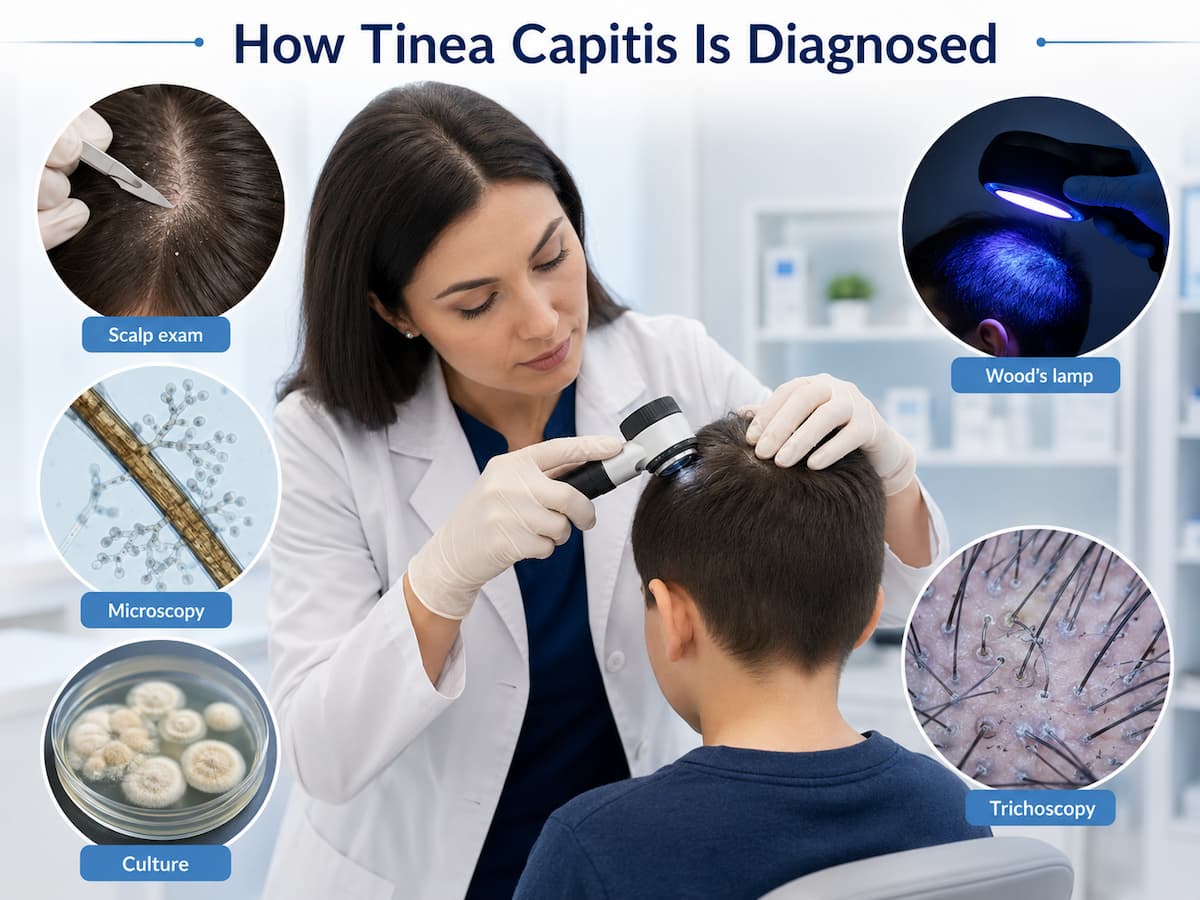
Diagnosis usually begins with an examination of the scalp. The pattern of scaling, hair breakage, inflammation, and hair loss can suggest tinea capitis, but testing is often useful because several scalp conditions look similar.
Hair and scalp scale can be collected and examined under a microscope using a potassium hydroxide preparation. This can reveal fungal structures within or around the hair.
A fungal culture may also be performed. Culture can identify the dermatophyte responsible and may help guide treatment, although results can take time.
Trichoscopy can provide additional clues. Magnified examination may reveal distinctive abnormal hairs, including comma-shaped, corkscrew, or broken hairs.
A Wood’s lamp can help detect some Microsporum infections because certain species fluoresce under ultraviolet light. However, many common causes of tinea capitis do not fluoresce, so a negative Wood’s lamp examination does not rule out the condition.
How is tinea capitis treated?
Successful treatment usually requires oral antifungal medication. This is one of the most important differences between scalp ringworm and fungal infections affecting many other areas of the skin.
Topical products can reduce fungal spores on the scalp surface, but they generally cannot reach fungi deep enough inside infected hairs to cure tinea capitis alone.
Oral antifungal medication
Griseofulvin and terbinafine are among the oral antifungal medications commonly used for scalp ringworm. Fluconazole and itraconazole may also be used in selected situations.
The best medicine can depend on the fungal species, age, medical history, location, and local treatment recommendations. Some Microsporum infections may respond better to griseofulvin, while terbinafine is often effective against Trichophyton species.
Treatment typically lasts several weeks and sometimes longer. Medication should be taken for the full prescribed course even if the scalp begins looking better earlier.
Medicated shampoo
Antifungal shampoos such as ketoconazole or shampoos containing selenium sulfide may be added to oral treatment. Their main purpose is to reduce the number of fungal spores on the scalp and lower the chance of transmission.
Shampoo alone should not be relied on to cure tinea capitis because it does not adequately treat infection within the hair shafts.
Household members may sometimes be advised to use an antifungal shampoo when there is concern about asymptomatic carriage or repeated transmission.
Treating a kerion
A kerion needs prompt medical assessment. Oral antifungal medication remains the central treatment because the swelling is caused by a strong inflammatory response to the fungal infection.
Doctors may consider additional anti-inflammatory treatment in selected severe cases, but this is not needed for every kerion.
A kerion should not automatically be treated like an ordinary bacterial abscess. Unnecessary cutting or drainage can add trauma to already inflamed scalp tissue. Secondary bacterial infection can occasionally occur, but antibiotics are not a substitute for antifungal treatment when tinea capitis is the underlying problem.
Do home remedies work for tinea capitis?
Home remedies cannot reliably cure tinea capitis. Tea tree oil, coconut oil, apple cider vinegar, garlic, and other natural products are commonly promoted online, but there is not enough evidence to use them as replacements for oral antifungal medication.
The problem is not simply fungus sitting on the scalp surface. Dermatophytes invade the hair, making it difficult for household products or topical oils to reach the full infection.
Trying home treatments for weeks before seeking medical care may allow scalp ringworm to spread and increases the risk of transmission to other people. Delayed treatment is particularly concerning when significant inflammation or a kerion is present.
How to prevent tinea capitis and reinfection
- Do not share combs, brushes, hats, helmets, towels, pillowcases, or hair accessories.
- Wash bedding, towels, and frequently used clothing during treatment.
- Clean or replace contaminated combs and brushes as advised.
- Avoid close scalp contact with someone who has untreated tinea capitis.
- Wash hands after touching affected scalp areas.
- Have pets assessed by a veterinarian if they develop suspicious patches of hair loss or scaling.
- Do not share hair clippers or grooming equipment unless they have been properly disinfected.
- Follow the full antifungal treatment course rather than stopping when symptoms first improve.
- Ask about household screening when several family members develop scalp symptoms.
These measures are especially important in households, schools, childcare settings, and sports environments where close contact and shared objects make fungal transmission easier.
Can tinea capitis cause permanent hair loss?
Most cases do not cause permanent hair loss when they are recognized and treated appropriately. Once the fungal infection clears and inflammation settles, follicles can usually return to normal growth.
Temporary patchy hair loss can look dramatic because infected strands break or fall from affected follicles. Regrowth takes time, so normal density may not return immediately after the infection disappears.
The risk changes when tinea capitis causes severe inflammation. A kerion can damage follicles if inflammation is intense or prolonged. Scarring may then develop, and follicles replaced by scar tissue cannot produce normal hair again.
Early treatment therefore matters not only for controlling infection and preventing transmission, but also for protecting long-term scalp hair.
When to see a doctor
Medical assessment is recommended whenever scalp ringworm is suspected because tinea capitis generally requires prescription oral antifungal treatment. It is particularly important when a child develops scaly areas together with broken hairs or patchy hair loss.
Seek prompt assessment when the scalp becomes swollen, very painful, covered with pustules or crusts, or develops a soft boggy mass that could represent a kerion. Enlarged lymph nodes, spreading inflammation, or rapidly increasing hair loss are additional reasons not to delay treatment.
Persistent scalp symptoms that have been treated as dandruff without improvement should also be examined. Tinea capitis can mimic several common scalp disorders, and the correct diagnosis often requires examination of the hair as well as the skin.
With timely diagnosis and the correct oral antifungal treatment, tinea capitis can usually be cleared without lasting damage. Recognizing the combination of scaling, broken hairs, itching, and patchy hair loss early also helps limit transmission and reduces the chance of severe inflammation or permanent scarring.
Sources
- Cotter, D., Zhang, Y., Bhatia, A. (2023). Griseofulvin. StatPearls, NCBI Bookshelf, National Library of Medicine.
- Leung, A. K. C. et al. (2025). Diagnosis and Management of Tinea Infections. American Family Physician.
- Tey, H. L., Tan, A. S., Chan, Y. C. (2011). Meta-analysis of randomized, controlled trials comparing griseofulvin and terbinafine in the treatment of tinea capitis. Journal of the American Academy of Dermatology, 64(4), 663-670.
- Mikaeili, A. et al. Clinico-mycological profile of tinea capitis and its comparative response to griseofulvin versus terbinafine. Current Medical Mycology.
- Ahmad Nasrollahi, S. et al. Microsporum canis-Induced Tinea Capitis, A Rapid Screening Algorithm. Cureus.
- American Academy of Dermatology Association. Ringworm of the scalp, Signs and symptoms.
