


Table of Contents
Getting a hair transplant is one of the most exciting steps toward a fuller head of hair, but the weeks that follow require some patience, especially when it comes to something as simple as a haircut. Cut too early, or with the wrong tool, and you risk dislodging grafts that haven’t finished settling into their new home. This guide covers exactly when it’s safe to trim your hair, which areas need the most caution, and what your barber should know before they pick up a pair of scissors.
When Can You Get a Haircut After a Hair Transplant?
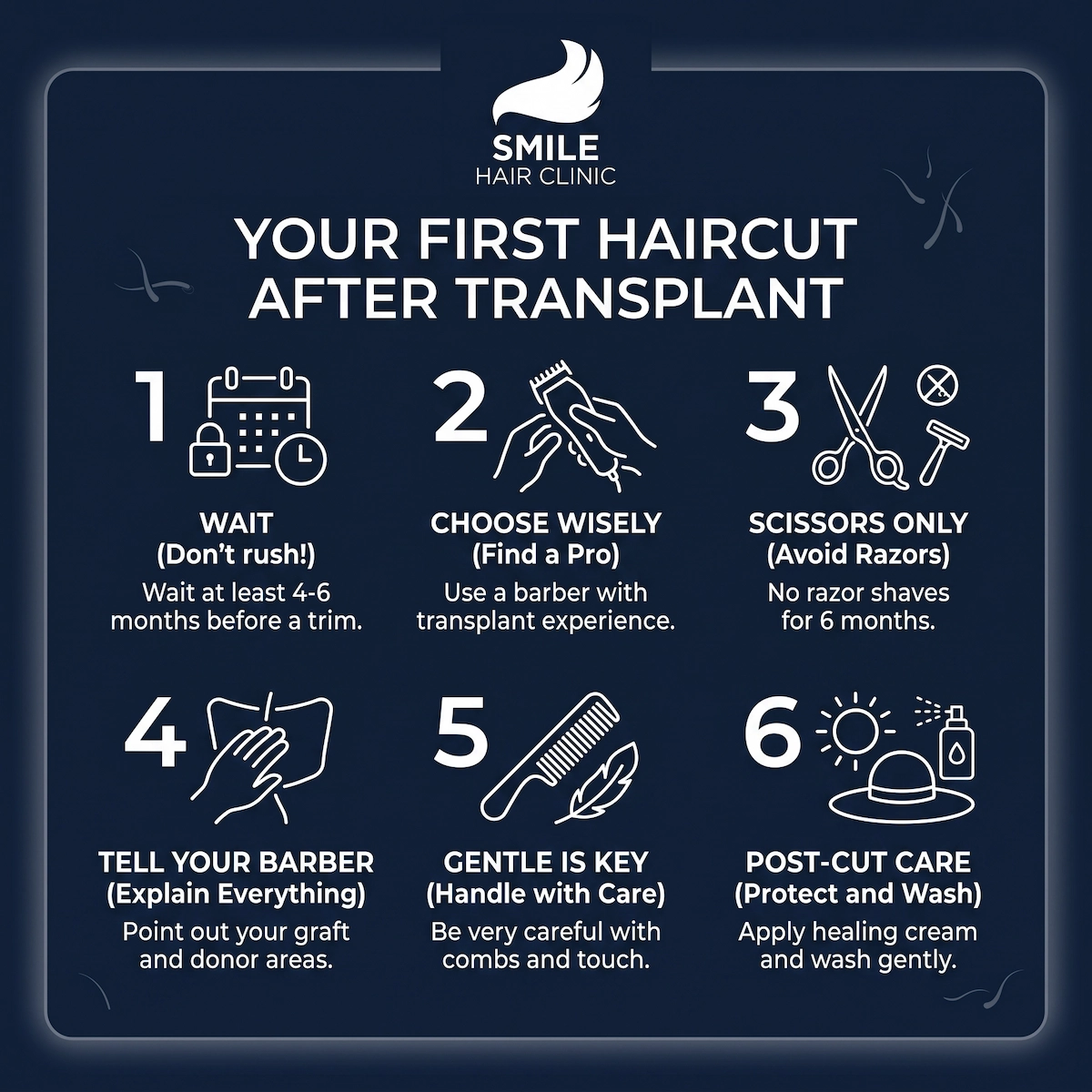
Recovery unfolds gradually over several months, and the safe window for cutting hair expands as healing progresses.
Weeks 1 and 2: Don’t cut or touch your hair at all during this period. Newly placed grafts are still settling into the scalp, and proper hygiene, following your surgeon’s washing instructions closely, matters more than styling right now.
Weeks 2 to 4: The donor area, meaning the sides and back where hair was taken from, can usually be trimmed with scissors once the first two weeks have passed. The transplanted area itself should still be left alone entirely.
Weeks 4 to 6: Healing continues, but deep cutting or shaving in the transplanted zone remains off-limits. Scissors can still be used on untouched, non-transplanted regions if needed.
Weeks 6 to 12: Most patients can have their first careful trim on top of the head during this window. If clippers feel too risky around the grafts, scissors remain the safer choice, since they don’t press or drag against the scalp the way a clipper guard can.
3 to 6 Months: By this stage, grafts are generally secure enough that hair can be treated more normally, and clippers become a reasonable option with some care. Most patients see meaningful growth by month six and settle back into a regular haircut routine from here.
Please Select Your Gender
Donor Area vs. Transplanted Area: Why the Distinction Matters?
Not all of your scalp heals on the same schedule, and treating it as one uniform zone is one of the most common mistakes patients make when planning their first post-surgery trim.
The donor area, typically the back and sides in an FUE or DHI procedure, heals faster because no new grafts were placed there, only extracted from it. Light trimming here is usually safe within a couple of weeks. The recipient area, where the actual grafts were implanted, is a different story entirely. This is the zone that needs the most protection, since every graft here is a living follicle that hasn’t yet formed a stable connection to the surrounding tissue. Treating both areas the same, whether by rushing a haircut or by being overly cautious with a donor area that’s actually ready, either risks your results or delays your return to normal grooming longer than necessary.
Why Grafts Need Time to Anchor?
The caution around early haircuts isn’t arbitrary. A graft anchoring study conducted by Bernstein Medical tracked how securely transplanted grafts were held in place over the days following surgery, using a series of controlled pull tests on real patients. The research found that grafts remained genuinely vulnerable to dislodgement in the first several days, but by around day six, a gentle pull on the hair itself was no longer enough to remove a graft, and by day ten, grafts were reliably anchored against normal mechanical stress.
This is exactly why most clinics draw the hard line at around two weeks before any cutting near the transplanted area, and it’s also why scabs shouldn’t be picked at during this window. A scab still attached to a graft can pull the follicle loose with it even after the graft itself has started to anchor.
What to Expect at Your First Post-Transplant Trim?
Many patients are caught off guard by shedding around the time they’re finally ready for that first haircut. Transplanted hairs commonly fall out a few weeks after surgery in a process called shock loss, which is a normal, expected part of the growth cycle rather than a sign anything has gone wrong. The follicle itself stays in place under the skin and will begin producing new hair in the months that follow.
This shedding phase is often exactly why patients want a haircut in the first place, since native hair and transplanted hair can be growing at noticeably different lengths and thicknesses in the early months, creating an uneven, patchy look. A gentle trim that blends these areas can make a real difference to how your hair looks day to day, even while the underlying growth process is still working itself out beneath the surface.
Why Scissors Come Before Clippers?
For your first several trims, scissors are the safer tool by a wide margin, and it’s worth understanding why. Scissors cut hair at a distance from the scalp itself, while clippers, even with a guard attached, need to make contact with or come very close to the skin, creating friction, tension, and occasional pressure against grafts that are still settling in. A clipper’s vibration alone can be enough to disturb a graft that hasn’t fully anchored yet.
Make sure your barber knows about your procedure before they start. A barber working with this information will use a lighter touch, avoid aggressive combing through the transplanted zone, and skip high-heat tools until your scalp has had more time to recover. Most surgeons recommend waiting at least three to six months before introducing clippers to the transplanted area, and closer to six months for anything approaching a skin fade.
Styling and Products to Avoid Early On
A few grooming habits are worth pausing entirely during the first weeks and months of recovery. Chemical treatments, hair dye, bleach, and perms in particular, should wait at least six weeks, and ideally longer, since they can irritate a scalp that’s still healing and potentially damage new follicles before they’ve had a chance to establish themselves. Heavy styling products, waxes, gels, and hair fibres used to conceal thinning, are best avoided for at least the first month, since they can clog pores around new grafts and contribute to folliculitis or small breakouts. Skin fades and very close razor shaves should also wait, generally until the three to six month mark, since keeping the scalp calm and free of irritation matters more than styling in these early stages.
Once your scalp has fully healed and your surgeon has confirmed it’s safe, these products and techniques can be reintroduced gradually rather than all at once.
“Patients are often more focused on how their hair looks in week three than on what actually protects their results long term,” says Dr. Gökay Bilgin. “A slightly awkward growing-out phase is temporary. A dislodged graft is not. My advice is always the same: keep it simple with scissors and a light touch until we’ve confirmed together that it’s safe to do more.”
When Can You Return to a Normal Haircut Routine?
By around the six-month mark, most of the caution built into earlier recovery stages is no longer necessary. Grafts are securely anchored, scalp sensitivity has largely resolved, and patients can typically return to clippers, fades, and their preferred styling products without the restrictions of the first few months. Some patients see continued density improvement out to twelve or eighteen months, but from a haircut standpoint, six months is generally when things open back up.
Please Select Your Gender
Frequently Asked Questions
Can I get a haircut two weeks after a hair transplant?
The donor area, yes, generally with scissors. The transplanted area itself needs more time, typically another two to four weeks at minimum, before it’s safe to trim.
Will cutting my hair make it grow back faster?
No. Hair growth happens at the follicle level beneath the skin and isn’t affected by trimming. A haircut simply helps blend uneven lengths during the growing-out phase, which can make the process feel less awkward day to day.
When can I use clippers after a hair transplant?
Most surgeons recommend waiting three to six months before using clippers on the transplanted area, since the vibration and skin contact carry more risk than scissors during earlier stages of healing.
Is shedding normal before my first haircut?
Yes. Many transplanted hairs shed a few weeks after surgery as part of a normal process called shock loss. The follicle remains in place and will produce new hair in the months that follow.
Sources
- Bernstein Medical. Graft Anchoring in Hair Transplant Surgery. Bernstein Medical Research
For a full overview of what to expect throughout recovery, see our after hair transplant procedure guide. If you have questions specific to your own recovery timeline, contact our team directly.
This guide was prepared and reviewed by Dr. Gökay Bilgin, M.D., hair transplant surgeon at Smile Hair Clinic, Istanbul.
Getting the first haircut right is easier with a clinic that already knows the case and can confirm timing directly, rather than relying on general rules alone. That kind of direct access is part of the year of follow-up built into every hair transplant turkey packages option at Smile Hair Clinic.
