


Table of Contents
This is one of the questions we hear most often after surgery, and for good reason. Whether it’s a baseball cap to cover redness on the way home, a motorcycle helmet for the commute back to work, or a hard hat because your job requires one, headgear puts pressure and friction exactly where newly placed grafts are most vulnerable. The right answer depends heavily on which type of headgear you mean, since a loose cotton cap and a snug motorcycle helmet carry very different levels of risk.
This guide covers the safe timeline for hats first, then goes in depth on helmets specifically, since motorcycle helmets, hard hats, and sports helmets each behave differently against a healing scalp and deserve separate answers rather than one blanket rule.
Why Grafts Are Vulnerable to Pressure in the First Place?
Freshly placed grafts don’t yet have their own blood supply. They rely on a natural fibrin seal that forms within the first few days, gradually reinforced by collagen as the scalp heals, and a graft anchoring study conducted by Bernstein Medical found that a graft could still be pulled loose by simple friction through around day five, with reliable anchoring generally established by day ten. Any headgear that presses, rubs, or shifts against the scalp during this window carries real risk, not just to the graft’s position but to the delicate blood supply it’s trying to establish.
This is exactly why the answer to “when can I wear a hat after hair transplant” isn’t a single date. It’s a curve: risk drops steadily as the days pass, and different types of headgear cross into safe territory at different points along that curve. This timeline applies regardless of which technique was used to place your grafts, whether that’s Sapphire FUE, DHI, or manual FUE, since the biological anchoring process is the same no matter how the grafts were extracted or implanted.
Please Select Your Gender
Hat Timeline After Hair Transplant
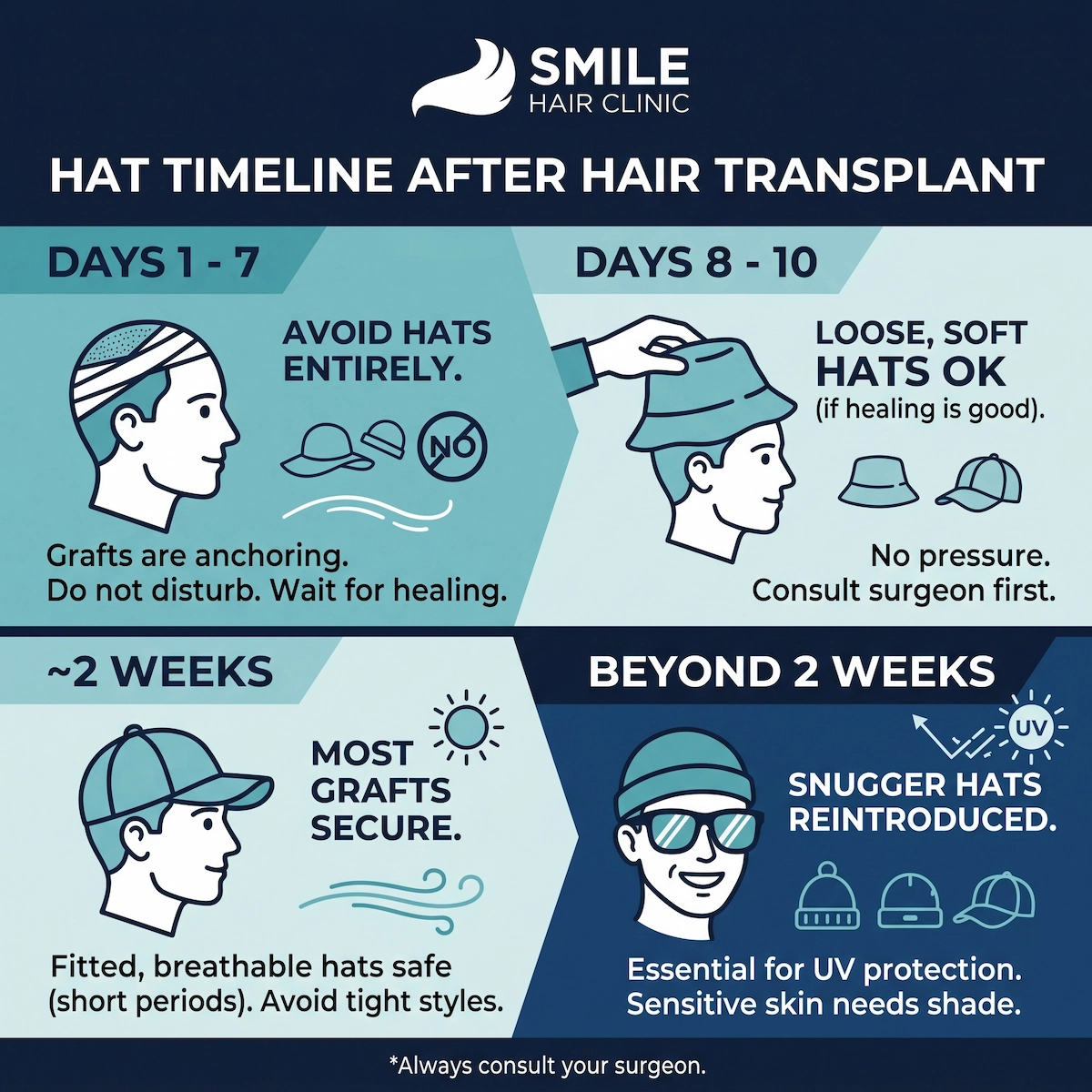
Days 1 to 7: Avoid hats entirely. Even a loose one can create enough contact to disturb grafts that haven’t begun anchoring yet, and this is also the window where scabs are still forming.
Days 8 to 10: A very loose, soft hat, something like a bucket hat or an oversized cap with no tight band, may be acceptable if your surgeon confirms healing is on track. It should sit without pressing anywhere against the recipient area.
Around 2 weeks: Most grafts are secure enough by this point that a properly fitted, breathable hat becomes reasonably safe for short periods, though tight-fitting styles are still worth avoiding a little longer.
Beyond 2 weeks: As healing continues, snugger styles can be reintroduced gradually. Sun protection actually becomes a good reason to wear a hat at this stage, since new grafts and the surrounding skin stay sensitive to UV exposure for months.
Wearing a Helmet After Hair Transplant: Why Timing Matters More?
Helmets are a different question entirely from hats, and this is where most of the questions we get actually concentrate, whether that’s a general “can I wear a helmet after hair transplant,” a motorcycle rider asking about a full-face helmet, or someone asking specifically about a hard hat for work. The honest answer is that helmets need considerably more healing time than a soft hat, and the reason comes down to how different helmet types are actually built.
Motorcycle and Sports Helmets
A motorcycle helmet’s interior is lined with dense foam designed to sit in firm, direct contact with the scalp across its entire surface, since that full contact is exactly what allows the foam to absorb and distribute impact force in a crash. There’s no meaningful air gap between the liner and your head. Combined with a chin strap that adds pressure and the friction of putting the helmet on and taking it off, this makes motorcycle and full-face sports helmets one of the higher-risk categories of headgear during early recovery. Most surgeons recommend waiting a minimum of three to four weeks before wearing one, and longer if your commute involves an extended ride where the helmet stays on and heats up the scalp for a sustained period.
Hard Hats
A construction hard hat actually works differently than most patients expect. Rather than sitting directly against the head, a hard hat uses an internal suspension system, a webbing arrangement that holds the shell roughly an inch away from the scalp, creating a genuine air gap. This means a hard hat’s outer shell typically doesn’t make direct contact with the healing area at all; contact is instead limited to a few narrow suspension straps. That’s a meaningfully different risk profile than a motorcycle helmet’s full-contact foam liner, though it doesn’t make a hard hat risk-free. The suspension band still crosses the scalp at specific points, and adjusting or removing the hard hat repeatedly throughout a work shift still creates friction. Most patients can return to wearing a hard hat at around the two to three week mark if the suspension is adjusted loosely and doesn’t press directly on the recipient area, though anyone in physically demanding work should confirm timing with their surgeon rather than assuming.
General Safe Helmet Practices
Whichever type of helmet you’re dealing with, a few things reduce risk meaningfully: loosening the fit as much as safety requirements allow, keeping wear time short in the first few weeks back, choosing a helmet with better ventilation if you have the option, and checking the scalp afterward for any irritation, redness, or unusual sensitivity. If your job or daily routine requires a helmet sooner than the general timeline allows, that’s worth raising directly with your surgeon before surgery, not after, since it may affect how your procedure and early recovery plan are structured.
“Helmets are the headgear I get asked about most, and motorcycle riders in particular need a straight answer rather than a vague one,” says Dr. Mehmet Erdoğan. “A full-face motorcycle helmet sitting against fresh grafts for an hour-long commute is genuinely one of the higher-risk scenarios we see. If that’s part of your daily life, tell us during consultation so we can plan your timeline and even your graft placement around it, rather than finding out it’s a problem two weeks after surgery.”
Choosing Hats and Helmets That Are Actually Safer
Fit matters more than style once you’re past the earliest days. Look for adjustable, breathable designs with a soft interior, and avoid anything with a tight elastic band that presses in one continuous line across the scalp. For helmets, a liner or thin, clean buff worn underneath can reduce direct friction against the skin, though it shouldn’t be used as a reason to wear the helmet earlier than your surgeon has cleared.
Hygiene matters just as much as fit during recovery. Wash or rotate hats regularly in the first few weeks, since a sweaty or unwashed hat sitting against healing skin raises infection risk unnecessarily. The same applies to helmet liners, which should be cleaned or replaced regularly, particularly if you’re wearing one daily for work or a commute.
Please Select Your Gender
Frequently Asked Questions
Can I wear a hat 3 days after a hair transplant?
No. The first week should be hat-free entirely, since grafts haven’t begun anchoring yet and scabs are still forming.
How long after a hair transplant can I wear a helmet?
For most helmets, a minimum of two to three weeks, and for motorcycle or full-face sports helmets specifically, three to four weeks is a safer benchmark given how directly the foam liner contacts the scalp.
Can you wear a hard hat after a hair transplant?
Yes, generally from around two to three weeks onward, since a hard hat’s suspension system holds the shell away from the scalp rather than pressing directly against it. The suspension straps still need to be adjusted loosely and kept clear of the recipient area.
Is a motorcycle helmet more risky than a hard hat after a hair transplant?
Generally, yes. A motorcycle helmet’s foam liner sits in full, direct contact with the scalp, while a hard hat’s suspension design creates an air gap between the shell and your head. Both still carry some risk from friction and repeated adjustment.
What kind of hat is safest right after a hair transplant?
A loose, soft, breathable hat with no tight band, a bucket hat or an oversized cap, for example, is the safest option in the first couple of weeks, and only once your surgeon has confirmed healing is on track.
Sources
- Bernstein Medical. Graft Anchoring in Hair Transplant Surgery. Bernstein Medical Research
For a complete overview of what to expect week by week, see our hair transplant recovery timeline. If your work or lifestyle involves daily helmet use, contact our team before surgery so we can plan your recovery around it. Practical aftercare details like this are exactly the kind of thing worth weighing alongside surgeon experience and hair transplant Turkey cost when comparing clinics for a hair transplant in Turkey.
This guide was prepared and reviewed by Dr. Mehmet Erdoğan, M.D., hair transplant surgeon at Smile Hair Clinic, Istanbul.
Timing questions like this one come up constantly during recovery, and having a clinic on hand to answer them directly is worth more than a general guideline. The follow-up support behind every tier of hair transplant turkey cost at Smile Hair Clinic exists for exactly this kind of question, whether it comes up at week two or month three.
