


Table of Contents
If you’re searching for cobblestoning hair transplant, chances are you’ve noticed something unusual after your procedure. Instead of a smooth, natural-looking scalp, the transplanted area may appear uneven, with small raised bumps or a textured surface. This can be concerning, especially when the expectation was a clean and natural result.
In simple terms, cobblestoning hair transplant describes a complication where the skin in the treated area heals with a bumpy, irregular texture. The surface may resemble small ridges or raised grafts, often referred to as a bumpy scalp after hair transplant. While mild irregularities can occur during early healing, true cobblestoning is different. It tends to persist and does not settle on its own in the same way normal swelling does.
The reason behind this effect is usually technical rather than biological. Cobblestoning typically develops when grafts are placed incorrectly during the procedure. This can include placing grafts too shallow or too deep, using incorrect angles, or packing too many grafts into a small area. As the skin heals around these grafts, it creates an uneven surface instead of a smooth one.
This is why many patients feel confused. They expect hair growth to improve appearance, but instead, they notice uneven hair transplant results. Naturally, questions follow. Is this permanent? Can it be fixed? Was the procedure done incorrectly?
In most cases, cobblestoning is manageable once properly evaluated. The key is understanding what caused it and choosing the right approach to correct it.
“Cobblestoning is not a random complication. It usually reflects how the grafts were placed and how the skin responded during healing.”
— Dr. Gökay Bilgin, Smile Hair Clinic
In the next section, we’ll look more closely at how cobblestoning appears and how to recognize it early.
Please Select Your Gender
What Is Cobblestoning in a Hair Transplant?
Cobblestoning hair transplant is a surface irregularity that appears after the procedure, where the treated area develops a raised, uneven texture instead of a smooth finish.
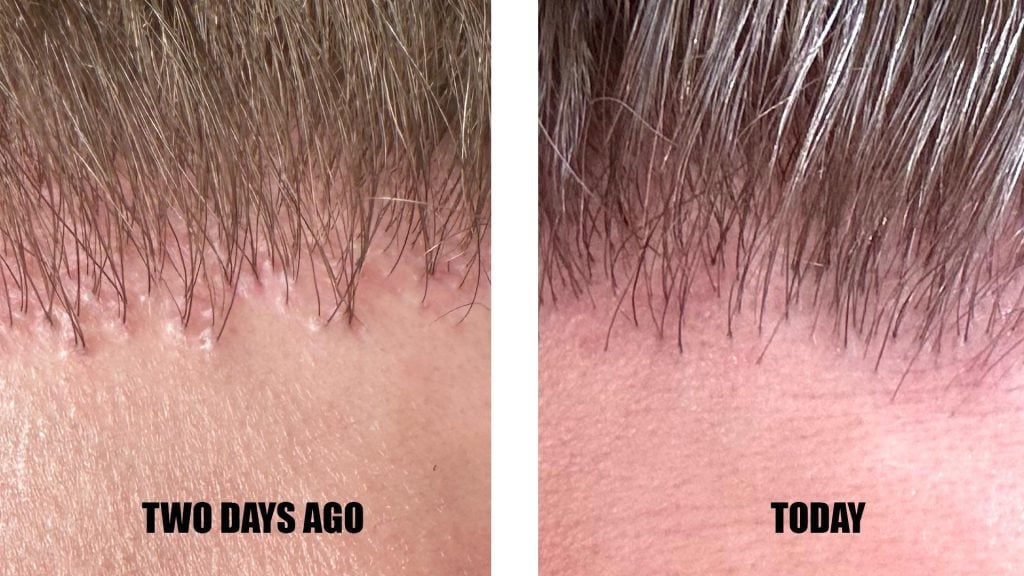
It’s called “cobblestoning” because the skin can resemble small, rounded bumps, similar to cobblestone streets. The effect is usually most noticeable in the frontal area, where the hairline is more exposed and any irregularity becomes easier to see.
What Actually Happens Under the Skin
To understand hair transplant cobblestoning, it helps to think about how grafts are placed.
Each graft is inserted into a small channel created in the scalp. Ideally, that graft should sit at the correct depth and angle, blending naturally with surrounding tissue.
When that doesn’t happen, the healing process changes.
Instead of settling evenly, the skin forms around the graft in a raised way. This leads to:
- visible bumps around individual grafts
- uneven surface texture
- irregular light reflection on the scalp
So the issue is not the hair itself. It’s how the skin heals around the implanted grafts.
Why It Looks Different From Normal Healing
Early healing after a transplant can include:
- redness
- minor swelling
- temporary unevenness
These usually improve within weeks.
Cobblestoning behaves differently. It tends to:
- appear more clearly after initial healing
- remain visible over time
- not fully smooth out on its own
This is why patients often describe it as raised grafts hair transplant or a bumpy scalp after hair transplant that doesn’t improve.
Where It Is Most Noticeable
Cobblestoning is often more visible in:
- the hairline
- frontal scalp
- areas with dense graft placement
These zones are more exposed and more sensitive to placement precision.
Clinical Perspective
“Cobblestoning is essentially a surface-level healing issue caused by how grafts interact with the skin. When placement is not optimal, the skin cannot settle evenly.”
— Dr. Mehmet Erdoğan, Smile Hair Clinic
Understanding this makes one thing clear.
Cobblestoning is not random. It follows a mechanical cause.
Next, let’s look at how to recognize it clearly in real cases.
What Does Cobblestoning Look Like?
If you suspect cobblestoning hair transplant, the first step is recognizing how it actually appears. Many patients confuse normal healing with complications, especially in the early weeks.
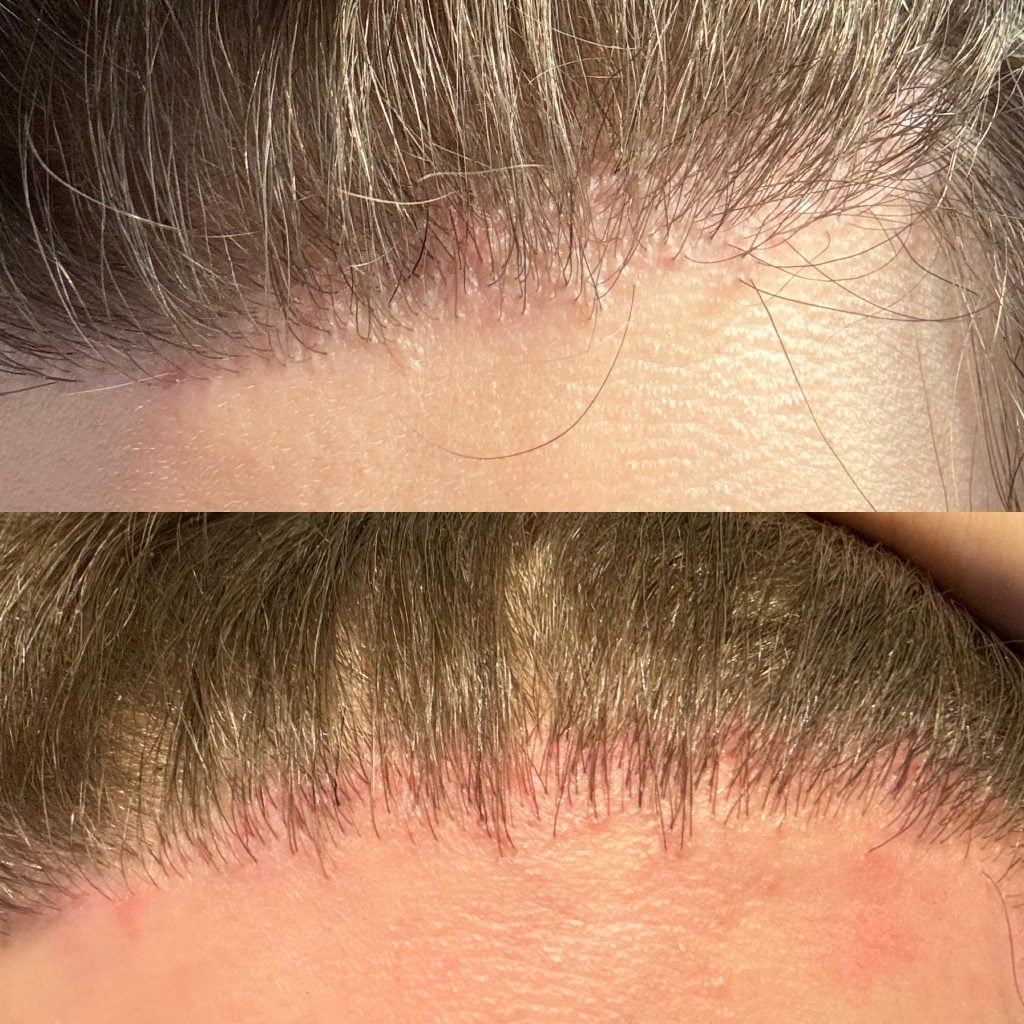
Cobblestoning has a distinct look once you know what to watch for.
Bumpy Scalp and Raised Texture
The most noticeable sign is a bumpy scalp after hair transplant. The surface does not appear flat. Instead, small elevations form around individual grafts, creating an uneven texture.
This can feel as well as look irregular.
Patients often describe:
- a rough surface when touching the area
- small raised points across the transplanted zone
- a “grainy” or “pebbled” feel under the fingers
This texture becomes more visible under direct lighting.
Uneven Surface and Light Reflection
One of the easiest ways to identify uneven hair transplant results is by observing how light reflects on the scalp.
A smooth scalp reflects light evenly. Cobblestoning disrupts that.
You may notice:
- patchy shine across the area
- shadows forming around raised grafts
- inconsistent appearance from different angles
This is often more visible in photos than in the mirror.
Raised Grafts and Irregular Growth Pattern
In some cases, the grafts themselves appear slightly elevated.
This can give the impression that:
- hairs are emerging from small bumps
- the skin around each follicle is raised
- the overall surface lacks uniformity
This is why the term raised grafts hair transplant is often used alongside cobblestoning.
What It Does Not Look Like
It’s important to separate cobblestoning from normal healing.
Cobblestoning does not look like:
- temporary swelling that fades within days
- redness that gradually improves
- scabbing that disappears after washing
Those are expected phases.
Cobblestoning is persistent and structural.
Clinical Perspective
“We evaluate cobblestoning by both sight and touch. The combination of raised texture and uneven reflection is what confirms it.”
— Dr. Ali Osman Soluk, Smile Hair Clinic
So if the scalp still feels uneven after the healing phase, it’s worth taking a closer look.
Next, we’ll break down why this happens at a technical level.
What Causes Cobblestoning?
Once you understand what cobblestoning hair transplant looks like, the next step is understanding why it happens. This is where most explanations stay too surface-level.
Cobblestoning is not just “poor technique.” It is a mechanical issue that develops during graft placement and healing.
Incorrect Graft Depth
Depth is one of the most critical factors.
Each graft must sit at the correct level within the skin. If it is placed too shallow, part of the graft remains elevated. As healing occurs, the skin forms around it unevenly, creating a raised surface.
If it is placed too deep, the surrounding tissue can collapse slightly, which also disrupts surface smoothness.
This imbalance is one of the main reasons behind raised grafts hair transplant appearance.
Angle and Direction Errors
Hair does not grow straight out of the scalp. It follows a natural angle that varies across different areas.
When grafts are implanted at incorrect angles:
- the exit point of the hair looks unnatural
- the skin tension around the graft changes
- healing can create small elevations
This contributes to the cobblestone effect hair transplant, especially in the frontal area where angles are more delicate.
Overpacking and Dense Placement
Trying to achieve high density too quickly can create pressure within the skin.
When too many grafts are placed in a limited area:
- blood supply becomes restricted
- tissue swelling increases
- the skin cannot settle evenly
This often leads to uneven hair transplant results with visible surface irregularities.
Skin Thickness and Patient Factors
Not all scalps behave the same.
Thicker or firmer skin may respond differently to graft placement. In some cases, even small technical errors become more visible because the skin does not adapt easily.
This is why two patients can have the same procedure but different outcomes.
Why This Is Not Random
Cobblestoning follows a pattern.
It usually appears in areas where:
- depth control was inconsistent
- angles were not aligned with natural growth
- density planning was too aggressive
Clinical Perspective
“Cobblestoning is a combination of depth, angle, and density issues. When these are not balanced correctly, the skin heals unevenly around the grafts.”
— Dr. Firdavs Ahmedov, Smile Hair Clinic
So the root cause is clear.
It comes down to execution during the procedure.
Next, let’s look at how common this complication is today.
How Common Is Cobblestoning?
Once patients learn about cobblestoning hair transplant, the next concern is usually straightforward.
How often does this actually happen?
The answer depends heavily on where and how the procedure is performed.
Modern Clinics vs Poor Technique
In experienced clinics using advanced techniques, hair transplant cobblestoning is relatively uncommon. Improvements in tools, planning, and graft handling have reduced the risk significantly.
In these settings:
- depth and angle are carefully controlled
- density is planned rather than rushed
- graft placement follows natural growth patterns
As a result, visible cobblestoning is rare when the procedure is performed correctly.
However, the situation changes in lower-quality settings.
Cobblestoning is more likely when:
- procedures are done quickly with high graft numbers
- inexperienced teams handle implantation
- planning focuses on quantity instead of natural outcome
This is why many cases of uneven hair transplant results are linked to clinics that prioritize volume over precision.
Why It Still Happens Today
Even with modern techniques like FUE, Sapphire FUE, and DHI, the outcome depends on execution.
The tools are advanced. The technique is refined.
But:
- incorrect depth
- inconsistent angles
- overpacking
can still lead to a bumpy scalp after hair transplant.
So the complication is not outdated. It is preventable, but still possible.
Perception vs Reality
Some patients worry that cobblestoning is common.
In reality:
- in well-performed procedures, it is uncommon
- in poorly executed procedures, it becomes much more visible
This difference explains why experiences vary so widely online.
Clinical Perspective
“With proper technique, cobblestoning should be rare. When we see it, it usually points to issues during graft placement rather than patient-related factors.”
— Dr. M. Reşat Arpacı, Smile Hair Clinic
So the risk is not equal everywhere.
It depends on how carefully the procedure is performed.
Next, let’s answer the question many patients are most concerned about.
Can Cobblestoning Be Fixed?
If you’re dealing with cobblestoning hair transplant, this is usually the most urgent question.
Can it actually be corrected?
The short answer is yes, in many cases it can be improved. But the approach depends on how severe the cobblestone effect hair transplant is.
Mild Cases
In mild cases, the surface irregularity is subtle.
You may notice:
- slight uneven texture
- small elevations visible under certain lighting
- minimal impact on overall appearance
These cases sometimes improve over time as the skin continues to remodel.
Supportive approaches may include:
- gentle scalp care
- patience during the healing cycle
- non-invasive treatments if needed
In some situations, no aggressive correction is required.
Moderate Cases
Moderate uneven hair transplant results are more noticeable.
Here, the texture is clearly irregular and does not improve on its own.
Treatment options may include:
- laser resurfacing to smooth the skin
- minor corrective procedures
- targeted adjustments to improve surface level
The goal is to reduce elevation and create a more even appearance.
Severe Cases
Severe hair transplant cobblestoning is easier to identify.
You may see:
- clearly raised grafts
- pronounced uneven surface
- visible distortion in the hairline
In these cases, surgical correction is often required.
This can involve:
- punch revision to remove or reposition grafts
- scar correction techniques
- redistribution of grafts if needed
What Determines the Outcome
The success of correction depends on:
- how early the issue is addressed
- the severity of the cobblestoning
- the condition of the surrounding skin
Clinical Perspective
“Cobblestoning can usually be improved, but the strategy must match the severity. Early evaluation gives us more options and better outcomes.”
— Dr. Mehmet Erdoğan, Smile Hair Clinic
So while cobblestoning hair transplant can be distressing, it is not a dead end.
There are solutions. The key is choosing the right one for your case.
Next, let’s look at the specific treatment options available.
Treatment Options for Cobblestoning
Once cobblestoning hair transplant is confirmed, treatment becomes more focused. The goal is simple. Smooth the surface and restore a natural appearance.
The method depends on how deep and visible the irregularity is.
Laser Resurfacing
Laser treatments are often used in mild to moderate cases.
They work by:
- smoothing the outer layer of the skin
- reducing small elevations
- improving overall texture
This approach is helpful when the bumpy scalp after hair transplant is shallow and spread across a wider area.
Results are gradual. Multiple sessions may be needed.
Punch Revision
For more defined bumps, punch revision is a common option.
This involves:
- removing or adjusting raised grafts
- redistributing them if possible
- correcting the surface level
It is a targeted solution. Each graft is evaluated individually.
This method is often used in raised grafts hair transplant cases where the elevation is clearly localized.
Scar and Surface Correction
In some situations, the issue is not just the graft, but how the skin healed around it.
Treatment may include:
- minor surgical correction
- blending uneven areas
- improving skin contour
This is more common in moderate to severe uneven hair transplant results.
Combined Approaches
In many cases, a single method is not enough.
A combination can be used:
- laser to smooth the surface
- minor revision for specific grafts
- supportive treatments for healing
This allows for more controlled improvement.
What to Expect From Treatment
Correction improves appearance, but it may not return the scalp to a completely untouched state.
The aim is:
- smoother texture
- less visible irregularity
- more natural overall look
Clinical Perspective
“The key is selecting the right method for the specific pattern. Not every cobblestoning case requires surgery, but every case needs proper evaluation.”
— Dr. Ali Osman Soluk, Smile Hair Clinic
So treatment is not one-size-fits-all.
It depends on what exactly went wrong during the initial procedure.
How to Avoid Cobblestoning Hair Transplant
When it comes to cobblestoning hair transplant, prevention is far more effective than correction. Once the surface heals unevenly, improving it takes time and additional procedures.
Avoiding it starts before the surgery even begins.
Choosing the Right Clinic
The biggest factor is where you have the procedure done.
Cobblestoning is closely linked to how grafts are placed. That depends on the experience and precision of the team.
When evaluating a clinic, look for:
- consistent, natural-looking results
- clear examples of healed hairlines under different lighting
- a focus on density planning, not just graft numbers
Clinics that emphasize volume alone are more likely to produce uneven hair transplant results.
Technique and Planning Matter
Even with modern methods, execution is everything.
Proper planning includes:
- controlling graft depth for each area
- matching implantation angles to natural hair direction
- spacing grafts to avoid excessive pressure
This is especially important in the hairline, where small mistakes become highly visible.
Techniques like FUE, Sapphire FUE, and DHI can produce excellent results, but only when applied correctly.
Avoiding Overpacking
High density sounds appealing, but it can create problems.
Placing too many grafts in a small area increases the risk of:
- restricted blood supply
- uneven healing
- a bumpy scalp after hair transplant
A balanced approach always produces better long-term outcomes.
Understanding Your Own Skin Type
Skin characteristics also play a role.
Thicker or less elastic skin may require more careful placement. A skilled team adjusts technique based on these factors.
This level of personalization is often missing in lower-quality procedures.
A Practical Way to Think About It
A good transplant is not about doing more.
It’s about doing it precisely.
“Preventing cobblestoning comes down to control. Depth, angle, and spacing must all work together for the skin to heal smoothly.”
— Dr. Gökay Bilgin, Smile Hair Clinic
So if you’re planning a procedure, focus on precision and planning.
What to Do If You Have Cobblestoning
If you’re dealing with cobblestoning hair transplant, the first reaction is often stress. That’s understandable. The result doesn’t match expectations, and it’s not always clear what to do next.
The key is not to rush. A structured approach leads to better outcomes.
Step 1: Give It Enough Time
Right after a procedure, the scalp goes through several healing phases.
In the first weeks, you may see:
- swelling
- redness
- temporary unevenness
These do not mean hair transplant cobblestoning.
True cobblestoning becomes clearer after the initial healing phase. So before making any decisions, allow enough time for the skin to settle.
Step 2: Evaluate the Pattern
Once healing stabilizes, look closely at the surface.
Ask yourself:
- is the texture consistently uneven
- do bumps remain visible under normal lighting
- has there been any improvement over time
This helps separate temporary healing from persistent bumpy scalp after hair transplant.
Step 3: Avoid DIY Solutions
It can be tempting to try quick fixes.
Topical products, aggressive massage, or online remedies rarely solve structural issues. In some cases, they can even make irritation worse.
Cobblestoning is related to how grafts healed. It requires proper evaluation, not trial and error.
Step 4: Seek Professional Assessment
This is where clarity begins.
A specialist can assess:
- depth and placement of grafts
- severity of the surface irregularity
- suitability for non-surgical or surgical correction
This step is especially important in uneven hair transplant results that persist beyond normal healing.
Step 5: Choose the Right Correction Plan
Treatment depends on severity.
- mild cases may improve with surface treatments
- moderate cases may need targeted correction
- severe cases may require revision procedures
Clinical Perspective
“Early evaluation allows us to choose the least invasive solution. Waiting too long or trying incorrect methods can limit options later.”
— Dr. Mehmet Erdoğan, Smile Hair Clinic
Stay calm. Assess properly. Then act.
Cobblestoning is manageable when handled correctly.
Please Select Your Gender
Frequently Asked Questions
Is cobblestoning hair transplant permanent?
Cobblestoning hair transplant is not always permanent, but it does not usually resolve completely on its own. Mild cases may improve slightly as the skin remodels, while moderate to severe cases often require treatment. The final outcome depends on how the grafts were placed and how the skin healed.
How can I fix cobblestoning after a hair transplant?
Fixing hair transplant cobblestoning depends on severity. Mild irregularities may respond to laser treatments or surface smoothing. More noticeable cases may require targeted procedures such as punch revision or minor surgical correction. A proper evaluation is necessary to choose the right approach.
What causes cobblestoning in a hair transplant?
The main causes are related to technique. These include incorrect graft depth, improper angle during placement, and excessive density in a small area. These factors lead to uneven healing, resulting in a bumpy scalp after hair transplant.
Is cobblestoning common today?
In experienced clinics, cobblestoning hair transplant is relatively uncommon. Modern techniques and better planning have reduced the risk significantly. However, it can still occur when procedures are performed without sufficient precision or experience.
How long should I wait before treating cobblestoning?
It is important to wait until the initial healing phase is complete. Early swelling or irregularity can look similar but usually improves within weeks. If uneven texture persists after a few months, it is appropriate to seek evaluation for uneven hair transplant results.
Can cobblestoning happen with FUE, Sapphire FUE, or DHI?
Yes, it can happen with any technique if graft placement is not done correctly. The method itself is not the problem. The outcome depends on how well depth, angle, and density are controlled during the procedure.
Does cobblestoning affect hair growth?
In most cases, hair can still grow from the grafts. The issue is mainly cosmetic, affecting the surface of the scalp. However, in more severe cases, poor placement can also impact the quality of growth.
How can I avoid cobblestoning in the first place?
The best prevention is choosing an experienced clinic that focuses on precision. Proper planning, controlled graft placement, and realistic density goals significantly reduce the risk of cobblestone effect hair transplant.
Not Sure If It’s Cobblestoning? Get a Clear, Expert Evaluation
If you’re dealing with a bumpy scalp after hair transplant or suspect cobblestoning hair transplant, the worst thing you can do is guess.
Some irregularities are part of normal healing. Others need proper correction. The difference is not always obvious without experience.
That’s where a professional evaluation makes all the difference.
At Smile Hair Clinic, specialists assess:
- surface texture and graft placement accuracy
- whether the issue is temporary or structural
- severity level and suitable treatment options
- realistic expectations for improvement
You don’t get generic advice. You get a clear explanation of what’s happening and what can actually be done.
“The earlier we evaluate cobblestoning, the more options we have to improve the result with minimal intervention.”
— Dr. Firdavs Ahmedov, Smile Hair Clinic
If you’re planning a procedure and want to avoid complications, or if you’re already experiencing uneven hair transplant results, getting the right guidance early changes the outcome.
Reach out to Smile Hair Clinic for a personalized consultation and take the next step with confidence.
